Understanding Dual AGN Activation in the Nearby Universe
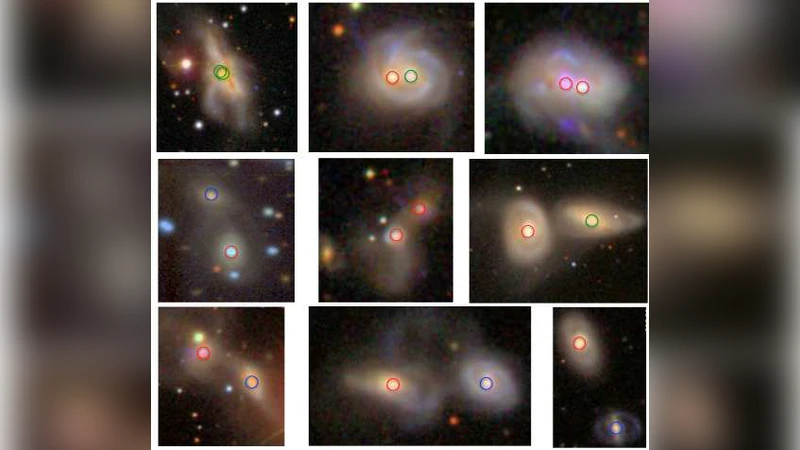
We study the fraction of dual AGN in a sample of 167 nearby (z<0.05), moderate luminosity, ultra hard X-ray selected AGN from the all-sky Swift BAT survey. Combining new Chandra and Gemini observations together with optical and X-ray observations, we find that the dual AGN frequency at scales <100 kpc is 10% (16/167). Of the 16 dual AGN, 3 (19%) were detected using X-ray spectroscopy and were not detected using emission line diagnostics. Close dual AGN (<30 kpc) tend to be more common among the most X-ray luminous systems. In dual AGN, the X-ray luminosity of both AGN increases strongly with decreasing galaxy separation, suggesting that the merging event is key in powering both AGN. 50% of the AGN with a very close companion (<15 kpc), are dual AGN. We also find that dual AGN are more likely to occur in major mergers and tend to avoid absorption line galaxies with elliptical morphologies. Finally, we find SDSS Seyferts are much less likely than BAT AGN (0.25% vs. 7.8%) to be found in dual AGN at scales <30 kpc because of a smaller number of companions galaxies, fiber collision limits, a tendency for AGN at small separations to be detected only in X-rays, and a higher fraction of dual AGN companions with increasing AGN luminosity.
💡 Research Summary
The authors investigate how frequently dual active galactic nuclei (dual AGN) occur in the nearby universe and what physical conditions favor their activation. Starting from the all‑sky Swift BAT hard‑X‑ray survey, they select 167 moderate‑luminosity AGN at redshifts z < 0.05. New Chandra imaging and Gemini optical spectroscopy are combined with existing optical and X‑ray data to identify companion galaxies and assess whether each nucleus hosts an active SMBH. By measuring projected separations from 100 kpc down to <15 kpc, they find that 16 systems (10 % of the sample) contain two X‑ray‑bright nuclei within 100 kpc. Remarkably, three of these dual AGN (19 %) are revealed only by X‑ray spectroscopy and would have been missed by traditional emission‑line diagnostics, underscoring the importance of a multi‑wavelength approach.
The incidence of dual AGN rises sharply at smaller separations: within 30 kpc the fraction climbs to ≈7.8 % and reaches 5 % for separations <15 kpc. Moreover, both AGN in a pair become more luminous in the 2–10 keV band as the galaxies approach each other, indicating that the merger drives gas inflows that simultaneously fuel both supermassive black holes. The authors also show that dual AGN preferentially occur in major mergers (mass ratios ≳1:3) and are rare in absorption‑line, elliptical hosts, suggesting that disk‑rich or disturbed morphologies are more conducive to simultaneous nuclear activity.
A comparison with an optically selected SDSS Seyfert sample reveals a stark contrast: only 0.25 % of SDSS Seyferts have a close dual AGN partner (<30 kpc) versus 7.8 % for the BAT sample. The discrepancy is attributed to several factors: (i) BAT’s hard‑X‑ray selection is less affected by obscuration, (ii) fiber‑collision limits in SDSS spectroscopy miss close companions, (iii) many low‑luminosity AGN are detectable only in X‑rays, and (iv) the probability of a companion hosting an AGN rises with the primary’s X‑ray luminosity.
In summary, the paper provides robust evidence that dual AGN constitute about one‑tenth of nearby moderate‑luminosity AGN when examined with high‑resolution X‑ray data, that their occurrence is tightly linked to small galaxy separations and major mergers, and that hard‑X‑ray selection dramatically improves detection efficiency over purely optical methods. These findings have important implications for models of SMBH growth during galaxy interactions and for the design of future surveys aiming to capture the full population of merging AGN.