Contractile network models for adherent cells
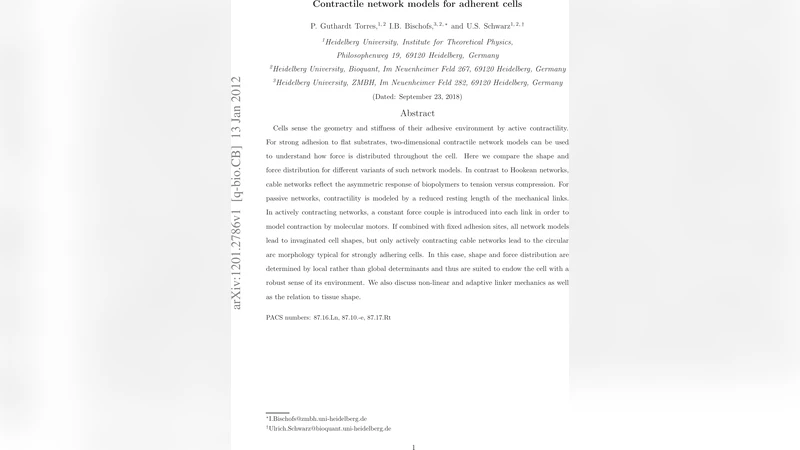
Cells sense the geometry and stiffness of their adhesive environment by active contractility. For strong adhesion to flat substrates, two-dimensional contractile network models can be used to understand how force is distributed throughout the cell. Here we compare the shape and force distribution for different variants of such network models. In contrast to Hookean networks, cable networks reflect the asymmetric response of biopolymers to tension versus compression. For passive networks, contractility is modeled by a reduced resting length of the mechanical links. In actively contracting networks, a constant force couple is introduced into each link in order to model contraction by molecular motors. If combined with fixed adhesion sites, all network models lead to invaginated cell shapes, but only actively contracting cable networks lead to the circular arc morphology typical for strongly adhering cells. In this case, shape and force distribution are determined by local rather than global determinants and thus are suited to endow the cell with a robust sense of its environment. We also discuss non-linear and adaptive linker mechanics as well as the relation to tissue shape.
💡 Research Summary
The paper investigates how adherent cells sense the geometry and stiffness of their substrate by modeling the cell’s cytoskeletal network as a two‑dimensional contractile mesh. Four distinct network variants are constructed by combining two mechanical link types—Hookean (linear elastic) and cable (tension‑only, compression‑inactive)—with two contractile mechanisms—passive contraction (implemented by shortening the rest length of each link) and active contraction (implemented by adding a constant force couple to each link, mimicking the action of molecular motors). The resulting four models are: Hookean‑passive, Hookean‑active, cable‑passive, and cable‑active.
All simulations place a set of fixed adhesion sites on the network perimeter (or interior) to represent focal adhesions. The network is initialized in various shapes (circular, elliptical, irregular) and allowed to relax under the imposed mechanical rules. The authors then analyze the equilibrium cell shape and the spatial distribution of internal stresses.
Key findings:
-
Hookean‑passive networks generate a relatively uniform compressive stress field. The cell contracts isotropically, producing a shallow central invagination while the outer contour remains close to its original shape.
-
Hookean‑active networks develop a uniform tensile stress because each link receives the same force couple. The fixed adhesions constrain the expansion, leading to a modestly swollen perimeter but preserving the overall circular or elliptical outline.
-
Cable‑passive networks respond only to tension; compression is ignored. Consequently, tension concentrates along the paths that span adhesion points, causing asymmetric edge pulling and non‑uniform invaginations. The shape deviates markedly from the experimentally observed smooth arcs.
-
Cable‑active networks reproduce the hallmark “circular‑arc” morphology seen in strongly adherent cells. Because links generate continuous tension while being insensitive to compression, the force balance is governed locally at each adhesion site. The edges become smooth arcs, and the interior forms a deep invagination. Stress maps reveal that the highest tensile forces are localized near adhesion points, while the bulk of the network carries relatively low stress.
The authors emphasize that in the cable‑active case, shape and force distribution are determined by local mechanical determinants rather than a global energy minimization. This locality provides a robust mechanism for cells to sense subtle variations in substrate stiffness or geometry: small changes in adhesion spacing or local stiffness immediately alter the local tension balance, leading to rapid morphological adaptation.
Beyond the basic models, the paper explores extensions that incorporate non‑linear link mechanics (e.g., strain‑hardening behavior) and adaptive link properties (time‑dependent changes in stiffness or rest length, mimicking cytoskeletal remodeling). These extensions allow the network to exhibit plasticity, hysteresis, or active adaptation to sustained mechanical cues, bridging the gap between single‑cell mechanics and tissue‑scale morphogenesis.
Finally, the authors discuss the relevance of their findings to tissue shape formation. In a multicellular context, cells can be viewed as nodes linked by similar contractile cables. The same principle—local tension balance dictating curvature—could explain how epithelial sheets bend, fold, or invaginate during development.
In summary, the study demonstrates that a cable‑based, actively contracting network is the most realistic and predictive framework for capturing the geometry‑dependent force distribution of strongly adherent cells. It highlights the importance of asymmetric tension/compression response and active motor‑driven contractility in shaping cellular morphology and mechanosensing. The model offers a quantitative platform for future experimental validation and for designing engineered tissues where precise control of cell‑generated forces is essential.
Comments & Academic Discussion
Loading comments...
Leave a Comment