Local Simulations of Instabilities in Relativistic Jets I: Morphology and Energetics of the Current-Driven Instability
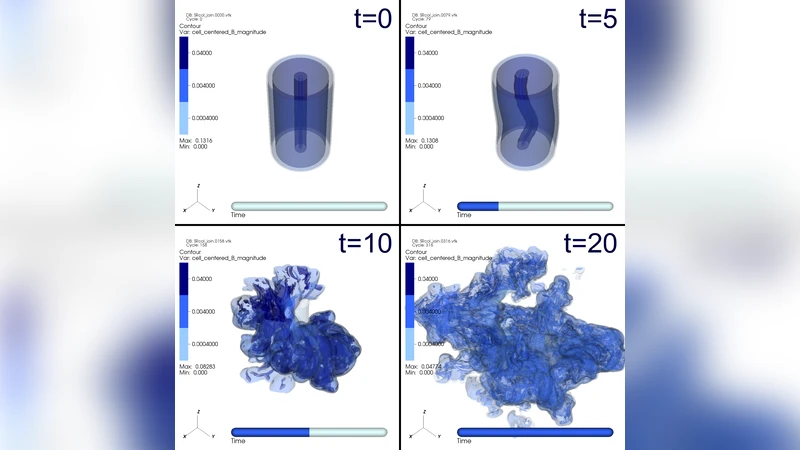
We present the results of a numerical investigation of current-driven instability in magnetized jets. Utilizing the well-tested, relativistic magnetohydrodynamic code Athena, we construct an ensemble of local, co-moving plasma columns in which initial radial force balance is achieved through various combinations of magnetic, pressure, and rotational forces. We then examine the resulting flow morphologies and energetics to determine the degree to which these systems become disrupted, the amount of kinetic energy amplification attained, and the non-linear saturation behaviors. Our most significant finding is that the details of initial force balance have a pronounced effect on the resulting flow morphology. Models in which the initial magnetic field is force-free deform, but do not become disrupted. Systems that achieve initial equilibrium by balancing pressure gradients and/or rotation against magnetic forces, however, tend to shred, mix, and develop turbulence. In all cases, the linear growth of current-driven instabilities is well-represented by analytic models. CDI-driven kinetic energy amplification is slower and saturates at a lower value in force-free models than in those that feature pressure gradients and/or rotation. In rotating columns, we find that magnetized regions undergoing rotational shear are driven toward equipartition between kinetic and magnetic energies. We show that these results are applicable for a large variety of physical parameters, but we caution that algorithmic decisions (such as choice of Riemann solver) can affect the evolution of these systems more than physically motivated parameters.
💡 Research Summary
The paper presents a systematic numerical study of the current‑driven instability (CDI) in relativistic magnetized jets using the Athena relativistic magnetohydrodynamics (RMHD) code. The authors construct a suite of local, co‑moving plasma columns that are initially in radial force balance through three distinct configurations: (i) a force‑free magnetic field where magnetic tension balances itself, (ii) a pressure‑balanced configuration where a radial pressure gradient counteracts magnetic pressure, and (iii) a pressure‑plus‑rotation configuration that adds centrifugal support. By varying magnetic field strength, plasma β, rotation rate, and the choice of numerical algorithms (Riemann solvers, flux limiters), they explore a broad parameter space while keeping the physical setup local and idealized.
In the linear regime, all models exhibit growth rates that match analytic predictions for CDI (γ ∝ k v_A), confirming that the code accurately captures the underlying physics. The non‑linear evolution, however, diverges dramatically depending on the initial equilibrium. Force‑free columns deform smoothly, developing helical distortions but retaining overall coherence; they do not fragment or become turbulent. By contrast, pressure‑balanced columns experience rapid shredding, mixing, and the onset of turbulence, leading to a substantial conversion of magnetic energy into kinetic energy. The kinetic energy in these cases grows more quickly and saturates at a higher fraction of the total energy (≈30–40 % of the initial magnetic energy).
When rotation is introduced, the dynamics change further. Rotational shear interacts with the magnetic field, driving the system toward an approximate equipartition between kinetic and magnetic energies. The simulations show that, after saturation, the kinetic and magnetic energy densities become comparable (each ≈45 % of the total), indicating that centrifugal forces both moderate the linear growth of CDI and facilitate efficient energy transfer in the non‑linear stage.
A key methodological finding is that algorithmic choices can dominate over physical parameters. The HLLD Riemann solver, which resolves Alfvénic and contact discontinuities with low numerical diffusion, reproduces the expected linear growth rates and yields realistic non‑linear fragmentation. In contrast, the more diffusive HLLC solver suppresses small‑scale structure, under‑predicting turbulence and kinetic energy amplification. High‑order reconstruction schemes and strict energy‑conserving time integrators also prove essential for capturing the correct saturation levels.
Overall, the study demonstrates that (1) the nature of the initial force balance critically determines whether CDI leads to mild deformation or violent disruption, (2) pressure gradients and rotation enhance kinetic energy amplification and drive the system toward equipartition, and (3) careful selection of numerical methods is as important as the physical setup for reliable simulation outcomes. These insights are directly relevant to interpreting observations of AGN jets, pulsar wind nebulae, and other relativistic outflows where CDI is thought to shape morphology, mix plasma, and redistribute energy.