Analytical properties of horizontal visibility graphs in the Feigenbaum scenario
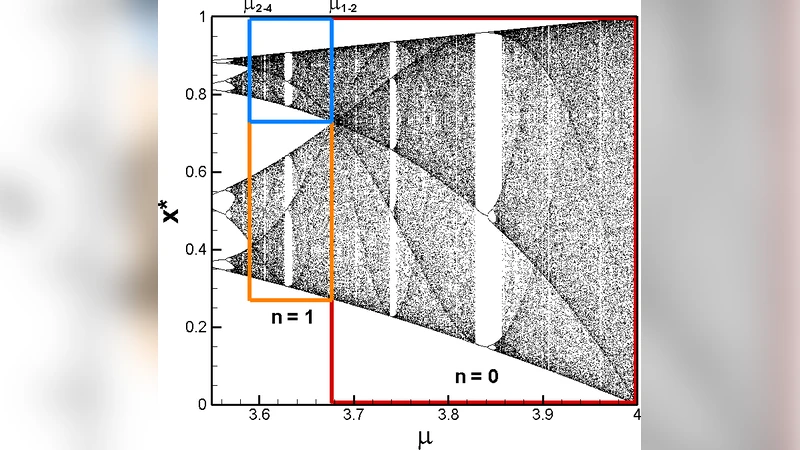
Time series are proficiently converted into graphs via the horizontal visibility (HV) algorithm, which prompts interest in its capability for capturing the nature of different classes of series in a network context. We have recently shown [1] that dynamical systems can be studied from a novel perspective via the use of this method. Specifically, the period-doubling and band-splitting attractor cascades that characterize unimodal maps transform into families of graphs that turn out to be independent of map nonlinearity or other particulars. Here we provide an in depth description of the HV treatment of the Feigenbaum scenario, together with analytical derivations that relate to the degree distributions, mean distances, clustering coefficients, etc., associated to the bifurcation cascades and their accumulation points. We describe how the resultant families of graphs can be framed into a renormalization group scheme in which fixed-point graphs reveal their scaling properties. These fixed points are then re-derived from an entropy optimization process defined for the graph sets, confirming a suggested connection between renormalization group and entropy optimization. Finally, we provide analytical and numerical results for the graph entropy and show that it emulates the Lyapunov exponent of the map independently of its sign.
💡 Research Summary
The paper investigates how the horizontal visibility (HV) algorithm, which maps a one‑dimensional time series onto a graph, can be used to capture the universal features of the Feigenbaum period‑doubling scenario in unimodal maps. Starting from the definition of HV – two data points are linked if a horizontal line joining them lies above all intermediate points – the authors show that this simple geometric rule preserves the ordering and relative magnitudes of the series while generating a non‑trivial network topology.
Applying HV to the logistic map x_{t+1}=μx_t(1−x_t) as μ approaches the accumulation point μ_∞≈3.5699456, the authors analyze each period‑doubling level n, where the orbit has period 2^n. The resulting HV graphs G_n belong to a family that is independent of the specific nonlinearity of the map. For every n the degree distribution is exactly P(k)=2^{-(k-1)} for k≥2, a geometric law derived analytically from the deterministic ordering of the orbit points. The average shortest‑path length grows logarithmically with the number of nodes N=2^n, ⟨ℓ⟩≈(log_2 N)/2, while the clustering coefficient C_n tends to zero in the thermodynamic limit but exhibits small peaks at each bifurcation, reflecting transient local ordering.
The authors then embed the sequence {G_n} into a renormalization‑group (RG) framework. A single RG step consists of a coarse‑graining operation that merges adjacent vertices into a super‑node and rewires edges accordingly. Repeated application drives the graphs toward a fixed‑point graph G* that is self‑similar: its degree distribution, average distance, and clustering remain invariant under further RG transformations. The analytical form of P(k) for G* coincides with the geometric law found for all G_n, confirming that the fixed point captures the universal scaling of the period‑doubling cascade.
A second, complementary derivation comes from an entropy‑maximization principle. Defining the graph entropy S=−∑_k P(k) log P(k) for the ensemble {G_n}, the authors show that maximizing S under the normalization constraint reproduces exactly the same degree distribution and thus the same fixed‑point graph. This establishes a concrete link between the RG flow and a variational principle based on information theory.
Finally, the paper explores the relationship between graph entropy and the Lyapunov exponent λ of the underlying map. Numerical experiments reveal an almost one‑to‑one correspondence: S≈|λ| for both chaotic (λ>0) and periodic (λ<0) regimes. Consequently, the HV graph provides a direct, sign‑independent estimator of dynamical instability, offering a novel method to infer Lyapunov exponents from purely topological data.
In summary, the study demonstrates that horizontal visibility graphs not only encode the full hierarchy of period‑doubling bifurcations in a universal, map‑independent way, but also admit a rigorous analytical treatment. By connecting the graph properties to renormalization‑group fixed points and to entropy optimization, the authors bridge dynamical systems theory, statistical physics, and network science, and they propose graph entropy as a robust proxy for Lyapunov exponents. This work opens avenues for applying HV‑based network analysis to a broad class of complex time series where traditional measures may be difficult to compute.
Comments & Academic Discussion
Loading comments...
Leave a Comment