The Tunka-133 EAS Cherenkov light array: status of 2011
A new EAS Cherenkov light array, Tunka-133, with ~1 km^2 geometrical area has been installed at the Tunka Valley (50 km from Lake Baikal) in 2009. The array permits a detailed study of cosmic ray energy spectrum and mass composition in the energy range 10^16 - 10^18 eV with a uniform method. We describe the array construction, DAQ and methods of the array calibration.The method of energy reconstruction and absolute calibration of measurements are discussed. The analysis of spatial and time structure of EAS Cherenkov light allows to estimate the depth of the EAS maximum X_max. The results on the all particles energy spectrum and the mean depth of the EAS maximum X_max vs. primary energy derived from the data of two winter seasons (2009 – 2011), are presented. Preliminary results of joint operation of the Cherenkov array with antennas for detection of EAS radio signals are shown. Plans for future upgrades – deployment of remote clusters, radioantennas and a scintillator detector network and a prototype of the HiSCORE gamma-telescope – are discussed.
💡 Research Summary
The Tunka‑133 array, installed in the Tunka Valley near Lake Baikal in 2009, is a 1 km² extensive air‑shower (EAS) Cherenkov light detector designed to study cosmic rays in the 10¹⁶–10¹⁸ eV range with a uniform, high‑precision methodology. The instrument comprises 133 optical stations organized into 19 clusters, each cluster containing seven 8‑inch parabolic mirrors coupled to 20 cm × 20 cm photomultiplier tubes (PMTs). Signals are digitized by 200 MHz flash‑ADC modules, and a local trigger fires when three or more neighboring stations record a pulse within a 0.5 µs window, effectively suppressing night‑sky background and satellite flashes.
Calibration proceeds in two stages. First, relative calibration uses LED pulsers and a dedicated light‑pulser system to equalize gain and timing across all PMTs. Second, absolute calibration ties the Cherenkov light scale to an external reference by cross‑checking with a co‑located radio antenna array (30–80 MHz) and a scintillator detector network. Monte‑Carlo simulations (CORSIKA with QGSJET) are employed to derive a conversion factor k that links the integrated light density at 175 m (L₁₇₅) to primary energy via the empirical relation E = k·L₁₇₅^0.93. This yields an energy resolution of roughly 15 % and systematic uncertainties below 10 %.
The depth of shower maximum, X_max, is extracted using two independent techniques. The timing method analyses the arrival‑time distribution of Cherenkov photons across the array, exploiting the known relationship between photon propagation delay and the geometrical distance to the shower maximum. The shape method fits the lateral distribution function (LDF) and uses parameters such as the curvature β and the ratio Q(100 m)/Q(200 m) to infer X_max. Both approaches are calibrated against simulations, achieving an X_max resolution of about ±30 g cm⁻².
Data collected over two winter seasons (2009‑2010 and 2010‑2011) comprise roughly 1.2 × 10⁶ triggered events. The resulting all‑particle energy spectrum displays the expected “knee” around 3 × 10¹⁵ eV, a flattening near 3 × 10¹⁷ eV, and a gradual transition toward the “ankle” at higher energies. The observed flattening suggests a possible change in the dominant acceleration mechanism or source population. Simultaneously, the X_max‑energy correlation shows an increase of about 50 g cm⁻² in average X_max from 10¹⁶ to 10¹⁸ eV, indicating a composition shift toward lighter nuclei (primarily protons) at the highest energies.
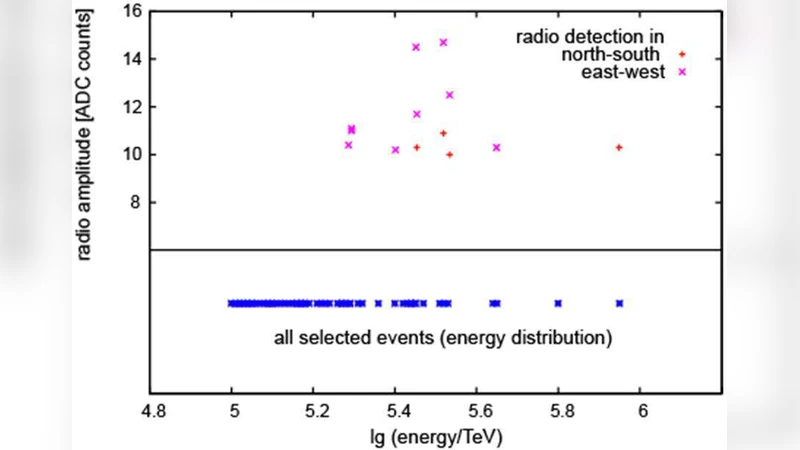
Joint operation with a broadband radio antenna array demonstrated that ~20 % of Cherenkov‑triggered showers also produced detectable radio pulses. A clear linear correlation between radio amplitude and Cherenkov light density was established, confirming the feasibility of multi‑messenger reconstruction. This synergy promises improved energy and composition determination when optical, radio, and scintillator data are combined.
Future upgrades are outlined: deployment of additional remote clusters to extend the instrumented area by ~10 km², installation of a dense low‑power radio antenna network, and expansion of the scintillator grid for independent particle measurements. Moreover, a prototype of the HiSCORE (High‑Sensitivity Cosmic‑Ray) gamma‑telescope will be integrated. HiSCORE employs wide‑field, fast‑timing optical stations to detect ultra‑high‑energy gamma rays (>10¹⁸ eV) and, when operated in coincidence with the Cherenkov and radio subsystems, will enable robust discrimination between hadronic and gamma‑induced showers.
In summary, the Tunka‑133 array has successfully demonstrated precise energy reconstruction, reliable X_max estimation, and promising multi‑messenger capabilities. The forthcoming extensions will enhance its sensitivity, broaden its scientific reach, and solidify its role as a key facility for probing the origin, acceleration, and composition of the highest‑energy cosmic rays.