On the consistency of neutron-star radius measurements from thermonuclear bursts
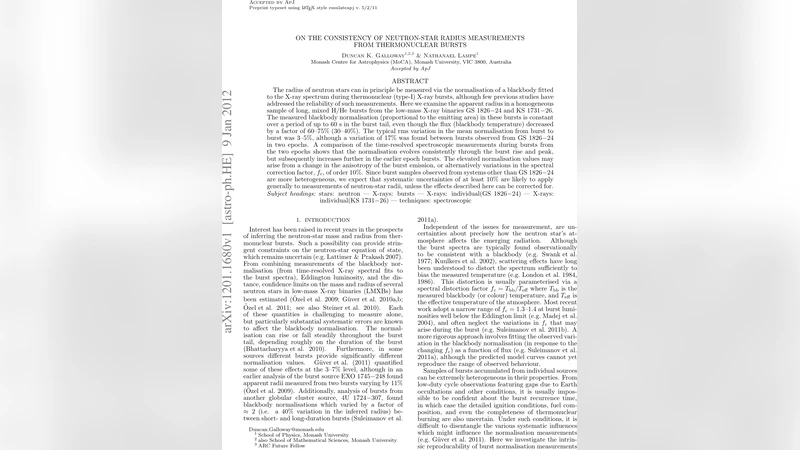
The radius of neutron stars can in principle be measured via the normalisation of a blackbody fitted to the X-ray spectrum during thermonuclear (type-I) X-ray bursts, although few previous studies have addressed the reliability of such measurements. Here we examine the apparent radius in a homogeneous sample of long, mixed H/He bursts from the low-mass X-ray binaries GS 1826-24 and KS 1731-26. The measured blackbody normalisation (proportional to the emitting area) in these bursts is constant over a period of up to 60s in the burst tail, even though the flux (blackbody temperature) decreased by a factor of 60-75% (30-40%). The typical rms variation in the mean normalisation from burst to burst was 3-5%, although a variation of 17% was found between bursts observed from GS 1826-24 in two epochs. A comparison of the time-resolved spectroscopic measurements during bursts from the two epochs shows that the normalisation evolves consistently through the burst rise and peak, but subsequently increases further in the earlier epoch bursts. The elevated normalisation values may arise from a change in the anisotropy of the burst emission, or alternatively variations in the spectral correction factor, f_c, of order 10%. Since burst samples observed from systems other than GS 1826-24 are more heterogeneous, we expect that systematic uncertainties of at least 10% are likely to apply generally to measurements of neutron-star radii, unless the effects described here can be corrected for.
💡 Research Summary
The paper investigates the reliability of neutron‑star radius measurements derived from the blackbody normalisation obtained during thermonuclear (type‑I) X‑ray bursts. Using a homogeneous set of long, mixed hydrogen/helium bursts from the low‑mass X‑ray binaries GS 1826‑24 and KS 1731‑26, the authors perform time‑resolved spectroscopy with RXTE/PCA data. For each 0.25‑second interval they fit an absorbed blackbody model, extracting the colour temperature (T_bb) and the normalisation K, which is proportional to the apparent emitting area (K ∝ (R/D)^2 · (1+z)⁻²).
The key observational result is that, in the burst tail lasting up to 60 seconds, the flux (and thus T_bb) declines by 30‑40 % while K remains essentially constant, showing only a 3‑5 % rms scatter from burst to burst. This stability suggests that the emitting area does not change appreciably during the cooling phase, supporting the basic premise of radius inference from burst spectra. However, a more subtle systematic effect emerges when comparing two epochs of GS 1826‑24 observations (early 2000s versus late 2000s). The mean K values differ by about 17 % between the epochs, even though the evolution of K during the rise and peak of the bursts is virtually identical. In the earlier epoch, K continues to increase after the burst peak, whereas in the later epoch it plateaus earlier.
The authors explore two plausible explanations for the epoch‑dependent offset. First, anisotropy of the burst emission could vary due to changes in the accretion disc geometry, the degree of atmospheric expansion, or the viewing angle, leading to a systematic scaling of the observed flux and therefore K. Second, the colour‑correction factor f_c (the ratio of colour temperature to effective temperature) may change by roughly 10 % between epochs. Since K ∝ f_c⁻⁴, a 10 % shift in f_c can produce a ∼20 % change in K, comfortably accounting for the observed 17 % difference.
These findings have important implications for neutron‑star radius determinations. In addition to the usual uncertainties in distance, interstellar absorption, and mass, the analysis demonstrates that systematic errors of at least 10 % are intrinsic to the method because of possible variations in anisotropy and f_c. Consequently, radius estimates based solely on blackbody normalisation from bursts cannot achieve the sub‑5 % precision required to tightly constrain the dense‑matter equation of state without additional corrections.
The paper concludes by recommending several strategies to mitigate these systematics: (i) restrict analyses to homogeneous burst samples (long, mixed H/He bursts) to minimise intrinsic variability; (ii) obtain independent constraints on anisotropy, perhaps through simultaneous optical/infrared observations or modelling of disc geometry; (iii) measure f_c directly using high‑resolution, broad‑band instruments such as NICER or the forthcoming eXTP, which can resolve deviations from a pure blackbody; and (iv) incorporate epoch‑dependent calibration factors into radius‑inference pipelines. By addressing these issues, future work can improve the reliability of neutron‑star radius measurements and thereby provide stronger constraints on the physics of ultra‑dense matter.