Disc-jet coupling in the 2009 outburst of the black hole candidate H1743-322
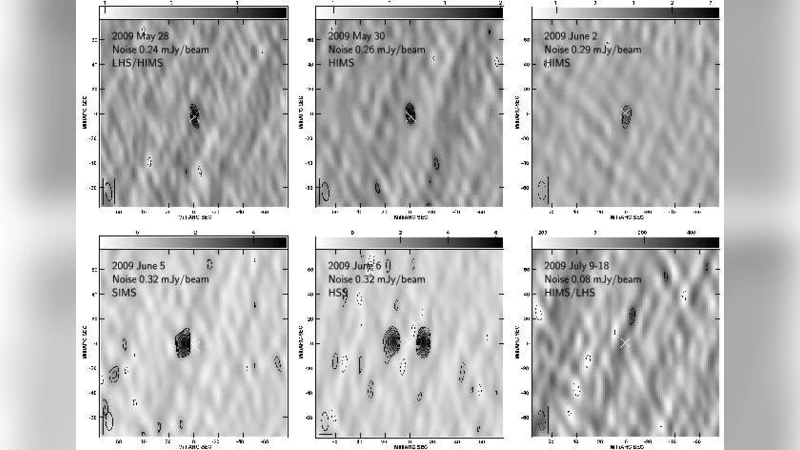
We present an intensive radio and X-ray monitoring campaign on the 2009 outburst of the Galactic black hole candidate X-ray binary H1743-322. With the high angular resolution of the Very Long Baseline Array, we resolve the jet ejection event and measure the proper motions of the jet ejecta relative to the position of the compact core jets detected at the beginning of the outburst. This allows us to accurately couple the moment when the jet ejection event occurred with X-ray spectral and timing signatures. We find that X-ray timing signatures are the best diagnostic of the jet ejection event in this outburst, which occurred as the X-ray variability began to decrease and the Type C quasi-periodic oscillations disappeared from the X-ray power density spectrum. However, this sequence of events does not appear to be replicated in all black hole X-ray binary outbursts, even within an individual source. In our observations of H1743-322, the ejection was contemporaneous with a quenching of the radio emission, prior to the start of the major radio flare. This contradicts previous assumptions that the onset of the radio flare marks the moment of ejection. The jet speed appears to vary between outbursts, with a possible positive correlation with outburst luminosity. The compact core radio jet reactivated on transition to the hard intermediate state at the end of the outburst, and not when the source reached the low hard spectral state. Comparison with the known near-infrared behaviour of the compact jets suggests a gradual evolution of the compact jet power over a few days near the beginning and end of an outburst.
💡 Research Summary
This paper presents a comprehensive multi‑wavelength monitoring campaign of the 2009 outburst of the Galactic black‑hole candidate X‑ray binary H1743‑322, focusing on the coupling between the accretion disc and relativistic jets. Using the Very Long Baseline Array (VLBA) together with the VLA and ATCA, the authors obtained high‑resolution radio images that resolved the compact core jet at the start of the outburst and later revealed two discrete ejecta moving away from the core. By fitting Gaussian components to the VLBA data, they measured proper motions corresponding to apparent speeds of roughly 0.45 c to 0.78 c, and they pinpointed the ejection epoch to MJD 54984.3 ± 0.2. Crucially, this ejection time precedes the onset of the major radio flare; the radio flux first undergoes a sharp quenching before the flare rises, contradicting the common assumption that the flare marks the moment of ejection.
Simultaneous X‑ray observations with RXTE and Swift tracked spectral evolution and timing properties throughout the outburst. Early on, the source displayed a hard spectrum with strong Type‑C quasi‑periodic oscillations (QPOs) in the 0.2–6 Hz range and high fractional rms variability (~30%). As the outburst progressed, the QPO amplitude rapidly diminished and the rms fell below 10%, coincident with the disappearance of the QPO from the power density spectrum. This timing change aligns precisely with the radio‑derived ejection epoch, indicating that X‑ray timing signatures—particularly the loss of Type‑C QPOs and the reduction of rapid variability—are the most reliable diagnostics of jet launch in this event.
The authors discuss several broader implications. First, the observed sequence (X‑ray timing change → radio quenching → delayed radio flare) suggests that the flare is a downstream manifestation of the ejection rather than the launch itself. Second, the measured jet speeds differ from those reported for earlier H1743‑322 outbursts (e.g., 2003), hinting at a possible positive correlation between jet velocity and the overall outburst luminosity. This supports models where the jet power scales with the accretion rate or the total radiative output. Third, the compact core jet re‑appears not when the source reaches the canonical low‑hard state (LHS) but during the transition back to the hard‑intermediate state (HIMS) at the end of the outburst, underscoring a tighter link between jet re‑activation and specific spectral‑state transitions. Fourth, comparison with near‑infrared (NIR) monitoring indicates that the compact jet power evolves gradually over several days at both the rise and decay phases, rather than changing abruptly.
Overall, the study demonstrates that precise jet‑ejection timing can be achieved by combining VLBI imaging with dense X‑ray timing coverage, and that X‑ray timing features provide a more direct probe of the disc‑jet coupling than radio flare onset alone. The variability of jet speed and ejection timing across different outbursts of the same source challenges simple, universal disc‑jet models and points to a more complex interplay of accretion flow geometry, magnetic field configuration, and radiative output. Future work should aim for simultaneous, high‑cadence observations across radio, NIR, and X‑ray bands to further quantify the relationship between outburst energetics and jet dynamics, and to refine theoretical frameworks describing how relativistic jets are launched from accreting black holes.