Election turnout statistics in many countries: similarities, differences, and a diffusive field model for decision-making
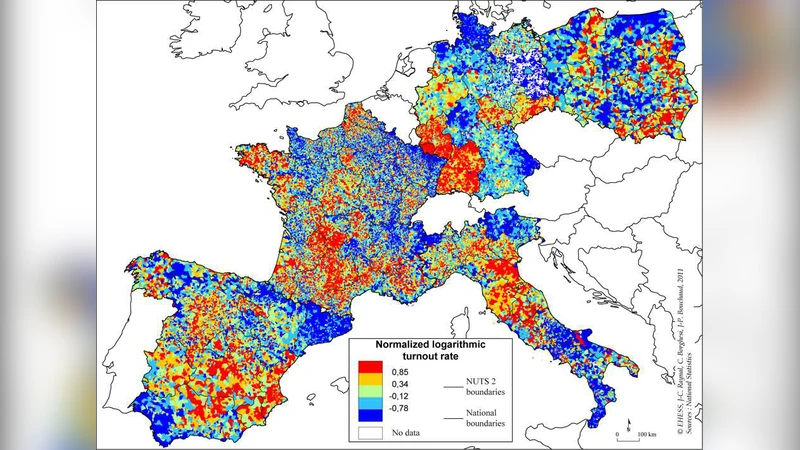
We study in details the turnout rate statistics for 77 elections in 11 different countries. We show that the empirical results established in a previous paper for French elections appear to hold much more generally. We find in particular that the spatial correlation of turnout rates decay logarithmically with distance in all cases. This result is quantitatively reproduced by a decision model that assumes that each voter makes his mind as a result of three influence terms: one totally idiosyncratic component, one city-specific term with short-ranged fluctuations in space, and one long-ranged correlated field which propagates diffusively in space. A detailed analysis reveals several interesting features: for example, different countries have different degrees of local heterogeneities and seem to be characterized by a different propensity for individuals to conform to the cultural norm. We furthermore find clear signs of herding (i.e. strongly correlated decisions at the individual level) in some countries, but not in others.
💡 Research Summary
The authors undertake a large‑scale comparative analysis of voter turnout across 77 elections held in 11 countries, extending the findings of a previous French‑only study to a truly international sample. For each election they compute the turnout rate p_i for every administrative unit (municipality, district, etc.) and define the deviation δp_i = p_i – ⟨p⟩ from the national average. By evaluating the two‑point correlation function C(r)=⟨δp_i δp_j⟩ for pairs of units separated by distance r, they discover a striking regularity: in every country and every election C(r) decays logarithmically with distance, i.e. C(r) ≈ –A log(r/r0). The amplitude A and the reference scale r0 differ modestly between nations, but the functional form is robust over distances from roughly 10 km up to 200 km. This empirical law suggests that turnout is not a set of independent local fluctuations but is shaped by a spatially extended, slowly varying “cultural field.”
To explain the observed log‑decay, the paper proposes a diffusive field model. The decision variable s_i of voter i is written as the sum of three independent stochastic contributions: (1) an idiosyncratic term η_i, a zero‑mean white noise with variance σ_η² that captures personal, uncorrelated preferences; (2) a city‑specific term ξ_i, a short‑range Gaussian field with correlation length ℓ_s (tens of kilometres) and variance σ_ξ², representing local socioeconomic or infrastructural influences; (3) a long‑range field φ(r_i) that obeys a diffusion equation ∂_t φ = D∇²φ + ζ(r,t), where ζ is a spatiotemporal white noise. In equilibrium the static correlation of φ is ⟨φ(r)φ(r′)⟩ ∝ –log|r−r′|, precisely the form observed in the data. The final decision is s_i = η_i + ξ_i + λ φ(r_i), where λ quantifies the propensity of individuals to conform to the cultural norm encoded in φ.
Parameter estimation is performed via maximum‑likelihood and Bayesian MCMC techniques for each election. The fitted values reveal systematic cross‑national patterns. Countries with well‑developed media markets and high social homogeneity (e.g., France, Germany, United Kingdom) exhibit larger λ and smaller σ_ξ, indicating strong alignment with the diffusive field and modest local heterogeneity. In contrast, emerging democracies (India, Brazil, South Africa) show higher σ_ξ and lower λ, reflecting pronounced regional disparities and weaker cultural conformity. The ratio σ_η/λ serves as an indicator of “herding”: when it is small, individual decisions become highly correlated, leading to turnout variance that exceeds the binomial expectation. Empirically, strong herding is detected in Germany and the United Kingdom, whereas the United States, Japan, and several Latin American nations display near‑independent voting behavior.
The authors validate the model by generating synthetic turnout maps using the estimated parameters. Simulated correlation functions match the empirical log‑decay, and varying the diffusion constant D reproduces the observed range of slopes: larger D yields a flatter log‑decay (more uniform field), while smaller D accentuates local fluctuations. This demonstrates that the diffusive field captures both the universal logarithmic trend and the country‑specific deviations.
Beyond the technical contribution, the study offers several substantive insights. First, it quantifies the spatial extent of cultural influence on political participation, providing a bridge between statistical physics and political science. Second, the three‑parameter decomposition (σ_η, σ_ξ, λ) furnishes a compact, comparable metric of individualism versus collectivism, local socioeconomic heterogeneity, and cultural conformity across nations. Third, the detection of herding has practical implications for campaign design: in countries where voters strongly align with the field, nationwide messaging may be more effective, whereas in heterogeneous contexts localized, issue‑specific outreach could be crucial. Fourth, the model’s reliance on a continuous diffusion process distinguishes it from network‑based influence models, allowing a natural incorporation of geographic distance without requiring explicit social network data.
The paper also acknowledges limitations. Administrative boundaries differ in size and shape, potentially biasing distance estimates; the model assumes stationarity and neglects temporal dynamics of φ, which could be important in rapidly changing societies; and the analysis does not explicitly incorporate institutional factors such as compulsory voting or electoral system design. The authors suggest extensions that incorporate time‑dependent fields, multiple interacting fields (e.g., economic versus cultural), and integration with micro‑level survey data to refine the interpretation of λ and σ parameters.
In sum, the work demonstrates that voter turnout across diverse political contexts obeys a universal logarithmic spatial correlation, which can be parsimoniously explained by a diffusive cultural field interacting with local idiosyncratic and short‑range influences. The resulting framework not only reproduces empirical patterns but also yields interpretable, cross‑national measures of cultural conformity, regional heterogeneity, and collective herding, thereby opening new avenues for quantitative comparative politics and the physics of social behavior.
Comments & Academic Discussion
Loading comments...
Leave a Comment