Non-Thermal Insights on Mass and Energy Flows Through the Galactic Centre and into the Fermi Bubbles
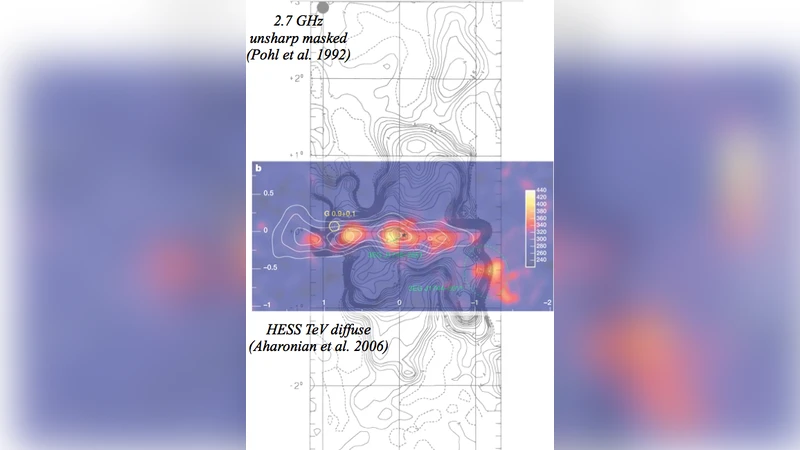
We construct a simple model of the star-formation- (and resultant supernova-) driven mass and energy flows through the inner ~200 pc (in diameter) of the Galaxy. Our modelling is constrained, in particular, by the non-thermal radio continuum and {\gamma}-ray signals detected from the region. The modelling points to a current star-formation rate of 0.04 - 0.12 M\msun/year at 2{\sigma} confidence within the region with best-fit value in the range 0.08 - 0.12 M\msun/year which - if sustained over 10 Gyr - would fill out the ~ 10^9 M\msun stellar population of the nuclear bulge. Mass is being accreted on to the Galactic centre (GC) region at a rate ~0.3M\msun/year. The region’s star-formation activity drives an outflow of plasma, cosmic rays, and entrained, cooler gas. Neither the plasma nor the entrained gas reaches the gravitational escape speed, however, and all this material fountains back on to the inner Galaxy. The system we model can naturally account for the recently-observed ~> 10^6 ‘halo’ of molecular gas surrounding the Central Molecular Zone out to 100-200 pc heights. The injection of cooler, high-metallicity material into the Galactic halo above the GC may catalyse the subsequent cooling and condensation of hot plasma out of this region and explain the presence of relatively pristine, nuclear-unprocessed gas in the GC. The plasma outflow from the GC reaches a height of a few kpc and is compellingly related to the recently-discovered Fermi Bubbles. Our modelling demonstrates that ~ 10^9 M\msun of hot gas is processed through the GC over 10 Gyr. We speculate that the continual star-formation in the GC over the age of the Milky Way has kept the SMBH in a quiescent state thus preventing it from significantly heating the coronal gas, allowing for the continual accretion of gas on to the disk and the sustenance of star formation on much wider scales in the Galaxy [abridged].
💡 Research Summary
The paper presents a physically motivated, yet deliberately simple, model of the mass and energy circulation within the inner ~200 pc of the Milky Way, constrained primarily by non‑thermal observables: the radio continuum (synchrotron) and the GeV–TeV γ‑ray emission detected by Fermi‑LAT. The authors start by assembling the spectral energy distribution of the Galactic Centre (GC) region, separating the thermal dust component from the non‑thermal synchrotron and pion‑decay γ‑rays. These non‑thermal signals directly trace the energy density of relativistic electrons, cosmic‑ray protons, and the hot plasma that fills the volume.
Using the observed γ‑ray luminosity as a proxy for the total cosmic‑ray (CR) power, and the radio flux to constrain the magnetic field and electron spectrum, the authors build a one‑dimensional vertical flow model. The model assumes that star formation (SF) drives supernova (SN) explosions, each injecting ~10⁵¹ erg of mechanical energy. A fixed fraction of this energy is partitioned into hot plasma (≈10 %), relativistic CRs (≈5 %), and bulk kinetic outflow (≈85 %). The star‑formation rate (SFR) in the central 200 pc is treated as a free parameter; the model is then fit to the radio and γ‑ray data using a Bayesian approach, yielding a 2σ confidence interval of 0.04–0.12 M⊙ yr⁻¹, with a best‑fit range of 0.08–0.12 M⊙ yr⁻¹.
From the fitted SFR the authors infer a supernova rate of ~0.003–0.01 yr⁻¹, which supplies a mechanical power of ~10³⁹ erg s⁻¹. The resulting hot plasma has a temperature of ~10⁷ K, a density of ~10⁻² cm⁻³, and a bulk outflow velocity of ~300 km s⁻¹. This velocity is below the local escape speed (~500 km s⁻¹), implying that the plasma rises to a few kiloparsecs, cools radiatively, and then falls back—a classic “galactic fountain”.
In addition to the plasma, the model includes entrainment of cooler, denser gas by the SN‑driven wind. The entrained mass flux is estimated at 0.1–0.3 M⊙ yr⁻¹, sufficient to explain the recently discovered molecular “halo” surrounding the Central Molecular Zone (CMZ), which extends to heights of 100–200 pc and contains ~10⁶ M⊙ of high‑metallicity gas. Because this gas does not reach escape speed, it too participates in the fountain cycle, delivering metal‑rich material into the lower halo where it can catalyze the cooling of the hot plasma.
A key implication of the model is its natural connection to the Fermi Bubbles—large, bipolar γ‑ray structures extending ~10 kpc above and below the Galactic plane. The authors argue that the hot plasma outflow from the GC, sustained over the Galaxy’s lifetime, processes ~10⁹ M⊙ of gas. The cumulative energy input from continuous low‑level star formation can maintain the relativistic electron population required to illuminate the Bubbles in γ‑rays, without invoking a recent AGN outburst.
The paper also addresses the long‑term evolution of the Milky Way’s central region. If the inferred SFR has persisted for ~10 Gyr, the GC would have produced ~10⁹ M⊙ of stars, matching the observed stellar mass of the nuclear bulge. Moreover, the model predicts a net inflow of ~0.3 M⊙ yr⁻¹ of external gas onto the central 200 pc, providing the fuel needed to sustain the star formation and the fountain. The authors speculate that this steady, modest level of activity has kept the supermassive black hole (SMBH) in a quiescent state, preventing powerful AGN feedback that could heat the circum‑galactic medium and shut down the galaxy‑wide star‑formation pipeline.
In summary, the study demonstrates that a simple, observation‑driven model can reconcile a suite of seemingly disparate phenomena: the radio and γ‑ray spectra of the GC, the presence of a high‑altitude molecular halo, the energetics and morphology of the Fermi Bubbles, and the overall mass budget of the nuclear bulge. It highlights the importance of low‑level, continuous star formation as a regulator of both local (GC) and global (Milky Way) evolution, and provides a framework for future high‑resolution observations (e.g., with ALMA, JWST, CTA) and more sophisticated hydrodynamic simulations to test the fountain‑bubble connection in detail.
Comments & Academic Discussion
Loading comments...
Leave a Comment