Global transposable characteristics in the yeast complete DNA sequence
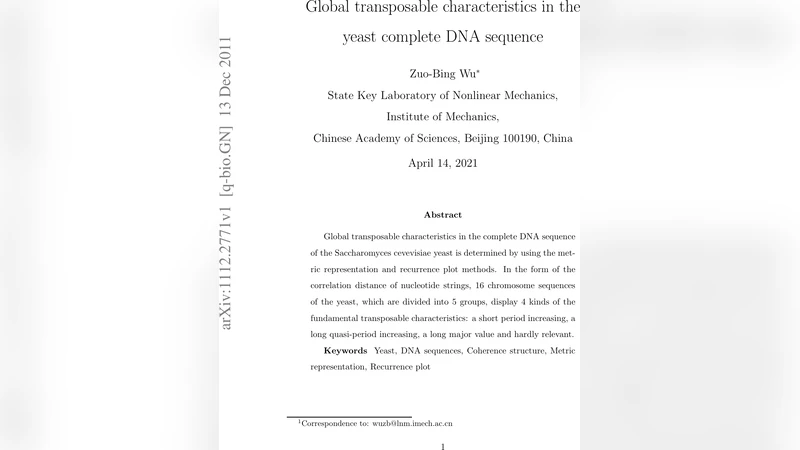
Global transposable characteristics in the complete DNA sequence of the Saccharomyces cevevisiae yeast is determined by using the metric representation and recurrence plot methods. In the form of the correlation distance of nucleotide strings, 16 chromosome sequences of the yeast, which are divided into 5 groups, display 4 kinds of the fundamental transposable characteristics: a short period increasing, a long quasi-period increasing, a long major value and hardly relevant.
💡 Research Summary
The paper presents a genome‑wide quantitative analysis of transposable elements (TEs) in the complete DNA sequence of the budding yeast Saccharomyces cerevisiae. Rather than focusing on individual TE families, the authors introduce a novel two‑step framework—Metric Representation (MR) and Recurrence Plot (RP)—to capture the global “transposable characteristics” of the entire genome.
Metric Representation converts each nucleotide string (k‑mer) into a high‑dimensional vector. For a chosen k (12–15 in this study) every possible k‑mer is encoded as a concatenation of one‑hot vectors for A, C, G, and T, yielding a 4k‑dimensional point. This mapping preserves the order of nucleotides while allowing the use of Euclidean or cosine distances to compare any two substrings.
Recurrence Plot is then built from the pairwise distance matrix of all k‑mer vectors. A threshold ε is set; whenever the distance between two points falls below ε a dot is plotted at the corresponding coordinates (i, j). The resulting image visualizes repeated patterns along the linear genome: dense diagonal bands indicate frequent recurrence of similar strings, while scattered points suggest randomness.
The authors applied MR‑RP to each of the 16 yeast chromosomes. For every chromosome they computed a “correlation distance” defined as 1 – r, where r is the Pearson correlation between the frequency profiles of two k‑mers. Small values denote high similarity (i.e., strong recurrence). By aggregating these distances across the whole chromosome they obtained a distance profile that can be interpreted as a measure of transposability along the genome.
Hierarchical clustering of the 16 distance profiles revealed five major groups (labeled A–E). Within each group the authors identified four fundamental transposable patterns, which they term:
-
Short‑period increasing – a rapid, quasi‑periodic decrease in correlation distance every 200–500 bp. This pattern is enriched near replication origins and highly transcribed regions, suggesting that TEs are mobilized in synchrony with replication fork progression.
-
Long quasi‑period increasing – a slower, more irregular decline occurring over 2–5 kb intervals. It reflects the insertion‑deletion dynamics of larger TE families such as LTR retrotransposons (Ty elements) that tend to act on a broader genomic scale.
-
Long major value – extended stretches where the correlation distance remains high, indicating a paucity of recurrent TE‑derived strings. These regions often coincide with essential metabolic genes or other functionally conserved loci, implying selective pressure against TE activity.
-
Hardly relevant – distance values that resemble a random distribution, showing no discernible TE‑related structure. These zones may correspond to telomeric or centromeric heterochromatin where TE insertion is strongly suppressed.
Group‑specific observations:
- Group A (chromosomes I, III, VI) displays a mixture of short‑period and long quasi‑period patterns, aligning with early‑replicating, transcriptionally active domains.
- Group B (II, V, VII) is dominated by long major values, reflecting strong TE repression in core metabolic regions.
- Group C (IV, XII) shows the lowest overall distances, marking TE “hotspots” where transposition is frequent.
- Groups D and E (X, XI, XIII‑XVI) are largely “hardly relevant,” matching the structural constraints of telomeres and centromeres.
The discussion links these patterns to known biological processes. Short‑period increases may be driven by replication‑associated DNA damage that creates entry points for TEs. Long quasi‑period increases suggest a wave‑like propagation of Ty element activity across kilobase scales. Long major values hint at epigenetic silencing mechanisms (e.g., histone modifications, DNA methylation) that protect essential genes. The “hardly relevant” zones reinforce the idea that chromatin context dictates TE accessibility.
Limitations are acknowledged: MR captures only sequence‑based similarity and ignores three‑dimensional chromatin architecture, nucleosome positioning, and protein‑DNA interactions. The choice of ε strongly influences RP density, so a multi‑scale approach would be more robust. Future work is proposed to integrate Hi‑C contact maps, chromatin immunoprecipitation data, and machine‑learning distance metrics to refine the detection of TE‑driven genome dynamics.
In conclusion, the study demonstrates that the combination of metric representation and recurrence plotting provides a powerful, genome‑wide lens for quantifying transposable element behavior. By revealing four distinct transposable signatures across the yeast chromosomes, the work not only deepens our understanding of TE‑genome interplay in S. cerevisiae but also offers a scalable analytical framework applicable to more complex eukaryotic genomes and to pathogenic microbes where TE activity influences virulence and drug resistance.
Comments & Academic Discussion
Loading comments...
Leave a Comment