The HI absorption distance of HESS J1943+213 favours its extragalactic nature
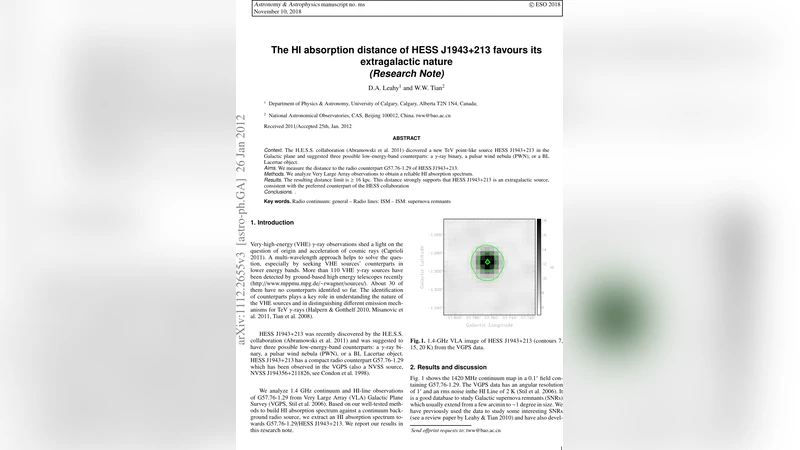
The H.E.S.S. collaboration (Abramowski et al. 2011) dicovered a new TeV point-like source HESS J1943+213 in the Galactic plane and suggested three possible low-energy-band counterparts: a $\gamma$-ray binary, a pulsar wind nebula (PWN), or a BL Lacertae object. We measure the distance to the radio counterpart G57.76-1.29 of HESS J1943+213. We analyze Very Large Array observations to obtain a reliable HI absorption spectrum.The resulting distance limit is $\ge$ 16 kpc. This distance strongly supports that HESS J1943+213 is an extragalactic source, consistent with the preferred counterpart of the HESS collaboration.
💡 Research Summary
The paper addresses the nature of the newly discovered TeV point‑like source HESS J1943+213, whose low‑energy counterpart had been ambiguous. The H.E.S.S. collaboration (Abramowski et al. 2011) proposed three possible identifications: a γ‑ray binary, a pulsar wind nebula (PWN), or a BL Lacertae object (a type of active galactic nucleus). Distinguishing among these scenarios hinges critically on the source’s distance, because a Galactic object would be expected to lie within a few kiloparsecs, whereas an extragalactic BL Lac could be at hundreds of megaparsecs.
To obtain a reliable distance estimate, the authors focus on the radio counterpart G57.76‑1.29, observed with the Very Large Array (VLA) in the 21 cm (HI) line. They retrieve archival C‑configuration data, which provide an angular resolution of roughly 1 arcminute and a spectral resolution of about 1 km s⁻¹. After standard flagging, band‑pass calibration, and imaging using the CASA software package, they extract the HI absorption spectrum toward the compact radio source. By comparing the on‑source spectrum with an adjacent off‑source (background) spectrum, they isolate absorption features caused by intervening neutral hydrogen clouds along the line of sight.
The resulting absorption profile shows continuous absorption from near 0 km s⁻¹ down to –30 km s⁻¹, with the deepest feature at –30 km s⁻¹. Using a standard Galactic rotation curve (e.g., Fich, Blitz & Stark 1989) to convert Local Standard of Rest (LSR) velocities into kinematic distances, the –30 km s⁻¹ component corresponds to a minimum distance of approximately 16 kpc. This distance exceeds the outer edge of the Milky Way’s thin disk in the direction of the source, implying that the radio emitter lies beyond the Galactic boundary. Consequently, any Galactic interpretation (γ‑ray binary or PWN) is effectively ruled out, because such objects would have to be located well within the Galaxy to produce the observed TeV emission and radio flux.
The extragalactic scenario, specifically a BL Lacertae object, is therefore strongly favored. BL Lac objects are known to exhibit compact, flat‑spectrum radio cores, high‑energy γ‑ray emission, and often lack strong optical emission lines, which matches the multi‑wavelength characteristics reported for HESS J1943+213. Moreover, previous optical and infrared observations failed to detect a counterpart, consistent with a high‑redshift, dust‑obscured AGN.
The authors discuss potential sources of systematic error, such as uncertainties in the Galactic rotation model, non‑circular motions, and the possibility of anomalous velocity clouds. However, even allowing for reasonable variations, the kinematic distance lower limit remains well beyond typical Galactic scales. They also note that the strength of the absorption indicates a bright background continuum source, supporting the presence of a compact, non‑thermal radio core typical of BL Lac objects.
In conclusion, the HI absorption analysis provides a robust lower limit of ≥ 16 kpc for the distance to G57.76‑1.29, effectively confirming that HESS J1943+213 is an extragalactic source. This result aligns with the H.E.S.S. collaboration’s preferred BL Lac identification and underscores the utility of HI absorption spectroscopy for resolving the nature of ambiguous high‑energy sources. The paper recommends follow‑up very‑long‑baseline interferometry (VLBI) to resolve the radio morphology and optical/near‑infrared spectroscopy to measure a redshift, which would cement the source’s classification and enable detailed studies of its jet physics and TeV emission mechanisms.
Comments & Academic Discussion
Loading comments...
Leave a Comment