X-Ray Absorption Analysis of NGC3516: Appearance of Fast Components with Increased Source Flux
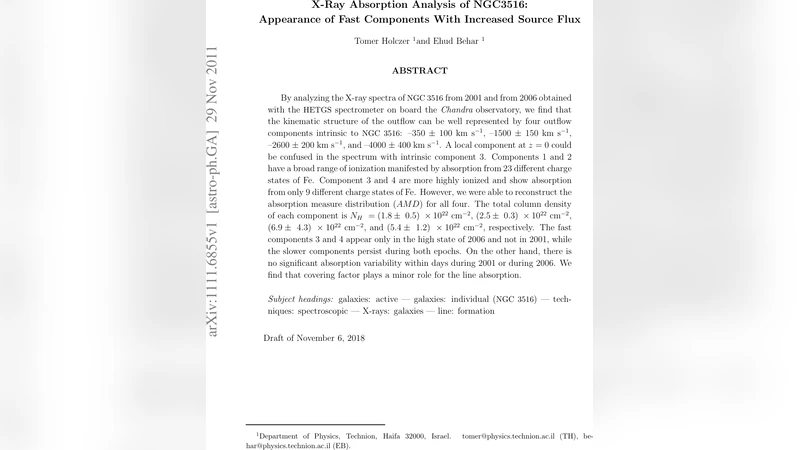
By analyzing the X-ray spectra of NGC 3516 from 2001 and 2006 obtained with the HETGS spectrometer on board the Chandra observatory, we find that the kinematic structure of the outflow can be well represented by four outflow components intrinsic to NGC 3516. The outflow velocities of the different components are 350 +-100 km s-1, 1500 +-150 km s-1, 2600 +-200 km s-1 and 4000 +-400 km s-1 for components 1, 2, 3 and 4, respectively. A local component at z = 0 could be confused with intrinsic component 3. Components 1 and 2 have a broad range of ionization manifested by absorption from 23 different charge states of Fe. Component 3 and 4 are more highly ionized and show absorption from only 9 different charge states of Fe, however we were able to reconstruct the absorption measure distribution (AMD) for all four. The total column density of each component is NH = (1.8+- 0.5) X10^22 cm-2, NH = (2.5+- 0.3) X10^22 cm-2, NH = (6.9+- 4.3) X10^22 cm-2 and NH = (5.4+- 1.2) X10^22 cm-2, respectively. The fast components 3 and 4 appear only in the high state of 2006 and not in 2001, while the slower components persist during both epochs. On the other hand, there is no significant absorption variability within days during 2001 or during 2006. We find that covering factor plays a minor role for the line absorption.
💡 Research Summary
The authors present a detailed X‑ray absorption study of the Seyfert 1 galaxy NGC 3516 using the high‑resolution Chandra/HETGS spectra obtained in 2001 (low flux state) and 2006 (high flux state). By combining all observations within each epoch, they achieve high signal‑to‑noise spectra covering 2–25 Å with over 1.4 × 10⁴ MEG and 7.5 × 10⁴ HEG counts. After correcting for Galactic absorption (N_H = 3.23 × 10²⁰ cm⁻²), the continuum is modeled with a power‑law (photon index Γ = 1.48) plus a soft black‑body component (kT = 110 eV), which adequately fits the 2–6 Å band.
The absorption analysis proceeds via an ion‑by‑ion fitting technique. For each ion, a template spectrum containing all relevant resonance lines and photo‑electric edges is generated using HULLAC and updated atomic data (e.g., Gu 2006 for Fe M‑shell ions). Turbulent broadening dominates line widths, and a single turbulent velocity v_turb = 300 km s⁻¹ (FWHM ≈ 500 km s⁻¹) is adopted for all components, together with the instrumental resolution (23 mÅ for MEG). The model assumes a covering factor of unity, justified by the deep, saturated O VII and O VIII lines.
Four distinct kinematic components are identified from the line profiles:
- Component 1: v ≈ −350 ± 100 km s⁻¹, present in both epochs, shows absorption from 23 Fe charge states (Fe I–Fe XXV) and a broad ionization range (log ξ ≈ 0.5–2.5).
- Component 2: v ≈ −1500 ± 150 km s⁻¹, also present in both epochs, similar ionization spread but with relatively stronger high‑ionization Fe XXV/XXVI lines.
- Component 3: v ≈ −2600 ± 200 km s⁻¹, detected only in the 2006 high‑state spectrum, dominated by higher‑ionization ions (Fe XVII–Fe XXV, Si XII–XIV, Mg XI–XII).
- Component 4: v ≈ −4000 ± 400 km s⁻¹, likewise exclusive to 2006, representing the most ionized gas (log ξ ≈ 2.5–3.5).
Total hydrogen column densities derived from the absorption measure distribution (AMD) are NH = (1.8 ± 0.5) × 10²² cm⁻² (Comp 1), (2.5 ± 0.3) × 10²² cm⁻² (Comp 2), (6.9 ± 4.3) × 10²² cm⁻² (Comp 3), and (5.4 ± 1.2) × 10²² cm⁻² (Comp 4). The AMD reconstruction uses XSTAR (v2.1kn3) to compute ion fractions f_ion(ξ) for each element, and solves the integral N_ion = A_Z ∫ (∂NH/∂log ξ) f_ion(ξ) dlog ξ for all measured ions. By binning log ξ into the narrowest intervals that still yield meaningful χ² constraints, the authors obtain a continuous NH(ξ) distribution for each velocity component, revealing that the fast components occupy the high‑ξ tail of the distribution.
Variability analysis shows that within each epoch (both 2001 and 2006) the ionic columns and ionization parameters remain stable on day‑scale timescales; the only significant change is the appearance of the fast components when the source brightens by a factor of ~5 in 2006. This suggests that the high‑flux state either ionizes previously unseen gas to observable charge states or drives a transient high‑velocity outflow. The covering factor remains close to unity for all components, indicating that partial covering does not play a major role in shaping the observed absorption lines.
The paper places its findings in the context of earlier UV and X‑ray studies of NGC 3516, which reported a variety of outflow velocities ranging from a few hundred to >1000 km s⁻¹. The present work reconciles many of those discrepancies by showing that the slower components are persistent, while the faster, highly ionized components are flux‑dependent. Moreover, the AMD methodology provides a more physically motivated description of the absorber than traditional multi‑component photo‑ionization models, capturing possible thermal instabilities and continuous ionization structure.
In conclusion, the study demonstrates that NGC 3516 hosts at least four distinct outflow components, with the two fastest only visible during high‑luminosity episodes. The AMD analysis yields robust column density and ionization distributions, and the negligible covering‑factor effect simplifies the interpretation of the absorption lines. These results advance our understanding of AGN wind physics, especially the link between central engine luminosity and the emergence of high‑velocity, highly ionized outflows that may contribute to AGN feedback processes.
Comments & Academic Discussion
Loading comments...
Leave a Comment