Type Ia supernovae in globular clusters: observational upper limits
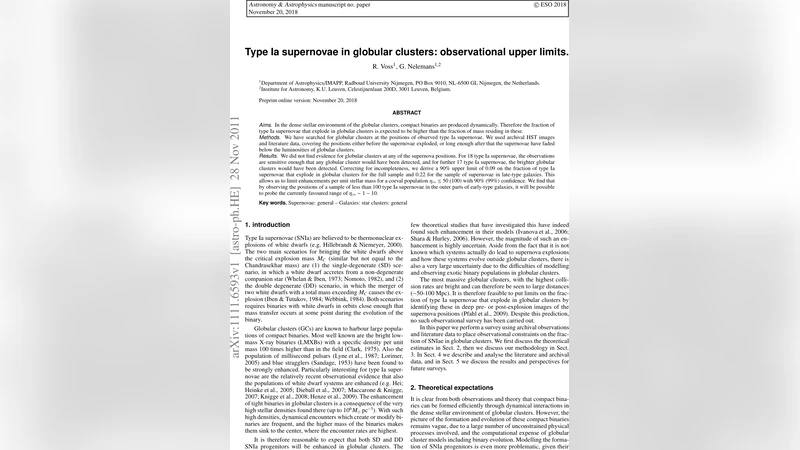
In the dense stellar environment of the globular clusters, compact binaries are produced dynamically. Therefore the fraction of type Ia supernovae that explode in globular clusters is expected to be higher than the fraction of mass residing in these. We have searched for globular clusters at the positions of observed type Ia supernovae. We used archival HST images and literature data, covering the positions either before the supernovae exploded, or long enough after that the supernovae have faded below the luminosities of globular clusters. We did not find evidence for globular clusters at any of the supernova positions. For 18 type Ia supernovae, the observations are sensitive enough that any globular cluster would have been detected, and for further 17 type Ia supernovae, the brighter globular clusters would have been detected. Correcting for incompleteness, we derive a 90% upper limit of 0.09 on the fraction of type Ia supernovae that explode in globular clusters for the full sample and 0.22 for the sample of supernovae in late-type galaxies. This allows us to limit enhancements per unit stellar mass for a coeval population eta_{co}<50 (100) with 90% (99%) confidence. We find that by observing the positions of a sample of less than 100 type Ia supernovae in the outer parts of early-type galaxies, it will be possible to probe the currently favoured range of eta_{co}~1-10.
💡 Research Summary
The authors set out to test the long‑standing theoretical expectation that Type Ia supernovae (SNe Ia) should be over‑represented in globular clusters (GCs) relative to the field because the high stellar densities in GCs dramatically increase the rate of dynamical encounters that can produce the close binary systems required for both the single‑degenerate (SD) and double‑degenerate (DD) progenitor channels. In the literature this “enhancement” is usually expressed as a mass‑weighted factor η, where η = 1 corresponds to a field‑like rate and η > 1 indicates a boost per unit stellar mass. Dynamical models (e.g., Ivanova et al. 2006; Shara & Hurley 2006) suggest η could lie anywhere between ∼1 and 10, but uncertainties in binary formation physics and in the structural parameters of GCs leave a very broad allowed range (η ≈ 0.1–100).
To obtain an observational constraint, the authors mined the Hubble Space Telescope (HST) archive and the published literature for images that either pre‑date the explosion of a SN Ia or are taken sufficiently long after the event that the supernova light has faded below the typical luminosity of a GC. They identified 35 SNe Ia with suitable coverage: 18 of them have images deep enough to detect any GC (complete to the faint end of the GC luminosity function), while a further 17 are only sensitive to the brighter half of the GC population. No GC was found at any of the SN positions.
A crucial part of the analysis is the treatment of completeness. Because the GC luminosity function spans several magnitudes, the authors used empirical relations derived from low‑mass X‑ray binaries (LMXBs) in GCs to define four completeness levels (CL100, CL75, CL50, CL25) corresponding to the mass (or luminosity) above which 100 %, 75 %, 50 % and 25 % of the compact binaries are expected to reside. These thresholds were calibrated in the K‑band and z‑band using data from Peacock et al. (2010) and Sivakoff et al. (2007), and then converted to absolute magnitudes for the various filters employed in the HST observations. By comparing the detection limits of each image with the appropriate CL level, the authors could assign a probability that a GC of a given mass would have been seen if it were present.
After correcting for the incompleteness of the sample, the authors derived a 90 % confidence upper limit on the fraction of SNe Ia that explode in GCs of 0.09 for the full sample, and 0.22 for the subsample of SNe Ia occurring in late‑type (spiral or irregular) galaxies. Translating this into the enhancement factor per unit stellar mass for a co‑eval population (η_co) yields η_co < 50 at 90 % confidence (η_co < 100 at 99 % confidence). These limits are still compatible with the theoretical range η_co ≈ 1–10 that many models favor, but they already rule out extreme enhancements (η ≫ 10) for the majority of nearby galaxies.
The paper discusses the implications for future surveys. Because the current constraints are limited by small numbers and by the depth of existing images, the authors argue that a dedicated program targeting the outer regions of early‑type galaxies—where background light is low and GC systems are rich—could dramatically improve the limits. Simulations suggest that observing fewer than 100 SNe Ia with deep HST (or next‑generation 30‑m class) imaging would be sufficient to either detect a GC‑associated SN Ia or to push the upper bound on η_co down to the theoretically favoured 1–10 range at the 3σ level.
In summary, this work provides the first empirical upper limits on the occurrence of SNe Ia in globular clusters, demonstrates a robust method for accounting for observational incompleteness, and outlines a realistic path toward testing the dynamical‑enhancement hypothesis with forthcoming high‑resolution imaging campaigns.
Comments & Academic Discussion
Loading comments...
Leave a Comment