Standing genetic variation and the evolution of drug resistance in HIV
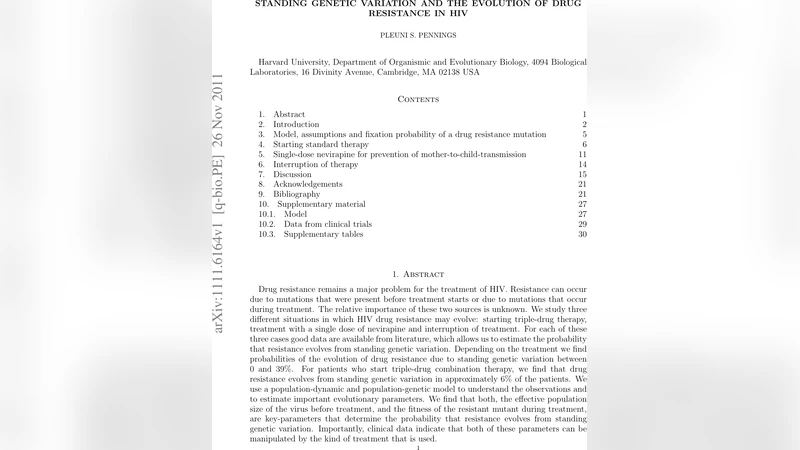
Drug resistance remains a major problem for the treatment of HIV. Resistance can occur due to mutations that were present before treatment starts or due to mutations that occur during treatment. The relative importance of these two sources is unknown. We study three different situations in which HIV drug resistance may evolve: starting triple-drug therapy, treatment with a single dose of nevirapine and interruption of treatment. For each of these three cases good data are available from literature, which allows us to estimate the probability that resistance evolves from standing genetic variation. Depending on the treatment we find probabilities of the evolution of drug resistance due to standing genetic variation between 0 and 39%. For patients who start triple-drug combination therapy, we find that drug resistance evolves from standing genetic variation in approximately 6% of the patients. We use a population-dynamic and population-genetic model to understand the observations and to estimate important evolutionary parameters. We find that both, the effective population size of the virus before treatment, and the fitness of the resistant mutant during treatment, are key-parameters that determine the probability that resistance evolves from standing genetic variation. Importantly, clinical data indicate that both of these parameters can be manipulated by the kind of treatment that is used.
💡 Research Summary
This paper investigates the relative contribution of pre‑existing (standing) genetic variation versus de‑novo mutations to the emergence of antiretroviral drug resistance in HIV. The authors focus on three clinically relevant scenarios for which robust epidemiological data exist: (1) initiation of standard triple‑drug combination therapy (ART) in treatment‑naïve patients, (2) administration of a single dose of nevirapine (sdNVP) to pregnant women for prevention of mother‑to‑child transmission, and (3) treatment interruptions followed by re‑initiation.
A simple yet biologically grounded population‑genetic model is employed. In the untreated state the viral population is assumed to be at a stable effective size N_u. Antiretroviral drugs reduce the fitness of the wild‑type virus to below one, causing a rapid decline, while a resistant mutant has absolute fitness F_m > 1 under therapy and incurs a cost C_rel (<1) in the absence of drugs. The model explicitly tracks mutation, drift, and selection, and uses an establishment probability derived from the mutant’s absolute fitness:
P_est ≈ 2 (F_m − 1) (assuming variance in offspring number σ² = 1).
This formulation is appropriate because, during effective therapy, the wild‑type cannot grow and the resistant strain essentially occupies an empty niche. The key parameters that determine the probability that a resistance mutation becomes established are therefore (i) the effective viral population size before treatment (N_e) and (ii) the absolute fitness of the resistant mutant during treatment (F_m).
Applying the model to published data yields the following estimates:
-
Triple‑drug ART initiation – Across large cohorts (e.g., Canada, UK) about 13 % of patients develop resistance within two years, but only ~6 % acquire resistance to more than one drug class. Using realistic values (N_e ≈ 10⁴–10⁵, C_rel ≈ 0.1–0.2) the model predicts that roughly 6 % of patients experience establishment of a resistant mutant that was already present at low frequency before therapy.
-
Single‑dose nevirapine (sdNVP) – Meta‑analyses report that ~44 % of women treated with sdNVP have detectable nevirapine‑resistant virus weeks after delivery. The model explains this high proportion by the combination of (a) a large pre‑treatment viral load (high N_e) and (b) a dramatic increase in F_m when the drug is present, allowing even very rare mutants to expand rapidly during the brief exposure.
-
Treatment interruptions – When therapy is stopped, viral load rebounds to pre‑treatment levels within ~4 weeks, effectively restoring a large N. Upon re‑initiation, any pre‑existing resistant mutants now have a fitness advantage, leading to a probability of resistance emergence that varies from 0 to 39 % depending on the length of the interruption, the half‑life differences among drugs, and the underlying N_e. This framework accounts for observations that (i) interruptions increase resistance risk even for protease‑inhibitor regimens with short half‑lives, and (ii) the “tail of monotherapy” hypothesis does not fully explain the data.
The authors emphasize that both N_e and F_m are modifiable through clinical practice. Reducing the initial viral load (e.g., with potent induction regimens) lowers N_e, while using drug combinations that minimize the fitness advantage of single‑drug resistant mutants (e.g., adding a second drug with a complementary resistance profile) reduces F_m. In the context of sdNVP, adding short‑acting agents (e.g., zidovudine) or employing a “tail‑covering” strategy can dramatically cut the probability of resistance. For treatment interruptions, synchronizing drug discontinuation to avoid periods where only one drug remains active, or employing regimens with matched half‑lives, can mitigate the rise in N and thus the chance of pre‑existing mutants fixing.
Beyond HIV, the analytical approach is applicable to any rapidly evolving pathogen where standing variation may seed drug resistance (e.g., HCV, influenza, SARS‑CoV‑2). The study underscores that overlooking the stochastic loss of low‑frequency resistant variants—an insight dating back to Haldane’s work on fixation probability—is critical for interpreting clinical resistance data.
In conclusion, the paper provides a quantitative framework linking viral population dynamics, mutant fitness, and clinical treatment strategies to the observed rates of drug resistance emergence. It demonstrates that standing genetic variation is a non‑negligible source of resistance across diverse treatment contexts and that rational manipulation of the two key parameters (pre‑treatment effective population size and mutant fitness under therapy) offers concrete avenues to reduce the burden of HIV drug resistance.
Comments & Academic Discussion
Loading comments...
Leave a Comment