Charge Exchange X-ray Emission of Nearby Star-forming Galaxies
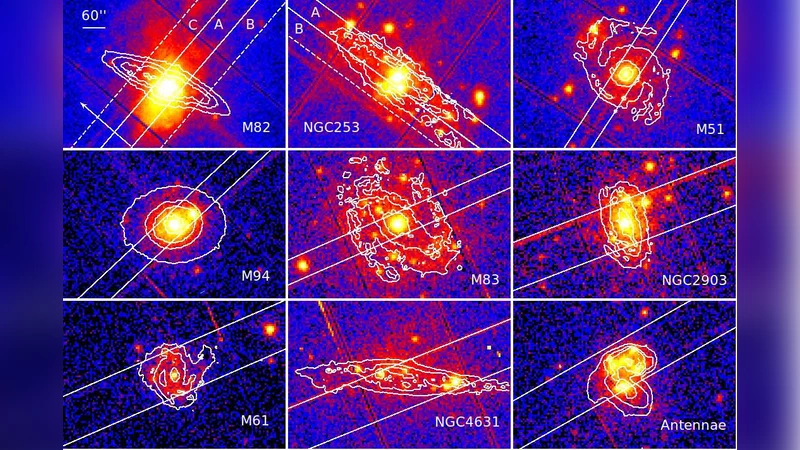
Properties of hot gas outflows from galaxies are generally measured from associated X-ray line emission assuming that it represents atomic transitions in thermally excited hot gas. X-ray line emission, however, can also arise from the charge exchange between highly ionised ions and neutral species. The K\alpha\ triplet of He-like ions can be used as a powerful diagnostic, because the charge exchange X-ray emission (CXE) favours the inter-combination and forbidden lines, while the thermal emission favours the resonance line. We analyse the OVII triplet of a sample of nine nearby star-forming galaxies observed by the XMM-Newton reflection grating spectrometers. For most galaxies, the forbidden lines are comparable to or stronger than the resonance lines, which is in contrast to the thermal prediction. For NGC 253, M51, M83, M61, NGC 4631, and the Antennae galaxy, the observed line ratios are consistent with the ratio of the CXE; for M94 and NGC 2903, the observed ratios indicate multiple origins; for M82, different regions show different line ratios, also indicating multiple origins. We discuss other possible mechanisms that can produce a relatively strong forbidden line, such as a collisional non-equilibrium-ionization recombining/ionizing plasma, which are not favoured. These results suggest that the CXE may be a common process and contribute a significant fraction of the soft X-ray line emission for galaxies with massive star formation.
💡 Research Summary
The paper investigates the origin of soft X‑ray line emission in nine nearby star‑forming galaxies by exploiting the diagnostic power of the He‑like O VII Kα triplet observed with the XMM‑Newton Reflection Grating Spectrometer (RGS). In a thermal plasma in ionization equilibrium, electron collisional excitation preferentially populates the resonance (r) line, yielding a line ratio G = (f + i)/r < 1.2. In contrast, charge‑exchange X‑ray emission (CXE) – where highly ionised ions capture electrons from neutral atoms – preferentially enhances the inter‑combination (i) and forbidden (f) lines, producing G ≈ 2.2 as measured in laboratory experiments.
The authors selected nine galaxies (M82, NGC 253, M51, M94, M83, NGC 2903, M61, NGC 4631, and the Antennae) that are bright enough for RGS analysis and lack dominant AGN photo‑ionisation. After standard SAS reduction, spectra were extracted from regions chosen to minimise spatial broadening; for edge‑on systems the extraction width was 60″, for fainter, more face‑on galaxies 120″. Each O VII triplet was fitted with three Gaussian components plus a constant continuum, allowing for a wavelength shift (Δλ) and dispersion (σλ) that account for the source’s spatial extent and offset from the nominal RGS centre. Bootstrap resampling provided 1σ uncertainties on the fitted fluxes.
The fitted G ratios are >1.2 for all galaxies except one sub‑region of M82, indicating that pure thermal emission cannot dominate. Six galaxies (NGC 253, M51, M83, M61, NGC 4631, the Antennae) have G ≈ 2.3–2.5, fully consistent with CXE. Two galaxies (M94, NGC 2903) show intermediate G ≈ 1.3–1.6, suggesting a mixture of CXE and thermal contributions. M82 exhibits spatial variation: dividing the cross‑dispersion direction into three zones (A, B, C) reveals that zone B is f‑dominated (CXE‑like), zone C is r‑dominated (thermal‑like or resonance scattering), and zone A shows a blend of both, implying multiple emission mechanisms operating simultaneously.
Alternative explanations—non‑equilibrium ionisation recombining or ionising plasma, resonance scattering, and contamination from point sources—were examined. The authors argue that these scenarios cannot reproduce the observed G ratios and spatial profiles as naturally as CXE. Consequently, they conclude that charge exchange at the interfaces between hot outflows and neutral gas is a common and significant contributor to the soft X‑ray line emission in star‑forming galaxies. This has important implications: measurements of outflow temperature, mass, and metallicity that rely solely on thermal models may be biased. Future high‑resolution, spatially resolved X‑ray spectroscopy (e.g., XRISM, Athena) will be essential to disentangle CXE from thermal emission and to refine our understanding of galactic feedback processes.
Comments & Academic Discussion
Loading comments...
Leave a Comment