The polytropic approximation and X-ray scaling relations: constraints on gas and dark matter profiles for galaxy groups and clusters
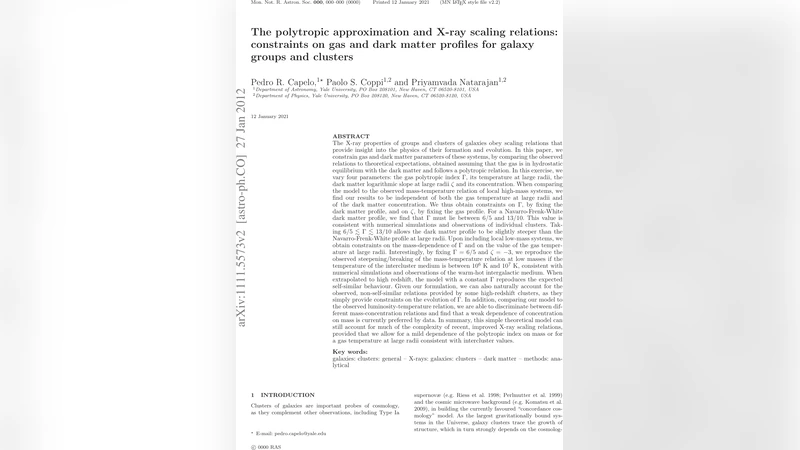
We constrain gas and dark matter (DM) parameters of galaxy groups and clusters, by comparing X-ray scaling relations to theoretical expectations, obtained assuming that the gas is in hydrostatic equilibrium with the DM and follows a polytropic relation. We vary four parameters: the gas polytropic index Gamma, its temperature at large radii T_xi, the DM logarithmic slope at large radii zeta and its concentration c_vir. When comparing the model to the observed mass-temperature (M-T) relation of local clusters, our results are independent of both T_xi and c_vir. We thus obtain constraints on Gamma, by fixing the DM profile, and on zeta, by fixing the gas profile. For an NFW DM profile, we find that 6/5<Gamma<13/10, which is consistent with numerical simulations and observations of individual clusters. Taking 6/5<Gamma<13/10 allows the DM profile to be slightly steeper than the NFW profile at large radii. Upon including local groups, we constrain the mass-dependence of Gamma and the value of T_xi. Interestingly, with Gamma=6/5 and zeta=-3, we reproduce the observed steepening/breaking of the M-T relation at low M, if 10^6 K<T_xi<10^7 K, consistent with simulations and observations of the warm-hot intergalactic medium. When extrapolated to high redshift z, the model with a constant Gamma reproduces the expected self-similar behaviour. We also account for the observed, non-self-similar relations provided by some high-z clusters, as they provide constraints on the evolution of Gamma. Comparing our model to the observed luminosity-temperature relation, we discriminate between different M-c_vir relations: a weak dependence of c_vir on M is currently preferred by data. This simple theoretical model accounts for much of the complexity of recent, improved X-ray scaling relations, provided that we allow for a mild dependence of Gamma on M or for T_xi consistent with intercluster values. [abridged]
💡 Research Summary
This paper investigates how well a simple analytical model can reproduce the observed X‑ray scaling relations of galaxy groups and clusters, and uses those relations to constrain the physical parameters of the intracluster gas and the underlying dark‑matter (DM) halo. The authors assume that the hot gas is in hydrostatic equilibrium (HE) within the gravitational potential of the DM and that the gas obeys a polytropic equation of state, P ∝ ρ^Γ, where Γ is the polytropic index (Γ > 1). Four free parameters are introduced: the polytropic index Γ, the gas temperature at large radii (Tₓᵢ), the outer logarithmic slope of the DM density profile (ζ), and the concentration parameter of the halo (c_vir).
For the DM distribution the authors adopt a generalized NFW profile (Bulbul et al. 2010), ρ_DM(r) ∝ (r/r_s)⁻¹(1 + r/r_s)⁻β, where β = 2 corresponds to the standard NFW case and β = 2 − ζ allows the outer slope to vary. This flexibility lets them explore whether the data prefer a steeper or shallower halo than the canonical NFW form. The gas density and temperature profiles follow analytically from the HE equation combined with the polytropic relation, yielding expressions that depend on Γ, Tₓᵢ, and the dimensionless gas parameter Δ_gas (which incorporates the central gas pressure and density).
The model is confronted with two key observational scaling relations: the mass–temperature (M–T) relation and the luminosity–temperature (L–T) relation. The authors first focus on massive clusters (M_vir ≈ 10¹⁴–10¹⁵ M_⊙) where the M–T relation is largely insensitive to Tₓᵢ and c_vir. By fixing the DM profile to the standard NFW form (β = 2) they find that the data require a polytropic index in the narrow range 6/5 ≤ Γ ≤ 13/10 (i.e., 1.20–1.30). This interval agrees with results from hydrodynamical simulations and with direct measurements of individual clusters. Holding Γ fixed, the outer DM slope ζ is constrained to be slightly steeper than the NFW value, with an optimal ζ ≈ ‑3.1 (β ≈ 2.1).
When lower‑mass systems (galaxy groups, M_vir ≈ 10¹³ M_⊙) are added, the observed M–T relation shows a pronounced steepening (or “break”) at the low‑mass end. The authors demonstrate that this feature can be reproduced if Γ is allowed to decrease mildly with decreasing mass and if the gas temperature at large radii lies in the range 10⁶–10⁷ K. Such temperatures are consistent with the warm‑hot intergalactic medium (WHIM) predicted by cosmological simulations. In this regime the model also requires a modest value of Tₓᵢ, effectively setting a floor for the gas temperature outside the virialized region.
The authors extend the analysis to higher redshifts (z ≈ 1). If Γ is assumed constant with redshift, the model naturally yields the self‑similar scaling expected from simple gravitational collapse (M ∝ T^{3/2}). However, several high‑z clusters exhibit non‑self‑similar M–T behaviour; fitting these objects provides constraints on possible redshift evolution of Γ, suggesting that modest evolution may be present.
The L–T relation is used to probe the concentration–mass (c_vir–M) relation. By imposing that the baryon fraction within the virial radius equals the cosmic value, the authors find that the observed L–T slope favours a weak dependence of concentration on mass (essentially c_vir ≈ constant). This is in tension with some simulation‑based prescriptions that predict a stronger decline of concentration with increasing mass (c_vir ∝ M^{-0.1}).
Overall, the study shows that a relatively simple analytical framework—hydrostatic equilibrium plus a polytropic gas law, combined with a flexible DM halo profile—can capture the main trends seen in modern X‑ray scaling relations. The key findings are: (1) Γ is tightly constrained to 1.2–1.3 for massive clusters; (2) the outer DM slope may be slightly steeper than NFW; (3) low‑mass groups require a mass‑dependent Γ and a WHIM‑like outer gas temperature; (4) self‑similar evolution holds at high redshift if Γ does not evolve, but observed deviations can be used to infer modest Γ evolution; and (5) the L–T data prefer a concentration–mass relation with only a weak mass dependence.
These results provide a valuable, computationally inexpensive tool for interpreting current and upcoming X‑ray surveys (e.g., eROSITA, Athena). By fitting the four parameters to observed scaling relations, one can infer the underlying DM halo structure and the thermodynamic state of the intracluster medium without resorting to full hydrodynamical simulations, thereby facilitating rapid cosmological analyses and the calibration of mass proxies for large cluster samples.
Comments & Academic Discussion
Loading comments...
Leave a Comment