Stochastic self-assembly of incommensurate clusters
We examine the classic problem of homogeneous nucleation and growth by deriving and analyzing a fully discrete stochastic master equation. Upon comparison with results obtained from the corresponding mean-field Becker-D"{o}ring equations we find striking differences between the two corresponding equilibrium mean cluster concentrations. These discrepancies depend primarily on the divisibility of the total available mass by the maximum allowed cluster size, and the remainder. When such mass incommensurability arises, a single remainder particle can “emulsify” or “disperse” the system by significantly broadening the mean cluster size distribution. This finite-sized broadening effect is periodic in the total mass of the system and can arise even when the system size is asymptotically large, provided the ratio of the total mass to the maximum cluster size is finite. For such finite ratios we show that homogeneous nucleation in the limit of large, closed systems is not accurately described by classical mean-field mass-action approaches.
💡 Research Summary
In this paper the authors revisit the classic problem of homogeneous nucleation and growth in a closed, finite‑volume system, but they do so from a fully discrete stochastic perspective rather than the traditional mean‑field approach. The system consists of a fixed total number of monomers M that can bind to form clusters of size k (1 ≤ k ≤ N), where N is the imposed maximal cluster size (e.g., the size of a virus capsid or a protein oligomer). Binding events occur at unit rate while monomer detachment occurs at a much slower rate ε ≪ 1.
Starting from the probability P({n};t) of finding the system in a configuration {n} = (n₁,n₂,…,n_N), the authors write down the exact high‑dimensional master equation (Eq. 1). By multiplying this equation by n_k and summing over all configurations they obtain a hierarchy of moment equations. Closing the hierarchy with the usual mean‑field approximations (⟨n_k n_j⟩≈⟨n_k⟩⟨n_j⟩, ⟨n₁(n₁−1)⟩≈⟨n₁⟩²) yields the classical Becker‑Döring (BD) rate equations (Eq. 2). In the limit ε→0⁺ the BD solution predicts that essentially all mass ends up in the largest possible cluster: c_eq(k)≈(M/N) δ_{k,N}, with negligible concentrations of smaller clusters.
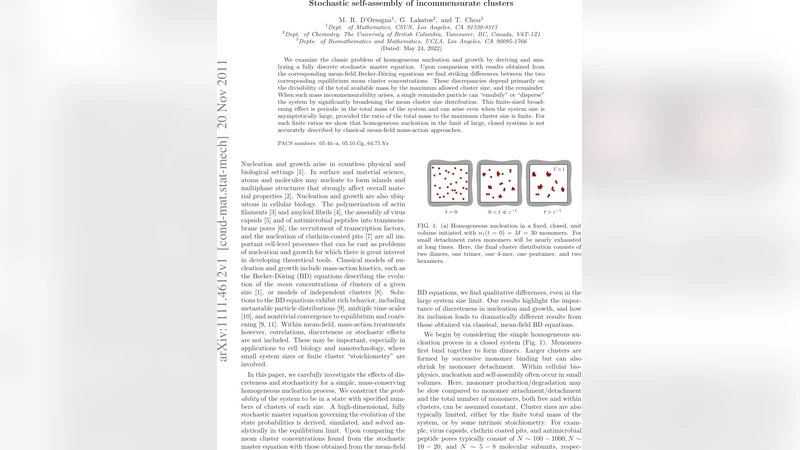
However, this mean‑field picture breaks down when the total mass M is not an integer multiple of N. The authors demonstrate this by kinetic Monte‑Carlo (KMC) simulations for N = 8 and two nearby values of M: 16 (exactly divisible) and 17 (one monomer in excess). While both the stochastic and BD models agree at early times (t ≪ ε⁻¹), they diverge dramatically at long times (t ≫ ε⁻¹). For M = 16 the equilibrium distribution is sharply peaked at k = 8, as BD predicts. For M = 17, however, the stochastic model yields a broad, almost uniform distribution across many cluster sizes, whereas BD still predicts almost all mass in k = 8 clusters.
To understand this “incommensurability” effect, the authors exploit the ε ≪ 1 limit. In this regime the equilibrium probability mass concentrates on configurations with the smallest possible number of clusters, N_min = ⌈M/N⌉. By enumerating these minimal‑cluster states and applying detailed balance between them and the next‑higher‑cluster states, they derive exact expressions for the equilibrium mean cluster numbers ⟨n_k⟩ in the ε→0⁺ limit. Writing M = σ N − j with 0 ≤ j < N (σ is the integer part of M/N, j the remainder), they obtain closed‑form formulas (Eqs. 3 and 4). When j = 0 (M divisible by N) the solution reduces to ⟨n_N⟩ = σ and ⟨n_{k<N}⟩≈0, reproducing the BD result. When j > 0, the remainder monomers force the system to populate many smaller clusters; the mean numbers scale with combinatorial factors involving σ and j. In the special case j = N − 1 (adding a single monomer to a system that otherwise forms only maximal clusters) the formulas contain additional factorial terms reflecting the two ways a solitary monomer can appear in a configuration.
These analytic results are validated against extensive KMC simulations (Fig. 4) and show excellent agreement. The authors also map out the regimes of validity for three modeling approaches (infinite‑N BD, finite‑N BD, and the full stochastic master equation) in Table I. The key finding is that the mean‑field BD equations are accurate only when M ≫ N² (i.e., σ ≫ N), a condition that is rarely met in many biological or nanotechnological contexts where the effective ratio M/N is finite. In the intermediate regime (finite σ, finite j) the stochastic description is essential; the “dispersion” effect caused by a single excess monomer can dramatically broaden the cluster size distribution, a phenomenon that persists even as M,N→∞ provided their ratio remains fixed.
The paper therefore highlights a previously unappreciated source of discrepancy between deterministic mass‑action kinetics and the true stochastic dynamics of self‑assembly. It shows that the discreteness of mass and the integer nature of cluster stoichiometry can produce periodic, system‑size‑independent fluctuations in equilibrium cluster populations. This insight has direct implications for modeling finite‑volume biological processes such as actin filament nucleation, amyloid fibril formation, viral capsid assembly, and antimicrobial peptide pore formation, where the number of subunits is limited and stochastic effects are non‑negligible. The authors conclude that for any system where the effective M/N is finite, a fully stochastic treatment is required to capture the correct equilibrium behavior, and reliance on classical Becker‑Döring equations may lead to qualitatively incorrect predictions.
Comments & Academic Discussion
Loading comments...
Leave a Comment