The Critical Coupling Likelihood Method: A new approach for seamless integration of environmental and operating conditions of gravitational wave detectors into gravitational wave searches
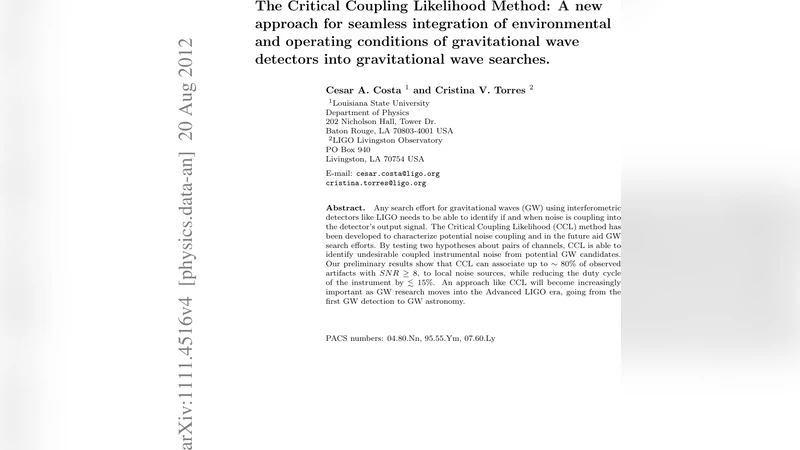
Any search effort for gravitational waves (GW) using interferometric detectors like LIGO needs to be able to identify if and when noise is coupling into the detector’s output signal. The Critical Coupling Likelihood (CCL) method has been developed to characterize potential noise coupling and in the future aid GW search efforts. By testing two hypotheses about pairs of channels, CCL is able to identify undesirable coupled instrumental noise from potential GW candidates. Our preliminary results show that CCL can associate up to $\sim 80%$ of observed artifacts with $SNR \geq 8$, to local noise sources, while reducing the duty cycle of the instrument by $\lesssim 15%$. An approach like CCL will become increasingly important as GW research moves into the Advanced LIGO era, going from the first GW detection to GW astronomy.
💡 Research Summary
The paper introduces the Critical Coupling Likelihood (CCL) method, a statistical framework designed to identify and quantify noise coupling between the primary gravitational‑wave (GW) readout channel of interferometric detectors such as LIGO and the multitude of auxiliary environmental and instrumental sensors (PEMs). Traditional data‑quality (DQ) procedures rely heavily on post‑hoc visual inspection and manual veto generation, which become impractical as detector sensitivity increases and the volume of auxiliary data grows in the Advanced LIGO era. CCL addresses this by simultaneously testing two hypotheses for each pair of channels: (1) a genuine coupling exists (foreground) and (2) any coincidence is accidental (background).
The method begins by extracting “artifacts” from the GW channel—time‑frequency structures that exceed a signal‑to‑noise ratio (SNR) threshold ρ₀—and from each sensor channel without additional cuts. Each artifact is characterized by its occurrence time t and its SNR ρ. The GW artifacts form a set Y, while the sensor artifacts form a set X. From these sets, two probability models are built. The foreground model P_f captures the empirical joint distribution of GW‑sensor coincidences, reflecting any true physical coupling. The background model P_b assumes statistical independence and is constructed from the marginal SNR distributions of the two channels.
Because the underlying noise in LIGO is largely Gaussian, the SNR distribution of pure Gaussian noise after a time‑frequency decomposition follows a Rayleigh law. However, real data exhibit a substantial excess of high‑SNR outliers that cannot be described by a Rayleigh tail alone. To model this, the authors introduce a modified Weibull distribution (MWD) for the outlier component. The overall background probability density C(x|α) is expressed as a weighted sum of the censored Rayleigh term R(x) and the Weibull term W(z(x)|α), where z(x)=log x and ψ₁, ψ₂ are mixing coefficients.
A key technical contribution is the adaptive histogram construction used to estimate these distributions. The authors maximize the Shannon entropy of the histogram by jointly optimizing the logarithmic bin base B and the number of bins b, thereby ensuring fine resolution across the wide dynamic range of SNR values while avoiding empty bins. Parameter estimation for the combined model (σ, α, λ, k, ψ₁, ψ₂) is performed using either Quantile Maximum Product of Spacing (QMPS) for well‑sampled data or the more computationally intensive Maximum Product of Spacing (MPS) for sparse data sets.
The CCL statistic is defined as
CCL = 2 log₁₀(P_f / P_b)
where a large positive CCL indicates a statistically significant coupling between the GW channel and a given sensor. Applying the method to LIGO data, the authors find that approximately 80 % of artifacts with SNR ≥ 8 can be associated with local noise sources identified by high CCL values, while the overall duty cycle loss incurred by discarding these intervals is less than 15 %. This demonstrates that CCL can effectively flag noisy periods without severely compromising observing time.
Beyond the quantitative results, the paper highlights several strategic advantages of CCL. First, it provides a near‑real‑time metric that can be incorporated directly into GW search pipelines, reducing reliance on manual veto generation. Second, by treating each sensor independently, the method can disentangle complex, multi‑source environmental influences (e.g., seismic activity, electromagnetic interference, temperature fluctuations). Third, the statistical framework is scalable: as the number of auxiliary channels grows, the same pairwise analysis can be parallelized, and the entropy‑based histogram ensures robust modeling even with heterogeneous data quality.
In conclusion, the Critical Coupling Likelihood method offers a rigorous, automated approach to data‑quality assessment for current and future gravitational‑wave observatories. Its ability to separate genuine instrumental coupling from accidental coincidences, while preserving most of the detector’s observing time, makes it a valuable addition to the toolkit needed for the transition from occasional GW detections to routine GW astronomy in the Advanced LIGO era.
Comments & Academic Discussion
Loading comments...
Leave a Comment