Bondi-Hoyle Accretion onto Magnetized Neutron Star
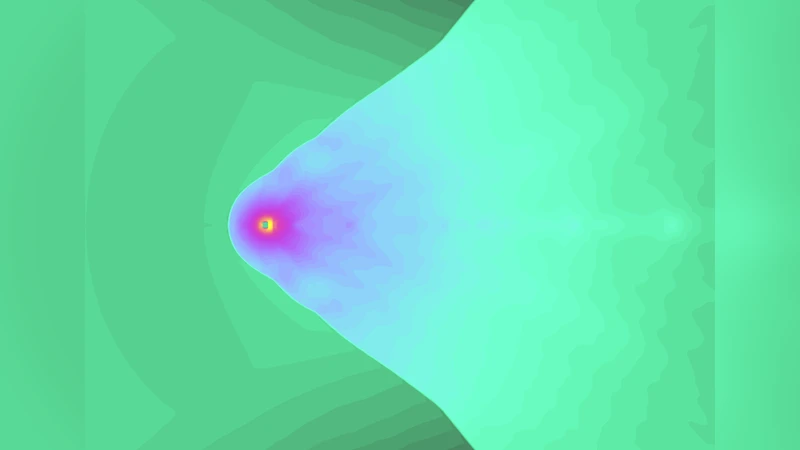
Axisymmetric MHD simulations are used to investigate the Bondi-Hoyle accretion onto an isolated magnetized neutron star moving supersonically (with Mach number of 3) through the interstellar medium. The star is assumed to have a dipole magnetic field aligned with its motion and a magnetospheric radius R_m less then the accretion radius R_BH, so that the gravitational focusing is important. We find that the accretion rate to a magnetized star is smaller than that to a non-magnetized star for the parameters considered. Close to the star the accreting matter falls to the star’s surface along the magnetic poles with a larger mass flow to the leeward pole of the star. In the case of a relatively large stellar magnetic field, the star’s magnetic field is stretched in the direction of the matter flow outside of R_m (towards the windward side of the star). For weaker magnetic fields we observed oscillations of the closed magnetosphere frontward and backward. These are accompanied by strong oscillations of the mass accretion rate which varies by factors ~ 3. Old slowly rotating neutron stars with no radio emission may be visible in the X-ray band due to accretion of interstellar matter. In general, the star’s velocity, magnetic moment, and angular velocity vectors may all be in different directions so that the accretion luminosity will be modulated at the star’s rotation rate.
💡 Research Summary
This paper presents two‑dimensional axisymmetric magnetohydrodynamic (MHD) simulations of Bondi‑Hoyle accretion onto an isolated neutron star that moves supersonically (Mach = 3) through the interstellar medium (ISM). The neutron star is endowed with a dipolar magnetic field aligned with its direction of motion, and the magnetospheric radius Rₘ is deliberately chosen to be smaller than the classical Bondi‑Hoyle accretion radius R_BH, so that gravitational focusing remains the dominant mechanism for capturing gas.
The authors first validate their numerical setup by reproducing the classic hydrodynamic Bondi‑Hoyle flow for a non‑magnetized point mass. With a Mach number of three, a conical shock forms upstream, and a low‑density wake trails downstream. The measured accretion rate is ≈ 0.7 × Ṁ_BH, consistent with earlier studies that noted a modest reduction due to the finite size of the numerical star.
Next, they introduce a magnetic dipole with a surface field B_* ≈ 10¹⁰–10¹² G (magnetic moment μ ≈ 10³⁰ G cm³). For this configuration the magnetospheric radius Rₘ ≈ 0.02 R_B, roughly one‑tenth of the Bondi‑Hoyle radius (R_BH ≈ 0.2 R_B). The simulations show that the magnetic field is strongly distorted by the incoming flow: field lines are swept back on the downstream side, forming “ear‑shaped” protrusions that oscillate in the axial direction. The shock front remains at roughly the same position as in the hydrodynamic case, but the post‑shock region is now divided into a magnetically dominated inner zone (p_mag > p) and a gas‑pressure dominated outer zone.
A key result is that the net mass accretion rate onto the magnetized star is reduced relative to the non‑magnetized case, typically by 30–50 %. The reduction arises because the magnetosphere acts as an obstacle that diverts part of the inflowing gas around the star. Moreover, the flow preferentially channels material onto the leeward (downstream) magnetic pole, producing an asymmetric accretion column. This asymmetry is a direct consequence of the gravitational focusing combined with the dipole geometry.
When the magnetic moment is lowered (μ < 2 × 10⁻⁸ in dimensionless units, corresponding to B_* ≲ 10¹¹ G), the magnetosphere no longer remains static. The simulations reveal quasi‑periodic oscillations of the magnetospheric boundary forward and backward along the direction of motion. These oscillations are driven by the competition between ram pressure of the ISM and magnetic pressure; they lead to large variations (up to a factor of three) in the instantaneous accretion rate. The period of the oscillation scales with the crossing time t₀ = (L/v_∞) of the computational domain and is sensitive to the adopted magnetic diffusivity (η_m = 10⁻⁵ in the runs).
The paper also provides detailed profiles of density, velocity, temperature, gas pressure, magnetic pressure, and plasma β along the symmetry axis. A normal shock is located at z ≈ ‑0.04 R_B; downstream of the shock the flow decelerates to sub‑sonic speeds, then re‑accelerates in the polar columns to supersonic velocities. Temperature and pressure rise sharply toward the star due to adiabatic compression, while magnetic pressure is amplified in the inner magnetosphere but remains sub‑dominant outside it.
Finally, the authors discuss astrophysical implications for old, slowly rotating isolated neutron stars (IONS). Even with the reduced accretion rate, a star with B ≈ 10¹¹ G can capture Ṁ ≈ 10⁸–10⁹ g s⁻¹ from the ISM, yielding an X‑ray luminosity L_X ≈ 10³¹–10³² erg s⁻¹, potentially detectable with modern X‑ray surveys. If the velocity vector, magnetic dipole axis, and spin axis are misaligned, the accretion luminosity will be modulated at the spin period, offering a diagnostic signature. The oscillatory behavior found for weaker fields could also produce quasi‑periodic X‑ray variability. The study thus bridges the gap between idealized Bondi‑Hoyle theory and realistic magnetized accretion onto neutron stars, highlighting how magnetic fields both suppress and channel accretion, and suggesting observable X‑ray signatures for otherwise radio‑quiet neutron stars.
Comments & Academic Discussion
Loading comments...
Leave a Comment