The spectrum of the recycled PSR J0437-4715 and its white dwarf companion
We present extensive spectral and photometric observations of the recycled pulsar/white-dwarf binary containing PSR J0437-4715, which we analyzed together with archival X-ray and gamma-ray data, to obtain the complete mid-infrared to gamma-ray spectrum. We first fit each part of the spectrum separately, and then the whole multi-wavelength spectrum. We find that the optical-infrared part of the spectrum is well fit by a cool white dwarf atmosphere model with pure hydrogen composition. The model atmosphere (Teff = 3950pm150K, log g=6.98pm0.15, R_WD=(1.9pm0.2)e9 cm) fits our spectral data remarkably well for the known mass and distance (M=0.25pm0.02Msun, d=156.3pm1.3pc), yielding the white dwarf age (tau=6.0pm0.5Gyr). In the UV, we find a spectral shape consistent with thermal emission from the bulk of the neutron star surface, with surface temperature between 1.25e5 and 3.5e5K. The temperature of the thermal spectrum suggests that some heating mechanism operates throughout the life of the neutron star. The temperature distribution on the neutron star surface is non-uniform. In the X-rays, we confirm the presence of a high-energy tail which is consistent with a continuation of the cut-off power-law component (Gamma=1.56pm0.01, Ecut=1.1pm0.2GeV) that is seen in gamma-rays and perhaps even extends to the near-UV.
💡 Research Summary
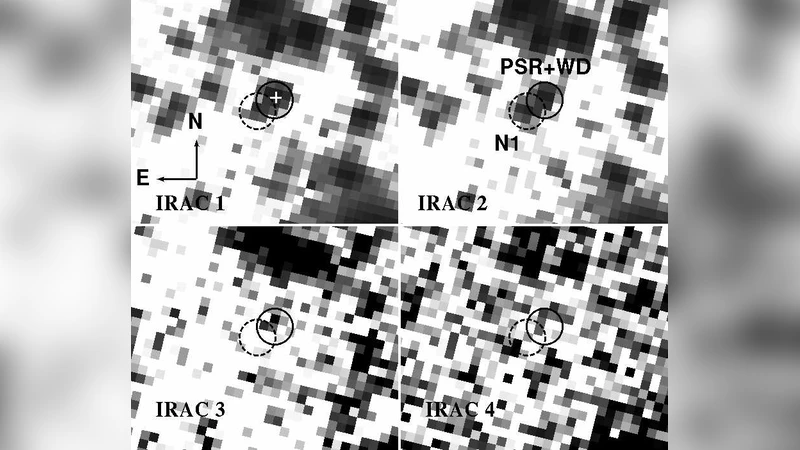
The authors present a comprehensive, multi‑wavelength study of the recycled millisecond pulsar PSR J0437‑4715 and its white‑dwarf companion, assembling data from the mid‑infrared to the γ‑ray regime. New observations include Spitzer/IRAC and MIPS photometry, Magellan/PANIC near‑infrared imaging, VLT/FORS1 optical spectroscopy, and HST/ACS and WFPC2 imaging and spectroscopy, complemented by archival Chandra, XMM‑Newton, and Fermi LAT data.
In the optical–infrared domain the spectral energy distribution is modeled with a pure‑hydrogen white‑dwarf atmosphere. The best‑fit parameters are an effective temperature Teff = 3950 ± 150 K, surface gravity log g = 6.98 ± 0.15, and radius RWD = (1.9 ± 0.2) × 10⁹ cm. These values are fully consistent with the independently measured white‑dwarf mass (0.25 ± 0.02 M⊙) and distance (156.3 ± 1.3 pc). Using standard cooling tracks, the authors infer a white‑dwarf age of 6.0 ± 0.5 Gyr, confirming that the companion is an old, cool object that no longer dominates the system’s UV output.
The ultraviolet spectrum, obtained with HST/ACS and STIS, shows a Rayleigh‑Jeans‑like slope indicative of thermal emission from the bulk of the neutron‑star surface. By fitting a black‑body component the authors derive a surface temperature in the range 1.25 × 10⁵ K to 3.5 × 10⁵ K. This temperature is far higher than expected for a neutron star of the pulsar’s characteristic age (~5 Gyr) if only passive cooling were at work. The authors therefore argue that a persistent heating mechanism—such as vortex creep, rotochemical heating, or magnetospheric return currents—must be active throughout the star’s life. The UV data also suggest that the temperature distribution across the surface is non‑uniform, a conclusion supported by the X‑ray pulse profile.
X‑ray analysis combines Chandra/ACIS imaging spectroscopy with XMM‑Newton/MOS data. The spectrum is best described by a combination of a soft thermal component (attributed to hot polar caps) and a high‑energy tail extending beyond several keV. The tail is well fitted by a power‑law with photon index Γ = 1.56 ± 0.01 and an exponential cutoff at Ecut = 1.1 ± 0.2 GeV. Remarkably, this power‑law connects smoothly to the γ‑ray spectrum measured by Fermi LAT, indicating that the same population of relativistic particles produces emission from the X‑ray band up to the GeV range. This continuity supports models in which magnetospheric curvature radiation or synchrotron self‑Compton processes dominate the high‑energy output of the pulsar.
By fitting the entire spectral energy distribution simultaneously, the authors demonstrate that three distinct components dominate different wavelength regimes: (1) the cool hydrogen‑atmosphere white dwarf in the optical/IR, (2) thermal surface emission from the neutron star in the UV, and (3) magnetospheric non‑thermal emission that spans the X‑ray to γ‑ray bands. The work provides precise constraints on the white‑dwarf’s physical parameters and cooling age, reveals ongoing heating of the neutron‑star surface, and establishes a clear spectral link between the X‑ray and γ‑ray emission mechanisms. These results advance our understanding of recycled pulsar systems, the thermal evolution of old neutron stars, and the high‑energy processes operating in millisecond pulsar magnetospheres.
Comments & Academic Discussion
Loading comments...
Leave a Comment