Spiral flows in cool-core galaxy clusters
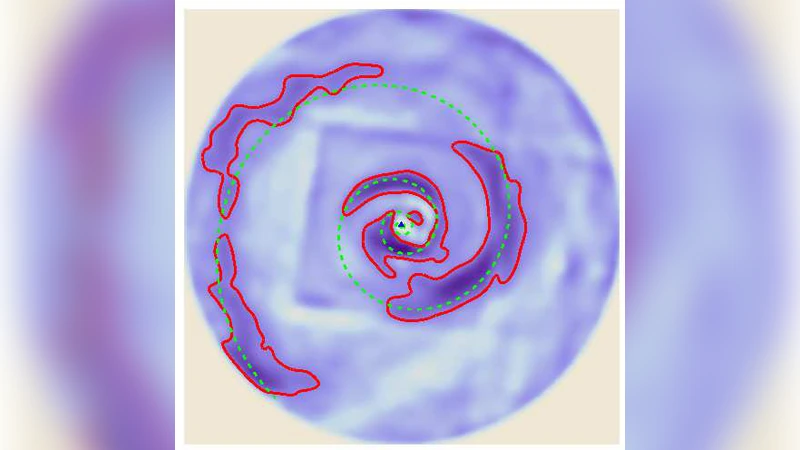
We argue that bulk spiral flows are ubiquitous in the cool cores (CCs) of clusters and groups of galaxies. Such flows are gauged by spiral features in the thermal and chemical properties of the intracluster medium, by the multi-phase properties of CCs, and by X-ray edges known as cold fronts. We analytically show that observations of piecewise-spiral fronts impose strong constraints on the CC, implying the presence of a cold, fast flow, which propagates below a hot, slow inflow, separated by a slowly rotating, trailing, quasi spiral, tangential discontinuity surface. This leads to the nearly logarithmic spiral pattern, two-phase plasma, \rho \sim r^{-1} density (or T \sim r^{0.4} temperature) radial profile, and ~100kpc size, characteristic of CCs. By advecting heat and mixing the gas, such flows can eliminate the cooling problem, provided that a feedback mechanism regulates the flow. In particular, we present a quasi-steady-state model for an accretion-quenched, composite flow, in which the fast phase is an outflow, regulated by active galactic nucleus bubbles, reproducing the observed low star formation rates and explaining some features of bubbles such as their R_b \propto r size. The simplest two-component model reproduces several key properties of CCs, so we propose that all such cores harbor a spiral flow. Our results can be tested directly in the next few years, for example by ASTRO-H.
💡 Research Summary
The paper proposes that bulk spiral flows are a ubiquitous and fundamental feature of cool‑core (CC) galaxy clusters and groups. Starting from the wealth of high‑resolution X‑ray observations that reveal spiral patterns, cold fronts (CFs), and multi‑phase temperature and metallicity structures, the authors argue that these phenomena are not merely transient sloshing artefacts but signatures of a persistent, quasi‑steady flow configuration.
The theoretical framework is built on the standard fluid equations (continuity, momentum, and energy) expressed in a cylindrical coordinate system aligned with the spiral symmetry axis. By assuming that the spiral pattern rotates uniformly about the z‑axis with angular frequency ω, and that the flow is confined to planes that are locally parallel to the tangential discontinuity (TD) surface, the equations simplify to a set of ordinary differential relations along streamlines. The key insight is that the TD—observed as a cold front in projection—acts as a slowly rotating, quasi‑spiral surface separating two distinct plasma components.
Two components are identified: (1) a cold, fast flow that lies just beneath the CF, is nearly adiabatic, and moves at speeds approaching the local sound speed; (2) a hot, slow inflow that supplies the bulk of the radiative cooling power and moves inward on a longer timescale. The cold component is interpreted as an outflow driven by active‑galactic‑nucleus (AGN) bubbles, while the hot component represents the classic cooling‑flow inflow. The authors derive power‑law scalings for density (ρ∝r⁻¹), temperature (T∝r⁰·⁴), and metallicity (Z∝r⁻⁰·³) that match the observed universal radial profiles of CCs.
A crucial part of the model is the feedback loop: AGN bubbles inject momentum and energy into the cold, fast phase, regulating its speed and mass flux. Because the bubbles expand as they rise, their size scales with radius (R_b∝r), a relation that naturally emerges from the spiral‑flow geometry and is consistent with observed bubble sizes. The fast outflow advects heat outward, while the slow inflow carries heat inward via radiative cooling; together they mix the plasma and suppress catastrophic cooling without requiring fine‑tuned thermal conduction. Magnetic fields, amplified by shear at the TD, are assumed to suppress perpendicular conduction, while parallel conduction is neglected for simplicity.
The paper also discusses how the spiral flow explains several observational puzzles: (i) the prevalence of cold fronts with modest pressure jumps and metallicity gradients; (ii) the existence of multiple, concentric CFs that appear as piecewise spirals when viewed edge‑on; (iii) the correlation between CFs and radio mini‑halos, which can be understood as the result of shear‑driven turbulence in the TD layer; and (iv) the multi‑phase nature of CC plasma inferred from high‑resolution spectroscopy.
Finally, the authors outline testable predictions. High‑resolution X‑ray spectroscopy (e.g., with the upcoming ASTRO‑H mission) should detect bulk velocities of order a few hundred km s⁻¹ in the cold phase and confirm the near‑adiabatic temperature profile across CFs. Detailed mapping of metallicity and temperature across multiple CFs should reveal the predicted power‑law scalings. Radio observations should continue to find mini‑halos aligned with the spiral geometry. If confirmed, the spiral‑flow paradigm would provide a unified explanation for the thermal, chemical, and dynamical properties of cool‑core clusters, linking AGN feedback, turbulence, and large‑scale gas motions into a self‑regulating system that solves the long‑standing cooling‑flow problem.
Comments & Academic Discussion
Loading comments...
Leave a Comment