Escape from Vela X
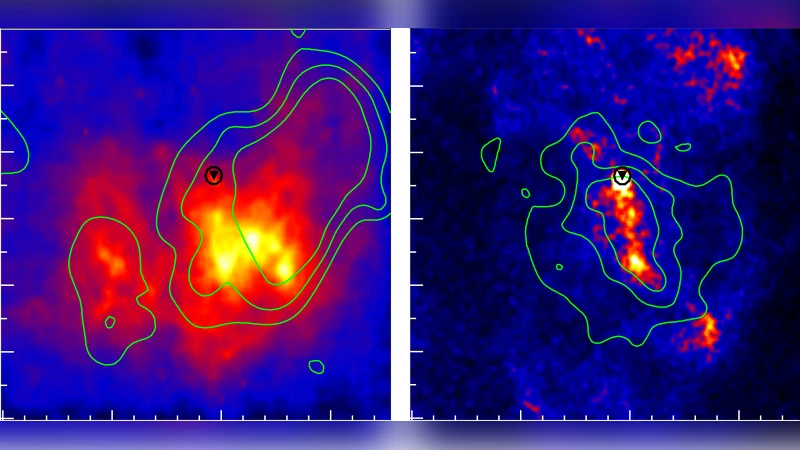
Whilst the Vela pulsar and its associated nebula are often considered as the archetype of a system powered by a \sim10^4 year old isolated neutron star, many features of the spectral energy distribution of this pulsar wind nebula are both puzzling and unusual. Here we develop a model that for the first time relates the main structures in the system, the extended radio nebula (ERN) and the X-ray cocoon through continuous injection of particles with a fixed spectral shape. We argue that diffusive escape of particles from the ERN can explain the steep Fermi-LAT spectrum. In this scenario Vela X should produce a distinct feature in the locally-measured cosmic ray electron spectrum at very high energies. This prediction can be tested in the future using the Cherenkov Telescope Array (CTA). If particles are indeed released early in the evolution of PWNe and can avoid severe adiabatic losses, PWN provide a natural explanation for the rising positron fraction in the local CR spectrum.
💡 Research Summary
The paper presents a unified model for the Vela X pulsar wind nebula (PWN) that simultaneously accounts for its multi‑wavelength emission from radio to TeV γ‑rays. Vela X consists of an extended radio nebula (ERN) spanning several degrees and a compact X‑ray “cocoon” located near the pulsar. The authors assume that the pulsar injects relativistic electrons (and positrons) with a fixed power‑law spectrum at a constant fraction η of its spin‑down power throughout its lifetime.
In the early phase (≈70 % of the system’s age, ~7 kyr) the particles are fully confined within the PWN. When the supernova remnant’s reverse shock reaches the nebula, confinement weakens and diffusion becomes the dominant transport mechanism. The diffusion coefficient is taken to be ~2000 times faster than Bohm diffusion, with an energy dependence D∝E^δ (δ≈1). This relatively rapid but still sub‑ISM diffusion allows electrons above ~100 GeV to escape from the ERN on timescales of a few kiloyears, while lower‑energy electrons remain trapped.
The cocoon is interpreted as a much younger structure (age ≈230 yr) formed by the interaction of the reverse shock with the pulsar wind. Electrons are first accelerated in a high‑magnetic‑field region (~100 µG) close to the pulsar, then injected into the low‑field cocoon (≈4 µG). Because the magnetic field in the cocoon is low, synchrotron cooling is negligible; thus the TeV γ‑ray spectrum observed by H.E.S.S. directly reflects the injected electron spectrum, with a cutoff around 70 TeV, consistent with observations.
For the ERN, the present magnetic field is ~4 µG, implying very long synchrotron lifetimes for GeV‑emitting electrons. The steep GeV spectrum measured by Fermi‑LAT cannot be explained by radiative cooling; instead the authors argue that diffusive escape of >100 GeV electrons from the ERN depletes the high‑energy population, producing the observed soft spectrum. Monte‑Carlo simulations that follow individual particle energy losses (synchrotron and full Klein‑Nishina inverse‑Compton scattering on CMB, infrared, and stellar photon fields) and diffusion reproduce both the ERN and cocoon spectral energy distributions.
A key prediction of the model is that the electrons escaping from Vela X should contribute a distinct feature to the local cosmic‑ray electron spectrum at energies of 1–10 TeV. The authors calculate the expected local flux for various release times, distances (within the measured 290 pc ± uncertainties), and diffusion coefficients. The resulting spectrum shows a pronounced bump that could be detected by the upcoming Cherenkov Telescope Array (CTA) or next‑generation space‑based instruments.
The broader implication is that PWNe can release high‑energy leptons early in their evolution, before severe adiabatic losses occur during the reverse‑shock crushing phase. This early escape provides a natural explanation for the rising positron fraction observed above ~10 GeV, supporting the hypothesis that nearby PWNe such as Vela and Geminga are major contributors to the local positron excess.
In summary, the paper introduces a diffusion‑escape plus young‑cocoon framework that (i) resolves the puzzling steep GeV spectrum of the ERN, (ii) accounts for the relatively low TeV efficiency of the cocoon, (iii) predicts a measurable high‑energy electron bump in the local cosmic‑ray spectrum, and (iv) strengthens the case for PWNe as dominant sources of the local positron excess. Future CTA observations will be decisive in testing these predictions.
Comments & Academic Discussion
Loading comments...
Leave a Comment