Characterizing X-ray binary long-term variability
Long-term (“superorbital”) periods or modulations have been detected in a wide variety of both low and high-mass X-ray binaries at X-ray and optical wavelengths. A variety of mechanisms have been proposed to account for the variability properties, such as precessing and/or warped accretion discs, amongst others. The All Sky Monitor on board the Rossi X-ray Timing Explorer provides the most extensive (~15 years) and sensitive X-ray archive for studying such behaviour. It is also clear that such variations can be intermittent and/or a function of X-ray spectral state. Consequently, we use a time-dependent Dynamic Power Spectrum method to examine how these modulations vary with time in 25 X-ray binaries for which superorbital periodicities have been previously reported. Our aim is to characterize these periodicities in a completely systematic way. Some (such as Her X-1 and LMC X-4) are remarkably stable, but others show a range of properties, from even longer variability time-scales to quite chaotic behaviour.
💡 Research Summary
This paper presents a systematic, time‑dependent study of long‑term (“superorbital”) variability in X‑ray binaries (XRBs) using the 15‑year archive of the Rossi X‑ray Timing Explorer’s All‑Sky Monitor (RXTE/ASM). Superorbital periods (Pₛᵤₚ), ranging from tens to hundreds of days, have been reported for many low‑mass (LMXB) and high‑mass (HMXB) systems, but traditional periodograms applied to the full dataset can miss intermittent or evolving signals. To overcome this, the authors employ a Dynamic Power Spectrum (DPS) technique, which computes a moving‑window Fourier transform (200‑day windows shifted by 10 days) to produce a time‑frequency map of power. Peaks exceeding a 99 % confidence level are identified as candidate superorbital periods, allowing the authors to track the presence, strength, and drift of Pₛᵤₚ over the entire mission.
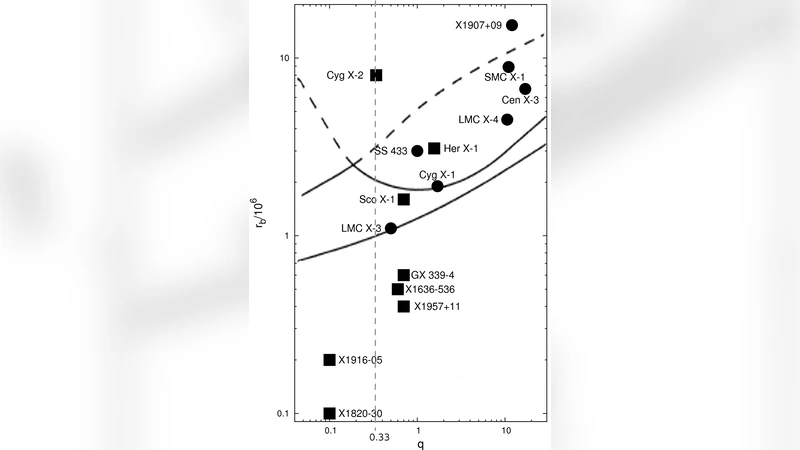
The sample comprises 25 XRBs previously reported to exhibit Pₛᵤₚ < 1 yr (9 HMXBs, 16 LMXBs). For each source the orbital period (Pₒᵣb) and mass ratio (q = M₂/Mₓ) are taken from the literature and plotted on the radiation‑driven warping stability diagram of Ogilvie & Dubus (2001, OD01). This diagram predicts three regimes: (i) stable warps (solid curves), (ii) intermediate instability (between solid and dashed curves), and (iii) unstable warps (dashed curves). The DPS results are then compared with these theoretical zones.
Three distinct behavioural classes emerge:
-
Stable, persistent superorbital modulation – Exemplified by Her X‑1 (≈35 d) and LMC X‑4 (≈30 d). Their DPS shows a narrow, high‑power peak that remains at a constant frequency throughout the 15‑year span. These systems lie in the OD01 stable‑warp region, consistent with a radiation‑driven, steadily precessing warped disc.
-
Variable, evolving superorbital modulation – Includes SMC X‑1 (50–70 d), Cyg X‑2 (50–80 d), GX 339‑4 (190–250 d) and several others. Their DPS displays drifting frequencies, multiple simultaneous peaks, or intervals where the peak weakens or disappears. These sources occupy the intermediate‑instability zone of OD01, suggesting that warps are periodically disrupted, perhaps by tidal torques (q < 0.33) or changes in mass‑transfer rate.
-
Chaotic or intermittent modulation – Seen in X 1636‑536, X 1820‑303 and a few more. The DPS either fails to detect a significant peak or shows only sporadic, low‑power features. Such behaviour may arise when the disc alternates between a flat and a warped configuration, or when large fluctuations in Ṁ suppress the superorbital signal.
Statistically, about 40 % of the sample are stable, 45 % variable, and 15 % chaotic. HMXBs are more likely to be stable than LMXBs, possibly because the stronger X‑ray illumination from a massive donor helps maintain a persistent warp.
Beyond the OD01 radiation‑warping framework, the authors discuss alternative mechanisms that could produce or modify superorbital periods: (i) tidal disc precession for low‑q systems, (ii) magnetic warping (Pfeiffer & Lai 2004) which can generate retrograde precession as observed in Her X‑1, (iii) wind‑driven tilting (Schandl & Meyer 1994; Montgomery & Martin 2010), (iv) state‑dependent mass‑transfer cycles that modulate Ṁ on viscous timescales, (v) precessing relativistic jets (SS 433), and (vi) third‑body perturbations (e.g., X 1820‑303 in a globular cluster). The DPS analysis provides a diagnostic to distinguish among these scenarios by revealing whether the period is steady, drifts smoothly, or appears/disappears abruptly.
Methodologically, the paper demonstrates that DPS, despite its higher computational cost, is essential for characterising quasi‑periodic, non‑stationary signals in long‑baseline X‑ray monitoring. Limitations include reduced sensitivity to very short (<5 d) or very long (>300 d) periods due to the chosen window length, and the ASM’s modest count‑rate sensitivity, which can bury low‑amplitude modulations in noise.
In conclusion, the authors provide the most comprehensive, systematic DPS survey of superorbital variability to date, confirming the relevance of radiation‑driven warping theory while also highlighting the need for additional physics (tidal, magnetic, wind, third‑body) to explain the full diversity of behaviours. Future work with higher‑sensitivity, higher‑cadence instruments (e.g., NICER, eROSITA) and simultaneous multi‑wavelength monitoring will allow tighter constraints on disc geometry, precession rates, and the interplay of the various mechanisms governing long‑term X‑ray binary variability.
Comments & Academic Discussion
Loading comments...
Leave a Comment