Unifying the Zoo of Jet-Driven Stellar Explosions
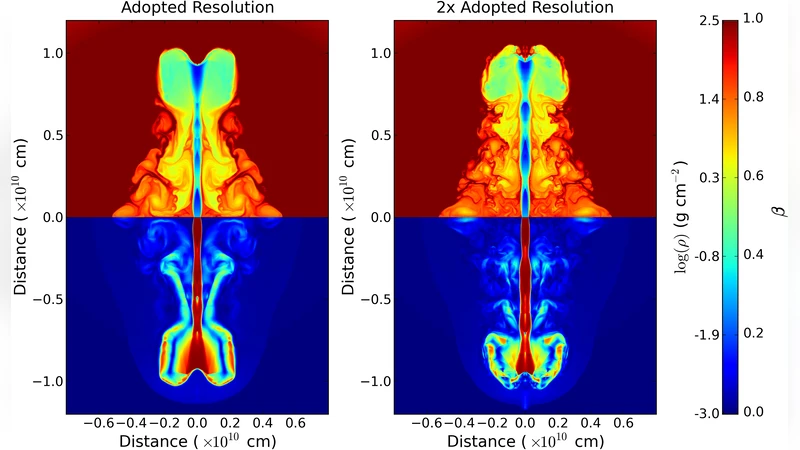
We present a set of numerical simulations of stellar explosions induced by relativistic jets emanating from a central engine sitting at the center of compact, dying stars. We explore a wide range of durations of the central engine activity, two candidate stellar progenitors, and two possible values of the total energy release. We find that even if the jets are narrowly collimated, their interaction with the star unbinds the stellar material, producing a stellar explosion. We also find that the outcome of the explosion can be very different depending on the duration of the engine activity. Only the longest-lasting engines result in successful gamma-ray bursts. Engines that power jets only for a short time result in relativistic supernova explosions, akin to observed engine-driven SNe such as SN2009bb. Engines with intermediate durations produce weak gamma-ray bursts, with properties similar to nearby bursts such as GRB 980425. Finally, we find that the engines with the shortest durations, if they exist in nature, produce stellar explosions that lack sizable amounts of relativistic ejecta and are therefore dynamically indistinguishable from ordinary core-collapse supernovae.
💡 Research Summary
This paper investigates how the duration of a central engine’s activity determines the outcome of jet‑driven stellar explosions. Using the adaptive‑mesh FLASH code, the authors simulate relativistic jets launched from the core of two Wolf‑Rayet progenitors (the 16 M⊙ “16TI” model and the 12 M⊙ “12OM” model). For each progenitor they fix the total injected energy at either 3 × 10⁵¹ erg or 10⁵² erg, and vary the engine activity time (t_eng) from a few seconds up to ~15 s. The jet luminosity is adjusted inversely with t_eng so that the total energy budget remains constant, while the jet’s initial opening angle is 10°, its initial Lorentz factor Γ₀ = 5, and its asymptotic Γ∞ ≈ 400. Magnetic fields, nuclear burning, and gravity are omitted to keep the calculations tractable; the resolution reaches 4 × 10⁶ cm, sufficient to resolve the jet cross‑section.
All simulations produce an explosion of the star, but the fraction of mass that becomes unbound and the amount of relativistic ejecta depend strongly on t_eng. The jet bores a narrow channel through the star, inflating a hot, high‑pressure cocoon that drives a conical shock into the surrounding stellar material. Because the cocoon expands faster along the poles than the equator, the breakout is highly anisotropic: polar breakout occurs roughly three times earlier than equatorial breakout in the intermediate‑duration runs.
A key physical insight is that the jet‑head propagation speed β_h does not scale linearly with the jet power L. Instead, the authors derive (and confirm with simulations) a sub‑linear scaling β_h ∝ L^{3/7}. This arises from a feedback loop: a more luminous jet inflates a higher‑pressure cocoon, which widens the jet head, making it harder for the head to advance; simultaneously, the increased cocoon pressure squeezes the jet, partially compensating the slowdown. An analytic model based on pressure balance (Eq. 1) and cocoon dynamics yields a closed‑form expression for β_h (Eq. 6), which reproduces the trend but overestimates the speed by a factor of ≈ 4 due to simplifications (e.g., assuming non‑dissipative acceleration).
Depending on the relation between t_eng and the breakout time t_break (≈ 10 s for the chosen parameters), three distinct regimes emerge:
-
Long‑duration engines (t_eng ≫ t_break): The jet remains powered while it exits the star, producing a clean, highly relativistic outflow that can generate a classical long‑duration gamma‑ray burst (GRB). The cocoon contributes modestly to the supernova kinetic energy.
-
Intermediate‑duration engines (t_eng ≈ t_break): The engine shuts off just as the jet head is about to emerge. The jet tail catches up with the head after breakout, allowing a modest amount of relativistic material to escape. This yields a weak GRB (e.g., GRB 980425) and a bright radio transient, consistent with observations of low‑luminosity GRBs.
-
Short‑duration engines (t_eng < t_break): The engine stops well before breakout. The jet head stalls, and the tail merges with the head inside the star, dissipating most of the jet’s bulk kinetic energy into the cocoon. The explosion is then driven primarily by the cocoon, producing a relativistic supernova (e.g., SN 2009bb) with fast ejecta (β > 0.7) but no accompanying GRB.
If t_eng is extremely short, the cocoon alone unbinds the star, resulting in an explosion indistinguishable from a normal core‑collapse supernova, lacking any relativistic ejecta.
The authors quantify the relativistic ejecta by selecting material with β > 0.7 and computing its energy-weighted average velocity. For the longest‑duration runs the relativistic ejecta carry ≈ 10⁵⁰ erg and reach Γ ≈ 10–20, whereas for the shortest runs the relativistic component is negligible. These values are compared to observed Type Ibc supernovae and engine‑driven events via radio measurements, showing good agreement with the proposed classification scheme.
Limitations of the study include the neglect of magnetic fields (which could affect jet collimation and stability), the omission of self‑gravity and nuclear burning (which may alter the exact unbound mass fraction), and the use of 2‑D axisymmetric geometry (precluding fully three‑dimensional instabilities such as Kelvin‑Helmholtz or Rayleigh‑Taylor modes). Despite these simplifications, the systematic exploration of engine duration provides a robust framework linking a single central engine model to the diverse phenomenology of GRBs, low‑luminosity GRBs, relativistic supernovae, and ordinary core‑collapse supernovae.
In summary, the paper demonstrates that the duration of central‑engine activity is the primary parameter governing whether a jet‑driven stellar explosion appears as a classic GRB, a weak GRB, a relativistic supernova, or a normal supernova. This unified picture offers a predictive tool for interpreting future observations of high‑energy transients and their associated supernovae.
Comments & Academic Discussion
Loading comments...
Leave a Comment