Spectrally and Spatially Configurable Superlenses for Optoplasmonic Nanocircuits
Energy transfer between photons and molecules and between neighboring molecules is ubiquitous in living nature, most prominently in photosynthesis. While energy transfer is efficiently utilized by living systems, its adoption to connect individual components in man-made plasmonic nanocircuits has been challenged by low transfer efficiencies which motivate the development of entirely new concepts for energy transfer. We introduce herein optoplasmonic superlenses that combine the capability of optical microcavities to insulate molecule-photon systems from decohering environmental effects with the superior light nanoconcentration properties of nanoantennas. The proposed structures provide significant enhancement of the emitter radiative rate and efficient long-range transfer of emitted photons followed by subsequent re-focusing into nanoscale volumes accessible to near- and far-field detection. Optoplasmonic superlenses are versatile building blocks for optoplasmonic nanocircuits and can be used to construct “dark” single molecule sensors, resonant amplifiers, nanoconcentrators, frequency multiplexers, demultiplexers, energy converters and dynamical switches.
💡 Research Summary
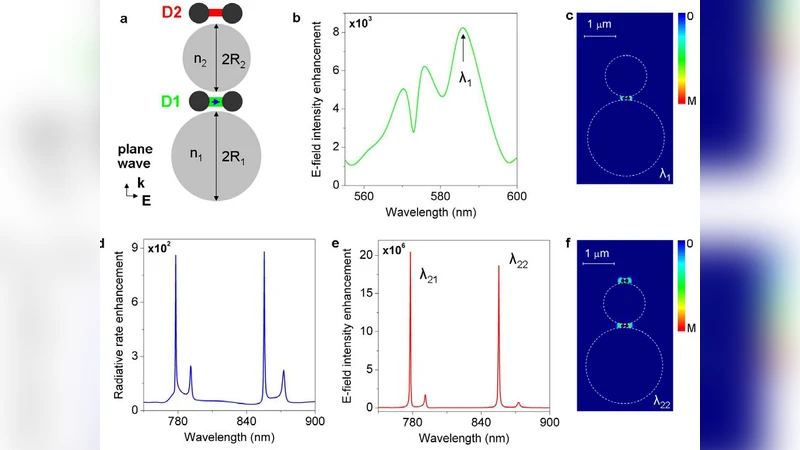
The paper introduces a novel class of devices termed “optoplasmonic superlenses,” which integrate high‑Q optical microcavities (OMs) with metallic nano‑antenna dimers to overcome the longstanding limitations of plasmonic nanocircuits. Conventional plasmonic components suffer from strong non‑radiative losses and limited photon propagation distances, making efficient long‑range energy transfer between quantum emitters difficult. By coupling a donor dipole (atom, molecule, or quantum dot) to a nano‑antenna that is itself linked via a sub‑10‑nm gap to a whispering‑gallery‑mode (WGM) microcavity, the authors achieve two synergistic effects: (1) the cavity traps photons for hundreds of microns, dramatically increasing the local density of optical states (LDOS) and the radiative decay rate (up to two orders of magnitude), and (2) the nano‑antenna concentrates the trapped field into a nanoscale hotspot, enhancing the electric‑field intensity by 4–5 orders of magnitude relative to free‑space emission.
Using generalized Mie theory (GMT) the authors compute the full electromagnetic response of the multi‑particle system, extracting radiative (γ_r) and non‑radiative (γ_nr) decay rates via surface‑integrated Poynting flux. The presence of the cavity reduces γ_nr by four orders of magnitude while boosting γ_r, yielding external quantum efficiencies approaching unity. The “acceptor” antenna placed on the opposite side of the cavity captures the majority of the re‑emitted photons, converting them back into a tightly confined plasmonic mode that can be detected either in the far field or via on‑chip electrical transducers (e.g., germanium wires, GaAs photodiodes, superconducting nanowire detectors).
Beyond a single donor‑acceptor pair, the authors demonstrate how multiple OMs with spectrally distinct WGMs can be cascaded to realize wavelength‑multiplexed routing. In a representative circuit, two microcavities (M1 and M2) support non‑overlapping resonances; M1 focuses incident light into nano‑antenna D1, generating a hot spot that excites nearby molecules or quantum dots. Emission from these sources couples into the WGMs of M2, which then refocuses the light into a second antenna D2, producing a second, spectrally shifted hotspot. By selecting cavity geometries that suppress unwanted higher‑order modes, the system functions as a compact wavelength demultiplexer, delivering different colors to spatially separated nanoscale detectors.
The paper also discusses practical fabrication routes: two‑step electron‑beam/3‑beam lithography, soft‑lithography, template‑assisted self‑assembly, DNA‑directed nanofabrication, and optical tweezers. While surface roughness and cavity shape imperfections can cause mode splitting and multimode coupling—especially for larger cavities—careful engineering of resonator geometry (e.g., microrings, microdisks) can mitigate these effects.
In summary, optoplasmonic superlenses merge the long photon‑dwelling capability of high‑Q photonic resonators with the extreme field confinement of plasmonic nano‑antennas. This hybrid platform enables (i) giant radiative‑rate enhancements, (ii) efficient long‑range photon transfer, (iii) on‑chip wavelength‑selective multiplexing/demultiplexing, (iv) “dark” single‑molecule sensing with amplified Raman signals, and (v) electrically addressable, dynamically switchable nanophotonic circuits. The authors argue that such devices could become foundational building blocks for next‑generation biosensing, quantum information processing, and integrated nanophotonic/electronic systems.
Comments & Academic Discussion
Loading comments...
Leave a Comment