Collisions of inhomogeneous pre-planetesimals
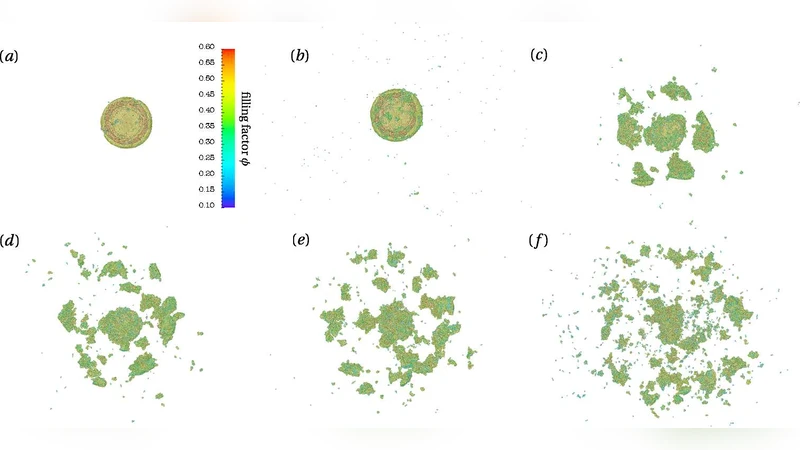
In the framework of the coagulation scenario, kilometre-sized planetesimals form by subsequent collisions of pre-planetesimals of sizes from centimetre to hundreds of metres. Pre-planetesimals are fluffy, porous dust aggregates, which are inhomogeneous owing to their collisional history. Planetesimal growth can be prevented by catastrophic disruption in pre-planetesimal collisions above the destruction velocity threshold. We develop an inhomogeneity model based on the density distribution of dust aggregates, which is assumed to be a Gaussian distribution with a well-defined standard deviation. As a second input parameter, we consider the typical size of an inhomogeneous clump. These input parameters are easily accessible by laboratory experiments. For the simulation of the dust aggregates, we utilise a smoothed particle hydrodynamics (SPH) code with extensions for modelling porous solid bodies. The porosity model was previously calibrated for the simulation of silica dust, which commonly serves as an analogue for pre-planetesimal material. The inhomogeneity is imposed as an initial condition on the SPH particle distribution. We carry out collisions of centimetre-sized dust aggregates of intermediate porosity. We vary the standard deviation of the inhomogeneous distribution at fixed typical clump size. The collision outcome is categorised according to the four-population model. We show that inhomogeneous pre-planetesimals are more prone to destruction than homogeneous aggregates. Even slight inhomogeneities can lower the threshold for catastrophic disruption. For a fixed collision velocity, the sizes of the fragments decrease with increasing inhomogeneity. Pre-planetesimals with an active collisional history tend to be weaker. This is a possible obstacle to collisional growth and needs to be taken into account in future studies of the coagulation scenario.
💡 Research Summary
In the context of the core‑accretion model, kilometre‑scale planetesimals are thought to arise from a cascade of collisions among porous dust aggregates—so‑called pre‑planetesimals—ranging from centimetres to hundreds of metres. While laboratory experiments have extensively characterised the collisional outcomes of homogeneous aggregates, real pre‑planetesimals are expected to develop internal density and porosity variations as a result of their collisional history. This paper introduces a novel approach to explicitly model such inhomogeneity and investigates its impact on the threshold for catastrophic disruption.
The authors describe an “inhomogeneity model” in which the local density of a dust aggregate follows a Gaussian distribution characterised by a standard deviation σ. A second parameter, the typical size of an inhomogeneous clump (l_c), defines the spatial scale over which the density fluctuations are correlated. Both σ and l_c can be measured in the laboratory, for example by X‑ray tomography of silica dust samples, making the model directly comparable to experimental data.
Numerical simulations are performed with a smoothed particle hydrodynamics (SPH) code that has been extended to treat porous solid bodies. The underlying porosity model, calibrated for SiO₂ dust, links the filling factor φ (=ρ/ρ_s) to elastic moduli (bulk K and shear μ) and to strength parameters (compressive Σ, tensile T, and shear Y). Because these material properties depend on φ, imposing a Gaussian density field automatically creates a spatially varying strength field, thereby mimicking damage without invoking an explicit fracture‑mechanics model such as Grady‑Kipp. The SPH particles are initialized with the prescribed density fluctuations, and the code follows the full elastic‑plastic response, compaction, bouncing, and fragmentation of the aggregates.
The collision suite consists of head‑on impacts between centimetre‑sized silica aggregates of intermediate porosity (φ≈0.35). The impact velocity is held within the experimentally relevant range (≈1–10 m s⁻¹) where fragmentation begins to dominate. For each run σ is varied from 0.01 to 0.10 while l_c is kept fixed (≈0.5 mm). The outcomes are classified using the four‑population model: (i) the most massive fragment, (ii) the second most massive fragment, (iii) a power‑law population of intermediate fragments, and (iv) a sub‑resolution population consisting of single SPH particles.
Key findings are:
-
Lowered catastrophic‑disruption threshold – As σ increases, the velocity at which the largest fragment’s mass drops below 50 % of the total mass shifts to lower values. Even modest inhomogeneity (σ≈0.05) reduces the threshold by roughly 30 % compared with a perfectly homogeneous aggregate.
-
Enhanced fragmentation – The mass fraction contained in the largest fragment declines sharply with σ (from ~70 % at σ=0.01 to <30 % at σ=0.10). Simultaneously, the power‑law fragment population becomes steeper, indicating a larger number of small pieces.
-
Size‑scale dependence – With l_c held constant, the effect is driven solely by the amplitude of the density fluctuations. The results suggest that the mere presence of small‑scale heterogeneities, even if their spatial extent is much smaller than the aggregate size, is sufficient to weaken the overall structure.
-
Implications for growth models – In a realistic protoplanetary disc, pre‑planetesimals experience many low‑velocity collisions before reaching the fragmentation regime. Each encounter can increase σ, gradually eroding the aggregate’s mechanical strength. Consequently, aggregates that appear robust early on may become increasingly fragile, making the “growth barrier” caused by catastrophic disruption more severe than previously estimated from homogeneous‑aggregate models.
The authors argue that incorporating σ and l_c into coagulation simulations provides a physically motivated pathway to bridge laboratory measurements and large‑scale planet formation models. Future work should explore a broader range of materials (e.g., icy aggregates), impact angles, and the temporal evolution of σ (σ(t)) to assess how inhomogeneity evolves over the lifetime of a dust population. Ultimately, this framework could refine predictions of the size distribution of planetesimals and the efficiency of the early stages of planet formation.
Comments & Academic Discussion
Loading comments...
Leave a Comment