Discovery of a Be/X-ray pulsar binary and associated supernova remnant in the Wing of the SMC
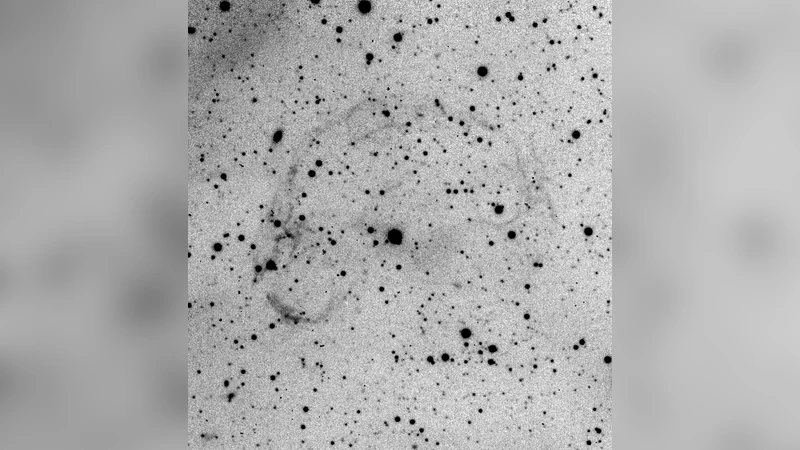
We report on a new Be/X-ray pulsar binary located in the Wing of the Small Magellanic Cloud (SMC). The strong pulsed X-ray source was discovered with the Chandra and XMM-Newton X-ray observatories. The X-ray pulse period of 1062 s is consistently determined from both Chandra and XMM-Newton observations, revealing one of the slowest rotating X-ray pulsars known in the SMC. The optical counterpart of the X-ray source is the emission-line star 2dFS 3831. Its B0-0.5(III)e+ spectral type is determined from VLT-FLAMES and 2dF optical spectroscopy, establishing the system as a Be/X-ray binary (Be-XRB). The hard X-ray spectrum is well fitted by a power-law with additional thermal and blackbody components, the latter reminiscent of persistent Be-XRBs. This system is the first evidence of a recent supernova in the low density surroundings of NGC 602. We detect a shell nebula around 2dFS 3831 in H-alpha and [O III] images and conclude that it is most likely a supernova remnant. If it is linked to the supernova explosion that created this new X-ray pulsar, its kinematic age of (2-4)x10^4 yr provides a constraint on the age of the pulsar.
💡 Research Summary
The authors report the discovery of a new Be/X‑ray binary pulsar, designated SXP 1062, located in the Wing of the Small Magellanic Cloud (SMC) near the star‑forming region NGC 602. The source was identified in deep Chandra ACIS‑I and XMM‑Newton EPIC‑pn observations (total exposures of 290 ks and 162 ks, respectively). Timing analysis of the combined data sets reveals a coherent X‑ray pulse period of 1062 seconds, making it one of only three known SMC pulsars with spin periods longer than 1000 s.
Spectral fitting was performed on the background‑subtracted Chandra and XMM‑Newton spectra. A simple absorbed power‑law (photon index Γ≈0.75) provides a reasonable description but leaves systematic residuals below 1 keV and at high energies. Adding a hot blackbody component (kT≈1.5 keV) and a soft thermal plasma component (kT≈0.6 keV) yields the best fit (model PBT). The blackbody normalization corresponds to an emitting radius of roughly 0.4 km, consistent with a hot spot on the neutron‑star polar cap. The total unabsorbed flux in the 0.2–12 keV band is ≈1.7 × 10⁻¹² erg cm⁻² s⁻¹, which translates to an intrinsic luminosity of ≈6 × 10³⁵ erg s⁻¹ for a distance modulus of 18.7 (≈62 kpc). The fitted column density (N_H≈1.3 × 10²¹ cm⁻²) implies modest visual extinction (A_V≈0.6 mag), consistent with optical colour excess estimates.
The optical counterpart is the emission‑line star 2dFS 3831. VLT‑FLAMES and 2dF spectroscopy classify it as a B0‑0.5 IIIe + star, showing weak He II λ4542 and λ4686 absorption, Fe II emission (λ4179, λ4233), and strong Balmer emission (Hα EW≈‑23 Å). The radial velocity of ≈167 km s⁻¹ matches the systemic velocity of the SMC, indicating no large kick velocity from a supernova explosion. Near‑infrared 2MASS colours reveal an infrared excess, confirming the presence of a circumstellar disc.
Imaging in Hα and
Comments & Academic Discussion
Loading comments...
Leave a Comment