On The Origin Of High Energy Correlations in Gamma-ray Bursts
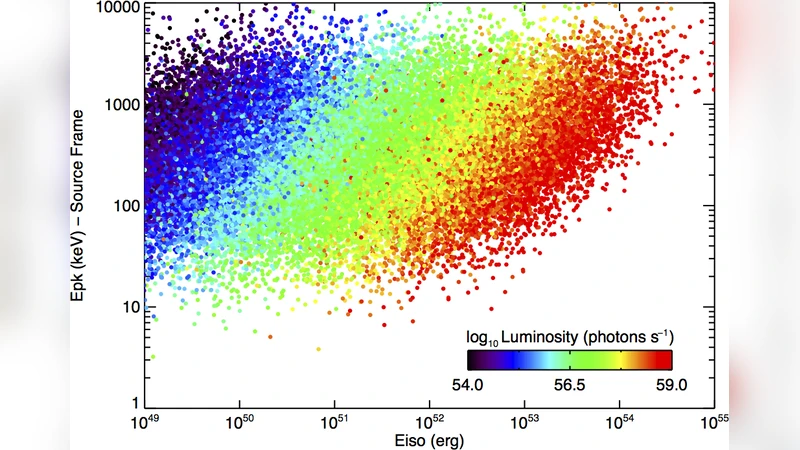
I investigate the origin of the observed correlation between a GRB’s nuFnu spectral peak Epk and its isotropic equivalent energy Eiso through the use of a population synthesis code to model the prompt gamma-ray emission from GRBs. By using prescriptions for the distribution of prompt spectral parameters as well as the population’s luminosity function and co-moving rate density, I generate a simulated population of GRBs and examine how bursts of varying spectral properties and redshift would appear to a gamma-ray detector here on Earth. I find that a strong observed correlation can be produced between the source frame Epk and Eiso for the detected population despite the existence of only a weak and broad correlation in the original simulated population. The energy dependance of a gamma-ray detector’s flux-limited detection threshold acts to produce a correlation between the source frame Epk and Eiso for low luminosity GRBs, producing the left boundary of the observed correlation. Conversely, very luminous GRBs are found at higher redshifts than their low luminosity counterparts due to the standard Malquest bias, causing bursts in the low Epk, high Eiso regime to go undetected because their Epk values would be redshifted to energies at which most gamma-ray detectors become less sensitive. I argue that it is this previously unexamined effect which produces the right boundary of the observed correlation. Therefore, the origin of the observed correlation is a complex combination of the instrument’s detection threshold, the intrinsic cutoff in the GRB luminosity function, and the broad range of redshifts over which GRBs are detected. These simulations serve to demonstrate how selection effects caused by a combination of instrumental sensitivity and the cosmological nature of an astrophysical population can act to produce an artificially strong correlation between observed properties.
💡 Research Summary
The paper investigates why the observed correlation between the νFν spectral peak energy (Epk) and the isotropic equivalent energy (Eiso) of gamma‑ray bursts (GRBs)—the so‑called Amati relation—appears much tighter than the underlying physical relationship. Using a population‑synthesis framework, the author builds a realistic model of GRB prompt emission that incorporates two well‑established empirical relations: the hardness‑intensity correlation (HIC) and the hardness‑fluence correlation (HFC). These relations, together with a Band‑function photon spectrum, are used to generate fast‑rise exponential‑decay (FRED) pulses whose spectral peak and bolometric luminosity evolve in time according to relativistic curvature effects of an expanding spherical shell.
The synthetic bursts are drawn from a luminosity function φ(L) and a co‑moving rate density ρ̇(z) derived from Butler et al. (2010). The luminosity function sharply declines above a cutoff Lcut≈10^53 erg s⁻¹ (with power‑law indices aL=–0.22 below and bL=–2.89 above the cutoff). The redshift distribution follows the cosmic star‑formation rate up to z≈2–3 and then flattens, parameterised by piece‑wise power‑law indices (g0=3.4, g1=–0.3, g2=–8) with a break at z1=4.5. Forty thousand GRBs are simulated, each assigned a redshift, luminosity, and initial Epk drawn from a log‑normal distribution centred near 200 keV · (1+z̄).
To emulate detection, the photon cubes are folded through a BATSE detector response matrix and added to an energy‑dependent background spectrum. A simple trigger criterion—5σ excess over background on one of three timescales (64 ms, 256 ms, 1024 ms)—determines whether a burst would be recorded. For detected events, observer‑frame quantities (Epk,obs, peak flux, fluence, T90) are measured, K‑corrected to the source frame, and used to compute Epk and Eiso.
The key result is that, although the intrinsic simulated population exhibits only a weak, broad Epk–Eiso relationship, the subset that satisfies the detector’s flux‑limited, energy‑dependent trigger reproduces a tight Amati‑like correlation. Two selection effects are responsible. First, low‑luminosity bursts are preferentially detected only when their Epk lies within the detector’s most sensitive energy band (≈20–200 keV). This creates a left‑hand boundary in the Epk–Eiso plane, eliminating low‑luminosity, low‑Epk events that would fall below the flux threshold. Second, high‑luminosity bursts are rare and therefore observable mainly at high redshift. At large z, the cosmological redshift shifts Epk,obs to lower energies where detector sensitivity declines sharply; consequently, high‑Eiso bursts with intrinsically low Epk are missed, forming the right‑hand boundary. The combination of these effects yields an apparently tight correlation for the detected sample, even though the underlying physics permits a much broader distribution.
The author concludes that the observed Amati relation is largely an artifact of instrumental selection—specifically, the energy‑dependent detection threshold, the intrinsic cutoff in the GRB luminosity function, and the wide redshift range over which GRBs are observed. This finding casts doubt on the use of GRBs as standard candles without careful correction for these biases and underscores the importance of designing future gamma‑ray instruments with broader, more uniform energy response to mitigate such selection effects.
Comments & Academic Discussion
Loading comments...
Leave a Comment