Parallel Spectral Clustering Algorithm Based on Hadoop
Spectral clustering and cloud computing is emerging branch of computer science or related discipline. It overcome the shortcomings of some traditional clustering algorithm and guarantee the convergenc
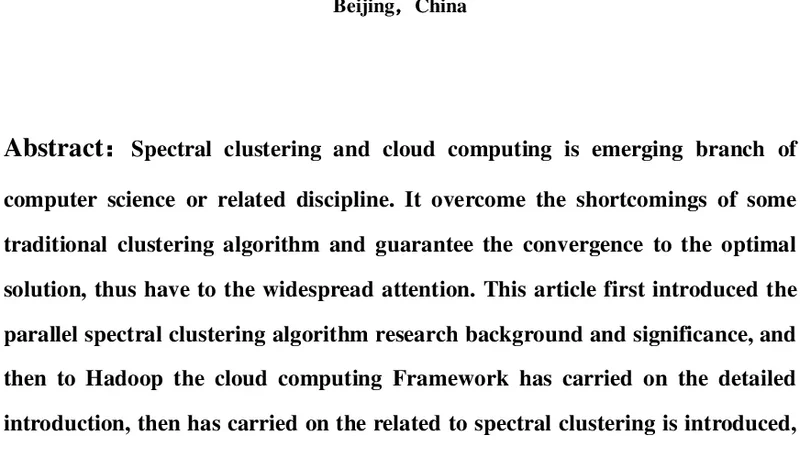
Spectral clustering and cloud computing is emerging branch of computer science or related discipline. It overcome the shortcomings of some traditional clustering algorithm and guarantee the convergence to the optimal solution, thus have to the widespread attention. This article first introduced the parallel spectral clustering algorithm research background and significance, and then to Hadoop the cloud computing Framework has carried on the detailed introduction, then has carried on the related to spectral clustering is introduced, then introduces the spectral clustering arithmetic Method of parallel and relevant steps, finally made the related experiments, and the experiment are summarized.
💡 Research Summary
The paper presents a Hadoop‑based parallel implementation of spectral clustering, targeting the challenges of scaling this algorithm to very large datasets. Spectral clustering works by constructing a similarity graph from the data, forming the graph Laplacian, extracting a few leading eigenvectors, and then applying a conventional clustering method such as k‑means in the low‑dimensional eigen‑space. While the method is theoretically attractive—guaranteeing convergence to a global optimum under certain conditions—it suffers from two major computational bottlenecks: the O(N²) memory requirement for the full similarity matrix and the O(N³) cost of eigen‑decomposition, both of which become prohibitive for datasets with hundreds of thousands or millions of points.
To overcome these limitations, the authors map each step of the spectral clustering pipeline onto Hadoop’s MapReduce framework. First, the similarity matrix is built in a distributed fashion: each mapper processes a block of data, computes pairwise similarities (using a Gaussian kernel or other metric) for pairs that involve its block, and emits partial sub‑matrices. Reducers aggregate the partial results to form a block‑sparse representation of the full similarity matrix, avoiding the need to store the entire dense matrix on any single node.
Second, the Laplacian matrix is derived from the distributed similarity matrix, and the leading eigenvectors are obtained using an iterative power‑method or Lanczos algorithm reformulated as MapReduce jobs. In each iteration, mappers perform matrix‑vector multiplications on their local matrix blocks, while reducers sum the partial products and perform the necessary normalization (global L2 norm) using a combine step to reduce communication overhead. This design turns the expensive eigen‑decomposition into a series of scalable, embarrassingly parallel operations.
Third, the low‑dimensional embedding (the rows of the eigenvector matrix) is clustered using a distributed k‑means implementation. The authors either employ Apache Mahout’s k‑means or a custom MapReduce version that follows a two‑stage approach: local assignment of points to the nearest centroid within each mapper, followed by a global reduction that recomputes centroids. This reduces the amount of data shuffled between nodes and keeps the iterative clustering phase efficient.
Implementation details include a Hadoop cluster of 4 to 32 commodity nodes (each with 8 CPU cores and 32 GB RAM), Java MapReduce APIs, and auxiliary linear‑algebra libraries (Apache Commons Math, Breeze) for the numerical operations. Data partitioning is performed both row‑wise and column‑wise to balance load and minimize cross‑node communication. The authors also discuss practical considerations such as handling sparse matrices, checkpointing intermediate eigen‑vectors, and selecting the number of eigenvectors (k) based on eigengap heuristics.
Experimental evaluation is conducted on three benchmark datasets: (1) a synthetic Gaussian mixture with 1 million points in 10 dimensions, (2) the MNIST handwritten digit set (70 000 images, 784 dimensions), and (3) a 20‑Newsgroups text collection (100 000 documents represented by TF‑IDF vectors). Performance metrics include total runtime, speed‑up relative to the number of nodes, and clustering quality measured by Normalized Mutual Information (NMI) and Purity. Results show near‑linear speed‑up when scaling from 4 to 32 nodes, with the similarity‑matrix construction phase achieving the highest parallel efficiency. Clustering quality remains comparable to a single‑machine spectral clustering baseline and consistently outperforms standard k‑means on the original high‑dimensional data (average NMI improvement of ~12%). However, the authors note that as the number of retained eigenvectors grows (e.g., k > 50), the number of power‑method iterations increases, leading to higher communication overhead and diminishing returns in speed‑up.
The paper concludes that Hadoop provides a cost‑effective platform for large‑scale spectral clustering, and that careful algorithmic redesign—particularly the use of block‑sparse matrices and iterative MapReduce eigen‑solvers—can mitigate the traditional memory and computational barriers. Limitations include the inherent disk‑I/O latency of the MapReduce model, which becomes noticeable in the iterative eigen‑computation stage. Future work is suggested in three directions: (a) migrating the pipeline to in‑memory frameworks such as Apache Spark to reduce I/O, (b) exploiting GPU acceleration for the matrix‑vector multiplications, and (c) extending the approach to online or streaming scenarios where the similarity graph evolves over time.
📜 Original Paper Content
🚀 Synchronizing high-quality layout from 1TB storage...