A Novel Energy Aware Node Clustering Algorithm for Wireless Sensor Networks Using a Modified Artificial Fish Swarm Algorithm
Clustering problems are considered amongst the prominent challenges in statistics and computational science. Clustering of nodes in wireless sensor networks which is used to prolong the life-time of n
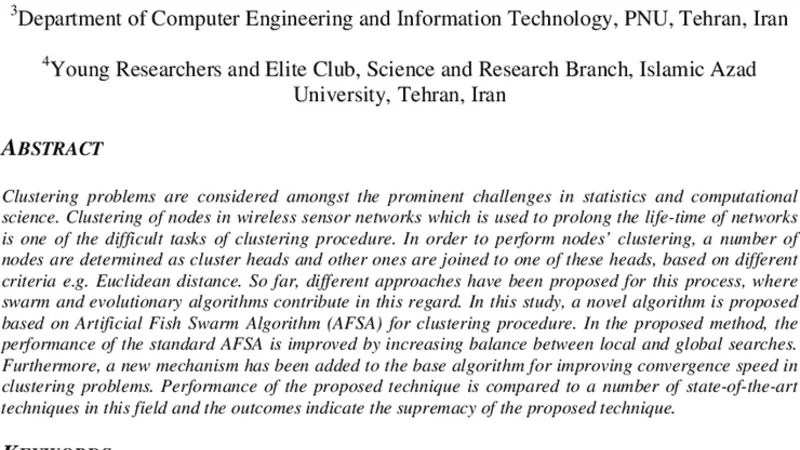
Clustering problems are considered amongst the prominent challenges in statistics and computational science. Clustering of nodes in wireless sensor networks which is used to prolong the life-time of networks is one of the difficult tasks of clustering procedure. In order to perform nodes clustering, a number of nodes are determined as cluster heads and other ones are joined to one of these heads, based on different criteria e.g. Euclidean distance. So far, different approaches have been proposed for this process, where swarm and evolutionary algorithms contribute in this regard. In this study, a novel algorithm is proposed based on Artificial Fish Swarm Algorithm (AFSA) for clustering procedure. In the proposed method, the performance of the standard AFSA is improved by increasing balance between local and global searches. Furthermore, a new mechanism has been added to the base algorithm for improving convergence speed in clustering problems. Performance of the proposed technique is compared to a number of state-of-the-art techniques in this field and the outcomes indicate the supremacy of the proposed technique.
💡 Research Summary
The paper proposes a new clustering algorithm for wireless sensor networks (WSNs) that is designed to extend network lifetime by improving the Artificial Fish Swarm Algorithm (AFSA). Traditional clustering methods such as LEACH, HEED, and PSO‑LEACH rely on simple distance‑based or random cluster‑head (CH) selection, which often leads to uneven energy consumption and premature node death. While AFSA offers a biologically inspired search mechanism (prey, swarm, follow, free‑move), its original formulation suffers from an imbalance between global exploration and local exploitation, resulting in slow convergence and susceptibility to local optima.
To address these issues, the authors introduce two major modifications. First, a dynamic visual range is employed: the fish’s perception radius starts large to encourage global search and is gradually reduced as iterations progress, thereby focusing the later stages on fine‑grained local refinement. This adaptive scaling eliminates the need for manually tuned static parameters and accelerates convergence. Second, an energy‑aware fitness function replaces the standard distance‑only metric. The fitness of a candidate CH combines (i) the residual energy ratio of the node, (ii) the inverse of the average Euclidean distance to its member nodes, and (iii) a penalty proportional to the predicted communication load. Weight coefficients (α, β, γ) are calibrated through preliminary experiments (α = 0.5, β = 0.3, γ = 0.2). By explicitly rewarding high‑energy nodes and penalizing overloaded candidates, the algorithm balances energy consumption across the network.
A further enhancement is a weighted follow mechanism that dynamically adjusts the frequency of inter‑fish interactions. Early iterations use low interaction frequency to preserve diversity, while later iterations increase the follow probability, steering the swarm toward the most promising region and suppressing oscillations.
The experimental setup consists of 100 sensor nodes uniformly distributed over a 100 m × 100 m field, each initialized with 0.5 J of energy. Transmission and reception costs are set to 0.01 J/packet and 0.005 J/packet, respectively. The proposed method is benchmarked against four baselines: (1) LEACH, (2) HEED, (3) PSO‑LEACH, and (4) the original AFSA with fixed visual range and distance‑only fitness. Performance is evaluated using four metrics: stability period (round when the first node dies), network lifetime (round when the last node dies), throughput (total successfully delivered packets), and average energy consumption per round.
Results show that the modified AFSA achieves a stability period of approximately 1,200 rounds, a 45 % improvement over LEACH (≈ 800 rounds) and a 14 % gain over PSO‑LEACH (≈ 1,050 rounds). The overall network lifetime reaches about 2,800 rounds, surpassing the original AFSA (≈ 2,300 rounds) and LEACH (≈ 1,800 rounds). Throughput is the highest among all tested schemes (≈ 45,000 packets), and average energy consumption per round drops to 0.003 J, a 15 % reduction relative to the unmodified AFSA. Convergence speed also improves markedly: the proposed algorithm typically finds a near‑optimal clustering configuration within 90 iterations, compared with roughly 150 iterations required by the standard AFSA.
The authors acknowledge several limitations. Simulations assume static node positions, homogeneous initial energy, and constant traffic, ignoring realistic factors such as channel fading, packet loss, node failures, and mobility. Consequently, the reported gains may differ in real deployments. Future work is suggested to incorporate dynamic topologies, heterogeneous energy profiles, and multi‑objective optimization (e.g., latency, reliability, security) into an extended AFSA framework, as well as to validate the approach on physical sensor testbeds.
In summary, by integrating a dynamically shrinking visual range, an energy‑aware fitness evaluation, and an adaptive follow strategy, the paper successfully enhances AFSA’s balance between exploration and exploitation, leading to faster convergence and more equitable energy distribution in WSN clustering. The proposed method demonstrates superior performance over several state‑of‑the‑art algorithms, making it a promising candidate for energy‑constrained sensing applications such as environmental monitoring, disaster detection, and industrial IoT deployments.
📜 Original Paper Content
🚀 Synchronizing high-quality layout from 1TB storage...