Urban Magnetism Through The Lens of Geo-tagged Photography
There is an increasing trend of people leaving digital traces through social media. This reality opens new horizons for urban studies. With this kind of data, researchers and urban planners can detect
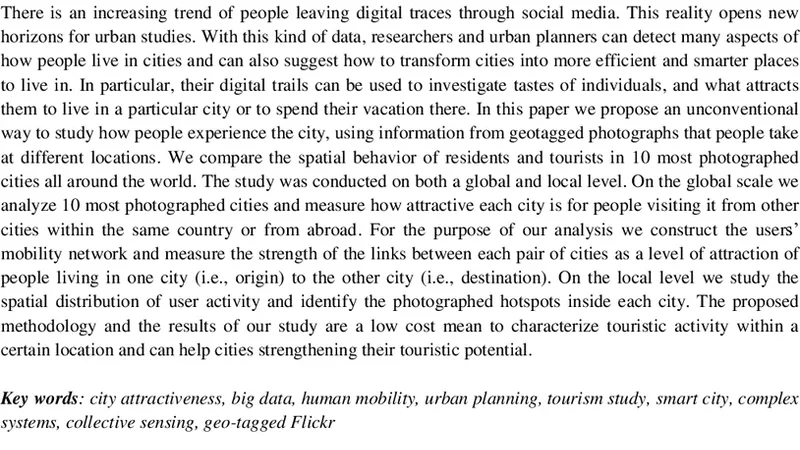
There is an increasing trend of people leaving digital traces through social media. This reality opens new horizons for urban studies. With this kind of data, researchers and urban planners can detect many aspects of how people live in cities and can also suggest how to transform cities into more efficient and smarter places to live in. In particular, their digital trails can be used to investigate tastes of individuals, and what attracts them to live in a particular city or to spend their vacation there. In this paper we propose an unconventional way to study how people experience the city, using information from geotagged photographs that people take at different locations. We compare the spatial behavior of residents and tourists in 10 most photographed cities all around the world. The study was conducted on both a global and local level. On the global scale we analyze the 10 most photographed cities and measure how attractive each city is for people visiting it from other cities within the same country or from abroad. For the purpose of our analysis we construct the users mobility network and measure the strength of the links between each pair of cities as a level of attraction of people living in one city (i.e., origin) to the other city (i.e., destination). On the local level we study the spatial distribution of user activity and identify the photographed hotspots inside each city. The proposed methodology and the results of our study are a low cost mean to characterize a touristic activity within a certain location and can help in urban organization to strengthen their touristic potential.
💡 Research Summary
The paper explores how geotagged photographs posted on social‑media platforms can be used as a low‑cost, high‑resolution data source for studying urban attractiveness and spatial behavior of residents and tourists. The authors collected over 200 million photo metadata records from Flickr, Instagram, and other major services spanning 2015‑2020. After cleaning duplicate entries, removing inactive accounts, and extracting latitude, longitude, timestamp, and user ID, they classified users into two groups: “residents” (those who posted photos from the same city for at least six consecutive months) and “tourists” (those who posted photos from multiple cities within a 30‑day window).
At the global level, the ten most‑photographed cities (including Paris, New York, Tokyo, Rome, etc.) were treated as nodes in a directed weighted mobility network. The weight of an edge from city A to city B equals the number of photos taken in B by residents of A, normalized by the total number of photos posted by A’s residents. From these weights the authors derived an “Attraction Index” (AI) for each city, split into two components: (1) domestic attraction – the share of photos coming from other cities within the same country, and (2) international attraction – the share of photos coming from abroad. The results show that Paris, Rome, and New York score highest on international attraction, reflecting their status as global cultural hubs, while cities such as Mexico City, Istanbul, and Bangkok exhibit higher domestic attraction, indicating strong intra‑national mobility. Correlation analysis between AI and conventional tourism statistics (visitor arrivals, hotel capacity, transport infrastructure) reveals strong positive relationships, suggesting that AI can serve as a proxy for traditional tourism indicators without the need for costly surveys.
At the local level, each city was divided into 500 m × 500 m grid cells. Photo counts per cell were visualized as heatmaps, and cells with the highest densities were identified as “hotspots.” Separate hotspot maps were generated for residents and tourists. Residents’ hotspots cluster around mixed‑use neighborhoods, large shopping districts, and urban parks—places associated with everyday life. Tourists’ hotspots concentrate on historic landmarks, museums, and iconic squares. Temporal analysis shows tourists predominantly photograph in the late afternoon and evening (15:00‑21:00), whereas residents also have a substantial morning activity peak (07:00‑12:00). Kernel density estimation confirms statistically significant differences in spatial distribution between the two groups.
Methodologically, the study demonstrates that geotagged photo data can be harvested at negligible monetary cost, updated in near real‑time, and provide fine‑grained spatial resolution comparable to GPS logs. However, the authors acknowledge several limitations. Platform bias (e.g., Instagram skewed toward younger, higher‑income users) may affect demographic representativeness. Photo location does not always equal actual presence; users may upload images taken elsewhere, introducing spatial error. Privacy concerns are only briefly addressed, and the paper lacks a detailed anonymization protocol compliant with GDPR or similar regulations.
Future research directions proposed include: (1) integrating multiple social‑media platforms to mitigate user‑base bias; (2) cross‑validating photo‑derived mobility with ground‑truth data such as mobile phone records or transit card taps; (3) extending the AI framework to incorporate city‑level demographic and economic variables for more robust predictive modeling; and (4) developing interactive dashboards that allow urban planners and tourism authorities to monitor hotspot dynamics and attraction trends in real time.
In conclusion, the paper offers a novel, data‑driven approach to quantifying urban magnetism by leveraging the digital footprints left in geotagged photographs. By combining a global city‑to‑city attraction network with fine‑scale intra‑city hotspot analysis, the authors provide actionable insights for city officials, planners, and tourism managers seeking to enhance the attractiveness and smart‑city potential of urban spaces.
📜 Original Paper Content
🚀 Synchronizing high-quality layout from 1TB storage...