The Dold-Kan Correspondence and Coalgebra Structures
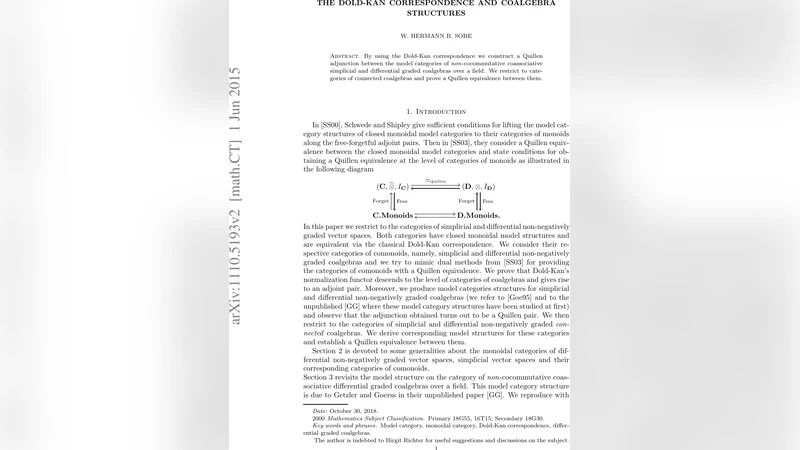
By using the Dold-Kan correspondence we construct a Quillen adjunction between the model categories of non-cocommutative coassociative simplicial and differential graded coalgebras over a field. We restrict to categories of connected coalgebras and prove a Quillen equivalence between them.
💡 Research Summary
The paper investigates the relationship between simplicial coalgebras and differential graded (DG) coalgebras through the classical Dold–Kan correspondence, with the ultimate goal of establishing a Quillen equivalence between the corresponding model categories. The author begins by recalling the work of Schwede and Shipley, who gave sufficient conditions for lifting model structures from closed monoidal model categories to their categories of monoids via free–forgetful adjunctions, and later extended these ideas to obtain Quillen equivalences at the level of monoids. The present work mirrors this strategy for comonoids (coalgebras) rather than monoids.
First, the paper sets up the necessary background. Two closed symmetric monoidal categories are considered: the category DGVect of non‑negatively graded chain complexes over a fixed field (K) (with the usual tensor product) and the category SVect of simplicial vector spaces (with levelwise tensor product). Their respective categories of comonoids are denoted DGcoAlg (DG coalgebras) and ScoAlg (simplicial coalgebras). The Dold–Kan equivalence between DGVect and SVect is recalled, but it is noted that this equivalence does not directly lift to an adjunction between the comonoid categories.
The core of the paper is the construction of a Quillen adjunction between DGcoAlg and ScoAlg. The author defines weak equivalences as morphisms inducing isomorphisms on homology, cofibrations as degreewise injections, and fibrations via the right lifting property with respect to acyclic cofibrations. To verify the model axioms, several technical results are proved:
-
Finite‑dimensional sub‑coalgebras: Lemmas 3.2–3.4 show that any homogeneous element of a DG coalgebra lies in a finite‑dimensional sub‑coalgebra, and that this sub‑coalgebra can be chosen to be closed under the differential. This finiteness property is crucial for constructing limits and colimits.
-
Duality with pro‑algebras: Proposition 3.5 establishes an anti‑equivalence between DGcoAlg and the category ProDGAlg≤0 of pro‑objects consisting of inverse limits of finite‑dimensional non‑positively graded DG algebras. Using this duality, Proposition 3.6 proves that DGcoAlg is both complete and cocomplete.
-
Cofree coalgebra functor: For any chain complex (V), a cofree coalgebra (S_d(V)) is defined (Proposition 3.8). When (V) is finite‑dimensional, (S_d(V) = (\mathcal{T}_d(V^*))’); for arbitrary (V) it is obtained as a filtered colimit of the finite‑dimensional cases. This functor is right adjoint to the forgetful functor (U\colon DGcoAlg\to DGVect) and provides the necessary factorisation of maps into cofibrations followed by acyclic fibrations.
-
Homotopy compatibility: Lemma 3.11 shows that chain homotopic maps between chain complexes induce homotopic maps between their cofree coalgebras, ensuring that the homotopy theory is respected by the adjunction.
Having built the Quillen adjunction ((N, S_d)) (where (N) is the Dold–Kan normalization functor), the author turns to the connected case. A connected coalgebra is one whose degree‑0 part is the ground field (K). Section 5 proves that the subcategory of connected DG coalgebras is also complete, cocomplete, and admits a transferred model structure from DGcoAlg. The author adapts techniques from Smirnov (2011) to obtain functorial (acyclic cofibration)–fibration factorizations in this subcategory.
Finally, the main theorem of the paper states that the restriction of the normalization functor (N) to connected objects, together with its right adjoint (S_d), yields a Quillen equivalence between the model categories of connected simplicial coalgebras and connected DG coalgebras. The proof relies on checking that the derived unit and counit are weak equivalences, which follows from the finiteness lemmas and the fact that connected objects are built from finite‑dimensional pieces.
The paper concludes with an appendix on connected differential graded algebras, indicating that the dual results for algebras mirror those for coalgebras and can be used to construct limits in the coalgebra setting.
In summary, the work accomplishes three major objectives:
-
Model structures: It provides explicit model category structures on both simplicial and differential graded coalgebras, including the verification of all axioms (MC1–MC5).
-
Adjunction via Dold–Kan: It adapts the Dold–Kan correspondence to the coalgebra context by introducing a cofree coalgebra functor that is right adjoint to normalization, thereby forming a Quillen adjunction.
-
Quillen equivalence for connected objects: By restricting to connected coalgebras and employing transfer techniques, it proves that the two model categories are Quillen equivalent, extending the Schwede–Shipley framework from monoids to comonoids.
These results enrich the homotopical algebra of coalgebras, opening avenues for further study of comodules, rational homotopy theory, and applications where coalgebraic structures interact with simplicial or chain‑complex models.
Comments & Academic Discussion
Loading comments...
Leave a Comment