Translation Covers Among Triangular Billiard Surfaces
We identify all translation covers among triangular billiard surfaces. Our main tools are the holonomy field of Kenyon and Smillie and a geometric property of translation surfaces, which we call the fingerprint of a point, that is preserved under bal…
Authors: Jason Schmurr
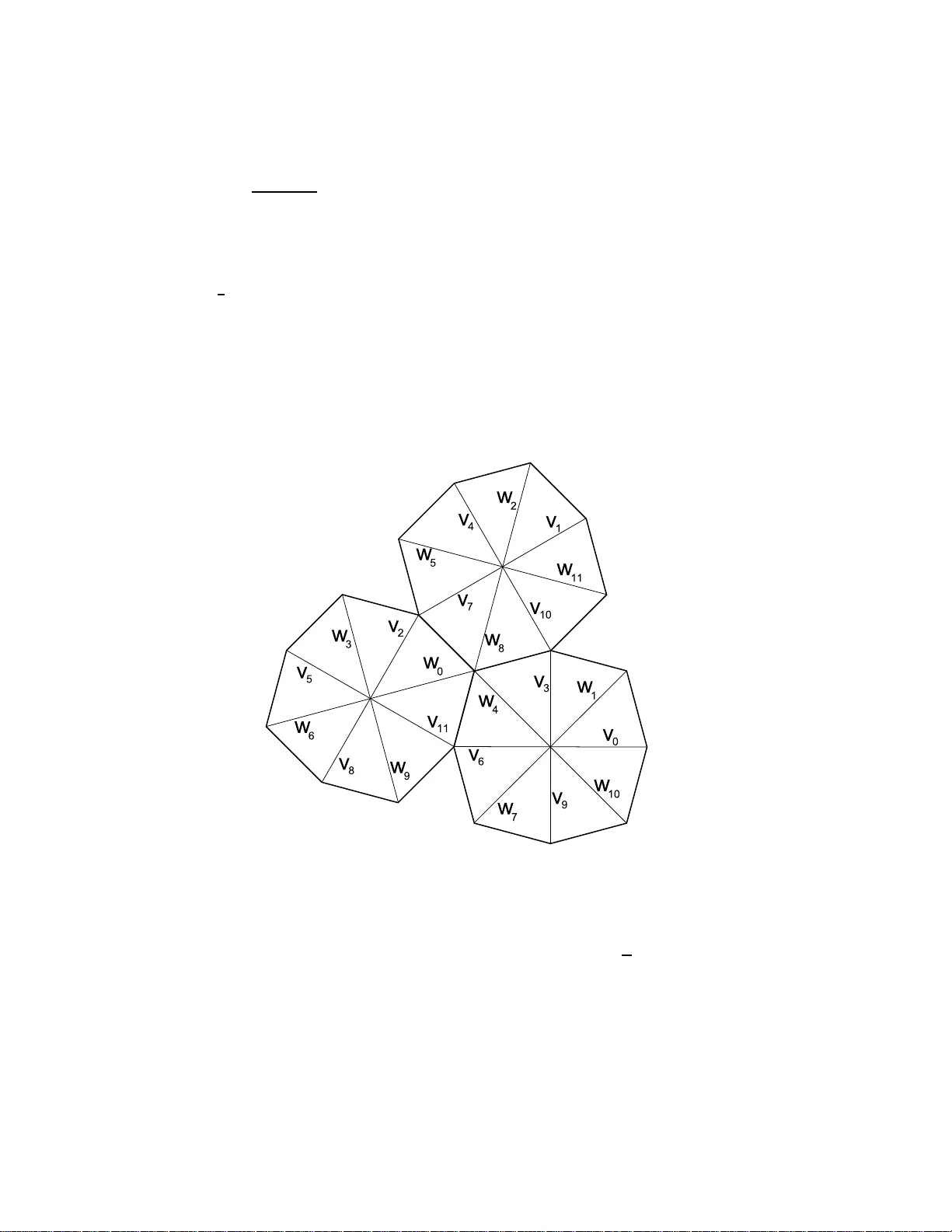
TRANSLA TION CO VERS AMONG TRIANGUL AR BILLIARD SURF A CES JASON SCHMURR Abstract. W e iden tify all translation cov ers among tri angular billiard surfaces. Our main tools are the holonomy field of Ken y on and Smilli e and a geometric prop erty of triangular bil liard surfaces, which w e call the fingerprint of a p oint, that i s pr eserv ed under balanced translation co v ers. 1. Intr oduction An unfo lding construction, alr e ady describ ed in [3] and furthered in [9], asso ciates a flat surface called a tra nslation sur fac e to eac h rational-a ngled triangle; we c a ll such a sur face a triangular b il liar d surfac e . Informally , a compact translation surface is a finite union of p oly gons in the plane, with pairs of parallel edge s ident ified in such a wa y as to pr o duce a co mpa ct surface. T ria ngular billiard sur faces are highly sy mmetric examples o f translation surfaces; as such, they are of interest in the field – see K eny on a nd Smillie[10] and Aure ll and Itzykson[1], fo r exa mple. Structure-preserving maps ca lled tr anslation c overs b etw een translatio n surfaces hav e been used by V orob ets [11], Hub ert a nd Schmidt [7], Ke n yon and Smillie [10], Gutkin and Judge [5] and others, to g a in information a bo ut the affine sy mmetry gro ups of the surfaces. Beyond genus 1, tra nslation covers b etw een tria ngular billiard surfac e s are rare; in fact, o ur main r esult is the following. Theorem 1. L et f : X → Y b e a nontrivial t r anslation c over of triangular bil liar d surfac es, wher e X has genus gr e ater than 1. Then e ach of X and Y is either a right triangular bil liar ds surfac e or an isosc eles t riangular bil liar d surfac e, and f is of de gr e e at most 2. W e give a n ex plicit description of which X and Y ar e related b y s uc h cov- ers in Lemma 3. T o pr ove Theo rem 1, we use t w o ma in to o ls: the holono m y field of Keny on and Smillie [10], and what we call the fingerprint of a p oint P on a transla tion surfac e, which is an inv aria n t whic h dep ends on the surface and a po in t o n the surface and whic h changes in a natura l way under certain 2010 Mathematics Subje ct Classific ation. 57M50 (prim ar y); 30F30, 37D50 (secondary). 1 2 JASON SCHMURR translation cov ers called b alanc e d c overs . In particular , for a g iven triangular billiard surface Y , w e use the holonomy field to narrow the search for p ossible translation coverings of Y to a finite set of cov ering surfaces. W e then use information (gleaned from fingerpr in ts of po ints) ab out the geometric config- uration of singular po in ts on these surfac e s to iden tify the ac tua l transla tion cov erings o f Y . Our hop e is that this strateg y of pairing the glo bal information of the holo- nomy field with the lo cal information of the fing erprint can be a pplied to other questions involving transla tion cov erings. F or ex ample, our main theorem can be seen as establishing a case of a more g eneral c onjecture (communicated to us b y Eugene Gutkin), that aside from a few trivial ca s es, most translation cov erings b etw een p olyg onal billiard sur faces are induced from the situation where one of the underlying p olygo ns tiles the other. 1.1. Outl ine. In Sections 2.1 a nd 2.2, we review the constr uc tio n of tria n- gular billia rd sur faces and the basics of trans la tion covers. In Section 2.3, we prov e Lemma 3 , whic h explicitly identifi es all po ssible tr anslation covers among tr iangular billiar d sur faces. The goa l of the r emainder o f the pap er is to s how that the list given in Lemma 3 is complete – this is Theorem 1. In Section 3 we discuss the holonomy field o f K eny on and Smillie. W e offer a new elementary computation of the holonomy field of a given triang ular billiard surface , and ex plain why such surfaces re la ted b y a transla tion cov er hav e the same holonomy field. In Section 4 we define the finger pr int of a po in t and prove results ab out its b ehavior under balanced translation cov ers. In 5.1, we prov e the main theor e m restric ted to balanced cov ers. After some combinatorial lemmas in 5.2, we complete the pro of of the main theorem in 5.3. 1.2. Ack no wledgments. The author thanks Thoma s A. Schmidt for many helpful discussions. Thanks ar e a lso due to the r eferee for several useful cri- tiques. 2. Ra tional Bil liards and Transla tion Co vers 2.1. The rational billi ards construction. Let R b e a p olygo nal regio n whose interior a ngles ar e ratio nal multiples of π . Let D 2 Q be the dihedr al group of o r der 2 Q genera ted by Euclidean reflectio ns in the s ides of R . Sup- po se a particle mov es within this r egion at constant sp eed and with initial direction vector v , c hanging directio ns only when it reflects o ff the sides of R , with the angle of incidence equaling the angle of r eflection. Every subsequent direction vector for the particle is of the fo r m δ · v , for some element δ ∈ D 2 Q , where D 2 Q acts on R 2 via Euclidean r eflections. The rational billiards co nstruction c o nsists of a flat surface corr esp onding to this ph ysical sys tem. Conside r the set D 2 Q · R of 2 Q copies of R transfor med TRANSLA TION COVERS AMONG TRIANGULAR BILLIARD SURF ACES 3 by the element s of D 2 Q . F or ea ch edge e of R , we consider the cor resp onding element ρ e ∈ D 2 Q which represents reflection acro ss e . F or each δ ∈ D 2 Q , we glue ρ e δ · R and δ · R together along their copies of e . The result is a closed Riemann surface with flat structure induced by the tiling by 2 Q copies of R . This construction is describ ed by F ox and Kers hner in [3]. In fact this sur face is a n example of a compa ct tr anslation surfac e . A compact tr anslation surface ca n b e defined as the result of gluing together a finite set of p olygons in the plane alo ng pa rallel e dges in such a wa y that the result is a compact surface (see, e.g., [2]). Equiv a len tly , a translation surface can b e defined a s a real tw o-manifold. Recall that given t w o co ordina te maps φ 1 : U 1 → R 2 and φ 2 : U 2 → R 2 defining ho meomorphisms from op en sets U 1 and U 2 of a manifold M into R 2 , the map φ 2 ◦ φ − 1 1 : φ 1 ( U 1 ∩ U 2 ) → φ 2 ( U 1 ∩ U 2 ) is called a tr ansition function . A conic a l singular it y P on a flat s ur face is a point such that, in the flat metric induced by the co or dina te maps, the total angle (“co ne angle” ) ab out P is not equal to 2 π . Definition 1. Let X be a fla t surface with conica l singula rities. Let ˜ X b e the flat surface o btained by puncturing all singular ities of X . If all tr a nsition functions of ˜ X a re transla tions, then X is a t r anslation su rfac e . On a tra nslation surface, the co ne angles of conica l sing ularities ar e always int eger multiples of 2 π . See [13] for an introduction to flat sur faces. W e fo cus on billiards in rational triangles . Let ( a 1 , a 2 , a 3 ) b e a triple of p os- itive integers. W e fix the notation T ( a 1 , a 2 , a 3 ) to refer to a triang le with inter- nal angles a 1 π Q , a 2 π Q , a nd a 3 π Q , wher e Q := a 1 + a 2 + a 3 and gcd( a 1 , a 2 , a 3 ) = 1 . W e us e the notation X ( a 1 , a 2 , a 3 ) to refer to the transla tion surface a rising from billiar ds in T ( a 1 , a 2 , a 3 ) via the F ox-Kers hner cons tr uction. W e call s uch a surface a triangular bil liar ds surfac e . If the triangle is isos celes or right, we call the corr esp onding surface an isosc eles triangular bil liar ds surfac e o r a right triangular bil liar d surfac e . Definition 2. Note that the F ox-Kershner co nstruction gives a natural “tiling by flips” of the surfa c e b y co pies of T . A bil liar ds triangulation is a triangu- lation τ o f X whos e triang les a r e the v arious elements o f D 2 Q · T descr ibed ab ov e. Remark 1. Some data can b e g ained ab out τ via s imple combinatorics. Letting T := T ( a 1 , a 2 , a 3 ), lab el the vertices of T as v 1 , v 2 , and v 3 , where v i corres p onds to a i . It is not ha rd to chec k that the total num ber o f triangles in τ is 2 Q , that the num b er o f vertices of τ corresp onding to v i is gcd( a i , Q ), and that each mem b er of this set has a cone angle o f a i gcd( a i , Q ) 2 π . A go o d reference for these matters is [1]. 4 JASON SCHMURR Definition 3 . Let v 1 , v 2 , v 3 be the vertices of T ( a 1 , a 2 , a 3 ), and let π X : X ( a 1 , a 2 , a 3 ) → T ( a 1 , a 2 , a 3 ) b e the standar d pro jection. A vertex class of X ( a 1 , a 2 , a 3 ) is any of the three sets π − 1 X ( v 1 ), π − 1 X ( v 2 ), or π − 1 X ( v 3 ) . Note that for a given vertex class, either all the ele men ts a re singular o r all are non- singular; hence we call a vertex cla ss singular if its elements are singularities and nonsingular if its e le men ts are nons ingular. Clearly , a vertex cla ss π − 1 X ( v i ) is nonsingular if and only if a i divides Q . F urthermo re, the sum o f the cone angles of the elemen ts of π − 1 X ( v i ) is 2 a i π . 2.2. T ranslation co v ers. The natural map b etw een translation surfac es is one which re spe c ts the translatio n structure: Definition 4. A t r anslation c over is a holomor phic (p ossibly ramified) cover of transla tion surfaces f : X → Y such that, for ea ch pair of co or dinate maps φ X and φ Y on X and Y , resp ectively , the map φ Y ◦ f ◦ φ − 1 X is a transla tion when φ X and φ Y are restricted to op en sets not containing singular p oints. W e s ay that f is b alanc e d if f doe s no t map singular p oints to nonsingula r po in ts. The ter m “balanced” cov er is due to Gutkin [4]. Balanced transla tion cov ers f : X → Y of tra nslation s urfaces are of par ticula r interest b ecause they imply an esp ecially str ong relationship b etw een the affine symmetry gro ups of X a nd Y ; in par ticular, these gr oups must share a subgro up whic h is of finite index in each (see [5] and [11]). Definition 5. W e say that X and Y are tr anslation e quivalent if there ex ists a degree 1 tra nslation cov er f : X → Y . The surface X (4 , 3 , 3) is pictured at the top o f Fig ure 1. The emphasized po in ts la b eled P 1 and P 2 form the singular vertex cla ss corr esp onding to the vertex angle of 2 π / 5 in T (4 , 3 , 3) . E ach of these p oints has a cone angle of 4 π , b ecause 1 0 co pies of T (4 , 3 , 3) are developed ab out each p oint. T o help visualize this, we follow Huber t and Schmidt [8] and use the do tted lines to represent slits with gluings indicated b y lab els a and b . The identification of parallel e dg es as indicated b y the lab eling scheme in the figur e leads to tw o more singular points on X (4 , 3 , 3), each of cone angle 6 π . Also in Fig ur e 1 w e depict X (3 , 1 , 1) and X (5 , 3 , 2) . These tw o surfaces are translation eq uiv alent, and there ex is t deg r ee tw o transla tion covers from X (4 , 3 , 3) to each of them. The following le mma demonstrates how we will use Remark 1 to a nalyze translation cov ers. Lemma 1 . Supp ose f : X ( a 1 , a 2 , a 3 ) → X ( b 1 , b 2 , b 3 ) is a tr anslation c over of triangular bil liar d surfac es. L et π X : X ( a 1 , a 2 , a 3 ) → T ( a 1 , a 2 , a 3 ) and π Y : X ( b 1 , b 2 , b 3 ) → T ( b 1 , b 2 , b 3 ) b e the c anonic al pr oje ctions to triangles with vertic es v 1 , v 2 , v 3 and w 1 , w 2 , w 3 r esp e ctively. Su pp ose that P ∈ π − 1 Y ( w i ) , P ′ ∈ π − 1 X ( v j ) , and f ( P ′ ) = P with a r amific ation index of m at P ′ . Then TRANSLA TION COVERS AMONG TRIANGULAR BILLIARD SURF ACES 5 a a b b 1 1 2 2 3 3 4 4 5 5 6 6 7 7 A A B B C C D D E E I I II II III III IV IV P 1 P 1 P 2 P 2 Figure 1. Above, the s ur face X (4 , 3 , 3) . Below, X (3 , 1 , 1) (left) and X (5 , 3 , 2) (rig h t) . mb i gcd( b i , b 1 + b 2 + b 3 ) = a j gcd( a j , a 1 + a 2 + a 3 ) . Pr o of. The cone a ngle at P ′ is m times the cone angle at P . Therefore the result follows from Remark 1. Of c o urse, the translation structur e of X ( a 1 , a 2 , a 3 ) dep ends on the c hosen area and dir ection of T ( a 1 , a 2 , a 3 ) . A translatio n s urface X can repr esented as a pair ( S, ω ), wher e S is a Riemann surface and ω is a holomo r phic 1- form on S which induces the transla tio n struc tur e of X . Using this langua ge, suppo se tha t ( S, ω ) is a tria ngular billiard surface arising from billiards in some T ( a 1 , a 2 , a 3 ), and that α is a nonze ro complex num ber. The nota tion X ( a 1 , a 2 , a 3 ) do es not distinguish the pair s ( S, ω ) a nd ( S, αω ) . The following lemma shows that this ambiguity will not a ffect o ur clas sification of trans lation cov ers. Lemma 2 . Supp ose that ( S, ω ) is a t riangular bil liar d surfac e of genus gr e ater than one, and let α ∈ C \{ 0 } . Then any t ra nslation c over f : ( S, ω ) → ( S, αω ) is of de gr e e 1. Pr o of. This is a simple application of the Riemann-Hur witz for mula. Let ( S, ω ) hav e genus g , and let deg f = n . The 1-fo r m ω which gives ( S, ω ) its translation struc tur e ha s 2 g − 2 zeros (counting multiplicities). Clear ly αω has the sa me zeros as ω . The Riema nn-Hurwitz formula then gives us that (1) g = n ( g − 1) + 1 + R 2 , 6 JASON SCHMURR where R is the total r amification n um b er o f f . Since R ≥ 0, Equa tio n (1) is only satisfied if n = 1 . 2.3. The Possible T ranslation Cov ers. Any isosceles tr iangle is na turally “tiled by flips” by a r ight triangle. The following lemma demonstr ates how to use this tiling to crea te non trivial tr anslation cov ers in the c a tegory of triangular billiard surfaces. In fact, o ur main theo rem is that the cov ers o f Lemma 3 are the only nontrivial translation covers among tria ngular billiard surfaces. Lemma 3. L et a and b b e r elatively prime p ositive inte gers, not b oth e qual to one. The right t riangular bil liar d surfac e Y := X ( a 1 + a 2 , a 1 , a 2 ) is r elate d to two isosc eles triangular bil liar d s u rfac es X 1 and X 2 via tr anslation c overs f i : X i → Y . F or e ach i , if a i is o dd then X i = X (2 a j , a i , a i ) and f i has de gr e e 2. If i is even then X i = X a j , a i 2 , a i 2 and f i has de gr e e 1. Pr o of. It suffices to prov e the result for X 1 and f 1 . W rite Q := 2 a 1 + 2 a 2 . W e reflect the triangle T = T ( a 1 + a 2 , a 1 , a 2 ) acros s the e dg e connecting the vertices corre spo nding to a 2 and a 1 + a 2 , to obtain its mirror imag e T ′ . B y joining T and T ′ along the edge of r eflection w e crea te an isosceles tr iangle ˜ T which can b e wr itten as either T (2 a 2 , a 1 , a 1 ) (if a 1 is o dd) o r T ( a 2 , a 1 2 , a 1 2 ) (if a 1 is even). Note that since ( a 1 + a 2 , a 1 , a 2 ) m ust be a r educed triple, a 1 and a 2 cannot b oth be even. It also follows that g c d( a i , Q ) ≤ gcd(2 a i , Q ) = 2 . Suppo se a 1 is e ven. Consider the trans lation surfa ce S (with b oundary) obtained by developing T around its vertex corr esp onding to a 2 . Since a 2 is o dd we hav e gcd( a 2 , Q ) = 1, so S is tiled (by reflection) by 2 Q copies o f T , and hence after appro priate identifications a lo ng the b oundary we will have X ( a 1 + a 2 , a 1 , a 2 ) . Let ˜ S be the surface obta ined by developing ˜ T aro und the corres p onding vertex; it is tiled via r eflection b y Q copies of ˜ T , so appropria te bo undary identifications will yield Y 1 . Because ˜ T is tiled via reflection by tw o copies of T , it follows that S and ˜ S a re translation equiv alen t. Finally , note that the b oundar y ident ifications ar e the same for S and ˜ S . Therefore Y and X 1 are trans lation equiv alent. Now supp ose that a 1 is o dd and a 2 is even. W e then hav e ˜ T = T (2 a 2 , a 1 , a 1 ) . Since gcd(2 a 2 , Q ) = 2, we again hav e that ˜ S is tiled by Q copies o f ˜ T . Since a 2 is even, g c d( a 2 , Q ) = 2, implying that S is tiled b y Q copies of T . Th us if a 2 is even then there exists a degree tw o cov er f : ˜ S → S , ramified ov er a single p oint. F urthermore, in this case X 1 and Y are obtained by iden tifying appropria te edges o f two copies of ˜ S and S , r esp ectively . It follows that if a 2 is even then there exis ts a ramified degr e e t wo cover f : X 1 → Y . Finally , supp ose that a 1 and a 2 are b oth o dd. W e hav e ˜ T = T (2 a 2 , a 1 , a 1 ), gcd(2 a 2 , Q ) = 2, and gcd( a 2 , Q ) = 1 . In this case we have tha t S a nd ˜ S a re translation equiv alent surfaces; how ev er, X 1 is obtained from tw o copie s of ˜ S TRANSLA TION COVERS AMONG TRIANGULAR BILLIARD SURF ACES 7 whereas Y is obtained from a single copy o f S . Thus again we hav e that X 1 is a double cov er of Y , this time unramified. Remark 2. Note that in addition to relating right and isosce les triang le s, Lemma 3 also gives a w ay to construct cov ers be t ween isosce le s triangula r billiard surfaces. In the lang uage o f Le mma 3, if a 2 is even, then f − 1 2 ◦ f 1 is a degree tw o translation cover of X 2 by X 1 . Remark 3 . If we allow a 1 = a 2 = 1 in the statement of Lemma 3, then we arrive at Y = X 1 = X 2 = X (1 , 1 , 2) . This is be cause T (1 , 1 , 2) is the unique right isosceles triangle. Because the lo cation of singular ities is suc h a ma jor to o l in ana lyzing tra ns- lation sur faces, it is worth identifying the triang ular billiard surfaces which hav e no singularities . As detailed in [1], there are only three of these surfaces: X (1 , 1 , 2), X (1 , 2 , 3), a nd X (1 , 1 , 1) . These ar e also the only three triang ula r billiard surfaces of genus 1; furthermore X (1 , 2 , 3) and X (1 , 1 , 1) are actually translation equiv alent . Each of these surfac es admits balanced tra nslation cov ers of itself by itself o f ar bitrarily high degree; this fact is related to the fact that T (1 , 1 , 2), T (1 , 2 , 3), and T (1 , 1 , 1) are the o nly Euclidean triang les which tile the Euclidea n pla ne by flips. Note that an y such cov er must b e unramified, since a bo ut ramification p oints flat r amified covers are lo cally of the form z 7→ z 1 /n for so me n > 1, implying that the c o ne angle of the ramification p oint is greater than 2 π ; hence r amification po in ts ar e singular . 3. The hol onomy field In order to prove that Lemma 3 provides a co mplete list o f the translation cov ers b et ween triangula r billiard s urfaces, we requir e some informa tion ab out the holono m y of a tria ng ular billia rd surfa ce. Definition 6. The rational absolute holonomy of a tra nslation surface X is the image of the map hol : H 1 ( X ; Q ) → C defined by ho l : σ 7→ R σ ω , where the 1-form ω is lo cally the differential dz in each chart not containing a singular po in t. The following definition is due to Keny on and Smillie [1 0]. Definition 7. The holonomy field o f a tra nslation surface X , deno ted k X , is the smalles t field k X such that the r ational a bsolute holonomy of X is contained in a tw o-dimensional vector space ov e r k X . 3.1. Calculatio n of the holo n o m y field. Keny on and Smillie [10] ca lculate the holo nomy field of X ( a 1 , a 2 , a 3 ) to be k X = Q (cos (2 π /Q )) . W e offer a more elementary pro of of this re s ult. Remark 4. W e let U n denote the n th Chebyshev p oly nomial of the seco nd kind. W e will use the following prop erties of Chebyshev p olyno mials. 8 JASON SCHMURR (1) sin(( n +1) θ ) sin θ = U n (cos θ ) (2) If n is even, then U n is an even po lynomial of degree n . If n is o dd, then U n is an o dd p o lynomial of degr ee n . Remark 5. Let φ b e the E uler totient function. It is well known that, for any p ositive integer Q , the degre e of the num ber field Q (cos(2 π /Q )) is equa l to 1 2 φ ( Q ) . Note that if Q is o dd, then φ ( Q ) = φ (2 Q ) . It fo llows that, when Q is o dd, we will hav e Q (cos ( 2 π /Q )) = Q (cos ( π /Q )) . The following is Pro po sition 2.5 of [2]. Lemma 4. (Calta-Smil lie) If a t r anslation su rfac e X is obtaine d by iden- tifying the e dges of p olygons in t he plane by maps which ar e r estrictions of tr anslations, and if al l the vertic es of these p olygons lie in a sub gr oup Λ ⊂ R 2 , then the holonomy of S is c ontaine d in Λ . Figure 2 . The sets { v n } and { w n } for X (3 , 4 , 5), with a 1 = 3 . Lemma 5. The holonomy fi eld of X = X ( a 1 , a 2 , a 3 ) is k X = Q (cos (2 π /Q )) . Pr o of. Le t k X denote the holonomy field of X . Let α = π Q . Let T = T ( a 1 , a 2 , a 3 ) . Since gcd( a 1 , a 2 , a 3 ) = 1, we can and do assume that a 1 is o dd. TRANSLA TION COVERS AMONG TRIANGULAR BILLIARD SURF ACES 9 Lab el the vertices of T c o rresp onding to the angle s a 1 α , a 2 α , and a 3 α as P 1 , P 2 , a nd P 3 . W e s cale and rota te T s o that the P 1 P 2 side has edge vector v = (1 , 0), and so that the P 1 P 3 side has edge vector w = ( t cos( a 1 α ) , t s in( a 1 α )), where b y the Law of Sines we have t = sin( a 2 α ) sin( a 3 α ) . The dihedral group D generated by reflections in the sides of T acts on the set D · T of 2 Q distinct oriented triangles arising from billiards in T . W e can construct X fro m this set by iden tifying the appropr iate edges of the elements of D · T . W e may also view D as acting on the edge vectors of T . Le t v n = (cos(2 nα ) , s in(2 nα )) and w n = ( t c o s((2 n + 1) α ) , t sin((2 n + 1) α )) . With this notation, we see that D · v is the set { v = v 0 , v 1 , ..., v Q − 1 } . Recalling that a 1 is o dd, we als o see that D · w is the set { w 0 , w 1 , ..., w Q − 1 } . Note that w = w ( a 1 − 1) / 2 . Let L = Q (co s(2 α )) . W e will show that all the v n and w n are L -linear combinations of v 0 and v 1 , and that furthermore L is the smallest such field. T o see tha t k X contains L , we note that v 2 is the result o f ro tating v 1 by an angle of 2 α . Co ns ider a vector space over k X with order ed basis { v 0 , v 1 } . In this basis, counterclockwise rota tion by 2 α is a linear tra nsformation R with matrix 0 − 1 1 2 cos(2 α ) . Hence, cos(2 α ) is in k X , and we hav e L ⊆ k X . Since ea c h v i and each w i is the r esult o f rep eated applicatio n of R to v 0 or w 0 , it r emains to b e shown that w 0 is a n L -line a r combination of v 0 and v 1 . Then Lemma 4 g ives that k X ⊆ L , completing the pr o of. Let l and l ′ be the real num bers such that l v 0 + l ′ v 1 = w 0 . Since v 0 and v 1 are reflections of ea ch o ther a cross the line ge ner ated by w 0 , we see that v 0 + v 1 is a real m ultiple of w 0 . Hence l ′ = l . Pro jecting v 0 and v 1 onto w 0 , we see that (2) l = || w 0 || || v 0 + v 1 || = t 2 cos α = sin( a 2 α ) sin α sin( a 3 α ) sin(2 α ) = sin( a 2 α ) sin α sin α sin( a 3 α ) sin α sin(2 α ) . Applying Remar k 4 to the la st expre s sion, w e get (3) l = U a 2 − 1 (cos α ) U a 3 − 1 (cos α ) U 1 (cos α ) . If Q is even, we have that ( a 2 − 1) and ( a 3 − 1) have opp osite parity , and thus by our Rema rk 4, U a 2 − 1 (cos α ) U a 3 − 1 (cos α ) U 1 (cos α ) is a r ational function in cos 2 α . There- fore l ∈ Q (cos 2 α ) = L . I f Q is o dd, then already by Remark 5, Q (co s α ) = L , and sinc e U a 2 − 1 (cos α ) U a 3 − 1 (cos α ) U 1 (cos α ) is a r ational function in cos α , we aga in hav e that l ∈ L . Hence spa n L { v 0 , v 1 } =Λ . Theorem 4 says that Λ contains the absolute holonomy of S . So L contains k X , which completes the pr o of. 10 JASON SCHMURR Corollary 1. If f : X → Y is a tra nslation c over of triangular bil liar d surfac es, then k ( X ) = k ( Y ) = Q (cos(2 π /Q )) . Pr o of. Since f is a translation cov er, the billiards triangulation τ of Y by T Y lifts to a tria ngulation o f X by T Y , in whic h each edge is is mapp ed by f to an edge of τ . Hence w e may take the subgro up Λ refer red to in Lemma 4 to be the same g roup for b oth X and Y . Then our calculation in L e mma 5 will be the sa me for X and Y . 3.2. Som e e lementa ry num be r theory. Since k X = Q (cos(2 π /Q )), w e would like to know when distinct v a lues of Q yield the s a me field k X . Letting ζ Q denote a primitive Q th ro ot o f unity , w e hav e that Q (cos(2 π / Q )) is equal to Q ( ζ Q + ζ − 1 Q ), which is a degree tw o subfield of the cyclotomic field Q ( ζ Q ), since it is the maximal subfield fixed b y co mplex c o njugation. In lig ht of this, we list so me classical results ab out these tw o fields a s recorded in W ashing ton’s text[12]. Lemma 6 . If Q is o dd then Q ( ζ Q ) = Q ( ζ 2 Q ) . Lemma 7. (Pr op 2.3 in [12] ) Assume that Q 6≡ 2 mo d 4 . A prime p r amifies in Q ( ζ Q ) if and only if p | Q . Lemma 8. (Pr op 2.15 in [12] ) L et p b e a prime, and assume that Q 6≡ 2 mo d 4 . If Q = p m then Q ( ζ Q ) / Q ( ζ Q + ζ − 1 Q ) is r amifie d only at the prime ab ove p and at the ar chime de an primes. If Q is not a prime p ower, then Q ( ζ Q ) / Q ( ζ Q + ζ − 1 Q ) is unr amifie d exc ept at the ar chime de an primes. Remark 6. W ashing ton’s pro ofs of Lemmas 7 and 8 make clea r that the results carr y thro ugh to the case Q ≡ 2 mo d 4 except that in that c a se, the prime 2 do es not ramify in Q ( ζ Q ) . F or a triangula r billiar d sur face X = X ( a 1 , a 2 , a 3 ), it is tempting to define a “ Q - v alue” for the sur face by Q X := a 1 + a 2 + a 3 . Unfortunately this notion is not quite w ell-defined up to tra nslation e q uiv alence; as demonstrated in Lemma 3, the distinct tria ngles T ( a, a, b ) and T (2 a, b, 2 a + b ) unfold to translation equiv alen t transla tion s urfaces if (a nd only if ) b is o dd. How ever, the following lemma and its cor ollary show tha t this no tio n is well-defined up to a factor o f 2 . Lemma 9. Distinct cyclotomic fields have distinct m aximal total ly r e al sub- fields. Pr o of. This is an exercise in elementary algebraic n umber theory , and is pre- sumably well known. Le t k b e the maximal totally rea l subfield of the cyclo- tomic fields Q ( ζ m ) a nd Q ( ζ n ) for p ositive integers m, n > 2 . Let p b e an o dd prime dividing m . By Lemma 7, p ra mifies in Q ( ζ m ) . If m is a p ow er of p , then p is totally ra mified in Q ( ζ m ) . Since Q ⊂ k ⊂ Q ( ζ m ), if m is a p ow er of TRANSLA TION COVERS AMONG TRIANGULAR BILLIARD SURF ACES 11 p then p m ust ramify in k . If m is not a p ow er of p , then Lemma 8 tells us that the extension Q ( ζ m ) /k is not ramified at the prime ab ov e p ; thus again p m ust ramify in k . But also Q ⊆ k ⊂ Q ( ζ n ), so p must ramify in Q ( ζ n ) . By Lemma 7, this implies that p divides n . Therefore m and n hav e the same o dd prime diviso rs; furthermo re, by Remar k 6, these arg umen ts extend to show that either 4 divides b oth m and n or it div ides neither. The deg rees of Q ( ζ m ) and Q ( ζ n ) as field ex tens io ns of Q ar e φ ( m ) and φ ( n ) resp ectively , where φ is the Euler totient function. Since Q ( ζ m ) and Q ( ζ n ) are each deg ree 2 extensio ns of k , we hav e that φ ( m ) = φ ( n ) . First s uppos e that m a nd n are co ngruent mo dulo 2 . Let m = Π p e i i and n = Π p f i i be the prime fa c to rizations of m a nd n . The n we have (4) 1 = φ ( m ) φ ( n ) = Q ( p i − 1 ) p e i − 1 i Q ( p i − 1 ) p f i − 1 i = Y p e i − f i i . Therefore e i = f i for ea ch i , and m = n . Hence in this c a se Q ( ζ m ) = Q ( ζ n ) . If m and n a r e not c o ngruent mo dulo 2, then we may a ssume that m is o dd and n is cong ruent to 2 mo dulo 4 . Since φ ( m ) = φ (2 m ) when m is o dd, we can r epea t the ca lculation (4) with 2 m and n , and get that 2 m = n . But it is well known that fo r any o dd m , Q ( ζ m ) = Q ( ζ 2 m ) . Ther efore in fact k is the maximal to ta lly real subfield o f only one cyclo tomic field. Corollary 2. Supp ose that X 1 = X ( a 1 , a 2 , a 3 ) and X 2 = X ( b 1 , b 2 , b 3 ) ar e r elate d by a t r anslation c over, and that b 1 + b 2 + b 3 < a 1 + a 2 + a 3 . Then b 1 + b 2 + b 3 is o dd, and a 1 + a 2 + a 3 = 2( b 1 + b 2 + b 3 ) . Pr o of. B y Coro llary 1, X 1 and X 2 hav e the same holo no m y field k . W rite Q X 1 = a 1 + a 2 + a 3 and Q X 2 = b 1 + b 2 + b 3 . Then k is the maximal totally r eal subfield of Q ( ζ Q X 1 ) a nd of Q ( ζ Q X 2 ) . Hence b y Lemma 8, Q ( ζ Q X 1 ) = Q ( ζ Q X 2 ) . The result then follows directly from the pr o of of Lemma 9. 4. The Fingerprint W e hav e seen in Section 3 that we can use the holo nomy field to reduce the list o f po ssible trans la tion cov ers of a given tr iangular billiard sur fa ce Y to a finite set: those surfaces X suc h that Q X and Q Y differ by at most factor of tw o . T o decide whic h o f these surfaces actua lly are related by trans- lation covers, we will study the geometric configuratio n of singularities on a billiard surface by examining the shortest paths fr o m p oints on the surface to singularities. Consider a p oint P on a tra nslation surface X , along with the set of S a ll shortest g eo desic segments on X which c o nnect P to a singula rity . Let s 1 and s 2 be tw o of these segments. W e say that s 1 and s 2 are adjac ent if s 1 can b e rotated c o nt inuously ab out P o nto s 2 without first coinciding with any other elements of S . 12 JASON SCHMURR Definition 8. A fingerprint of a p oint P ∈ τ is the data {{ θ i } , φ, d } , where { θ i } contains the distinct angle measures sepa r ating adjacent pairs o f shortest geo desic segments connecting P to sing ularities, φ is the to tal cone a ngle at P , and d is the length of each of the sho rtest geo des ic segments. W e shall say that P has a T yp e I fingerprint if { θ i } has one e lemen t, and that P has a T yp e II fingerprint if { θ i } has tw o elements. W e c a ll { θ i } the angle set of a fingerprint. Figure 3. Parts of a Type I finger print (left) and a Type I I fingerprint (r ight). Figure 4 . T yp e I finger prints arising fr om isosceles triang les. The left side of Figure 4 depicts part of the fingerprint of the p o int P (in bo ld) on X (1 , 1 , 3) corr e spo nding to the vertex of angle 3 π 5 . Since the p oints corres p onding to v ertex angles of π 5 (circled) ar e nonsingular, the sides of the billiards tr iangulation of X (1 , 1 , 3) which are geo desics connec ting them to P are not par t of the fingerpr int of P . TRANSLA TION COVERS AMONG TRIANGULAR BILLIARD SURF ACES 13 F or a given triangle T X corres p onding to a triang ular billiar d surface X of genus g r eater than 1, we can ca lculate the fingerprint o f each elemen t P of a vertex class on X . W e describ e this in the following theorem. Theorem 2. Su pp ose T X unfolds to a surfac e X of genus gr e ater than 1. L et T X have vertic es v 1 , v 2 , and v 3 . Denote t he angle me asur e of v i by α i . Supp ose P ∈ π − 1 X ( v 1 ) . Then one of thr e e situ ations exists: 1) If v 1 is the ap ex of an isosc eles triangle, then P has angle set { θ } , wher e θ = α 1 . 2) If v 1 is not the ap ex of an isosc eles triangle, and if for some j ∈ { 2 , 3 } we have that b oth π − 1 X ( v j ) is singular and α j > π 6 , then P has a T yp e I fingerprint with angle set { θ } , wher e θ = 2 α 1 . 3)If v 1 is not the ap ex of an isosc eles triangle, and if for e ach j ∈ { 2 , 3 } either α j = π k for some inte ger k > 1 or α j < π 6 , then P has a T yp e II fingerprint with angle set { θ 1 , θ 2 } , wher e θ 1 = π − 2 α 2 and θ 2 = π − 2 α 3 . Pr o of. 1 ) Supp ose that v 1 is the ap ex of a n isos celes triang le. Then the shortest geo desics connecting P to a singula rity either co rresp ond to the edg es of T X incident on v 1 or to the billiar d path from v 1 to the midp oint of the opp osite side a nd back. See Figure 4. The incident edges are longer tha n the billiard path precisely when α 2 = α 3 < π 6 ; in this situation α 1 > 2 π 3 and so π − 1 ( v 1 ) must b e singular. Note that when α 2 = α 3 = π 6 we hav e that π − 1 ( v 2 ) and π − 1 ( v 3 ) a re nons ingular, so the edg es and the billiard path cannot b oth corres p ond to s hortest geo des ics connecting P to a singular p o int . In e ither case, it is evident that a djacent shortes t geo desics form a n angle of α 1 . 2) Now supp ose that v 1 is no t the ap ex of a n iso s celes triang le, and that for so me j ∈ { 2 , 3 } we ha ve that b oth π − 1 ( v j ) is singular and α j > pi 6 . Then the edge of T X with endp oints v 1 and v j is shor ter than the shor test billiard path fro m v 1 to itself. Since v 1 is not the a pex o f an iso sceles tria ngle, exactly one of the edges incident on v 1 corres p onds to a ll of the shor test geo desics connecting P to singula r ities. Th us t wo such g e o desics which are adjacent form an angle of 2 α 1 . See Figure 3. 3) Finally , s upp os e that v 1 is not the a pex of an isosceles triangle, and that for each j ∈ { 2 , 3 } either α j = π k for some int eger k > 1 or α j < π 6 . It follows that for each side of T X incident on v 1 , either the side will not cor resp ond to a geo desic connecting P to a singular it y , or else the side w ill be longer than the shortest billiard path from v 1 to itself. F urthermo re, w e see that π − 1 X ( v 1 ) m ust be singula r. F or, either π − 1 X ( v 2 ) a nd π − 1 X ( v 3 ) are nonsingular, in whic h case π − 1 X ( v 1 ) m ust be sing ular since X ha s a singular it y , or else α 2 + α 3 < 2 π 3 ; 14 JASON SCHMURR in this ca se, α 1 > π 3 implies that π − 1 X ( v 1 ) is singular, since if α = π 2 it is impo ssible to find α 2 and α 3 satisying the co nditions of case 3. The claim is now eviden t fr o m Figure 5, whic h illustr ates the finger print o f the singularity on X (3 , 4 , 5) . (In the figure, the geo desics defining the fingerpr int are the Figure 5. Part o f a Type I I fingerpr in t on X(3,4 ,5 ). Non- singular vertex po in ts ar e circled. thic ker lines, whereas the edges of the billiards tria ngulation are the thinner lines.) Let the angle set o f the finge r print of P b e { θ 1 , θ 2 } . Each θ i is an int erior ang le o f a quadrila teral who s e other thre e angles include tw o right angles and an angle which has t wice the measur e of an angle of the tr ia ngular billiard table T X for X . Ther efore tw o of the ang les of T ha ve the form 1 2 (2 π − π 2 − π 2 − θ i ) = π − θ i 2 , and the third angle is θ 1 + θ 2 2 . Corollary 3. Supp ose t he bil liar ds triangulation of a t riangular bil liar d sur- fac e X c ont ains a p oint with a T yp e II fingerprint. Then X is uniquely deter- mine d by that fingerprint, up to an action of O (2 , R ) . In de e d, if the fingerprint has angle set { θ 1 , θ 2 } , then X is the bil liar ds surfac e for the triangle of angles θ 1 + θ 2 2 , π − θ 1 2 , and π − θ 2 2 . The fingerpr int is a useful to o l for studying transla tion cov ers b eca use it is nearly inv aria n t under balanced cov e rs. It seems worth noting that one can define the notion of a fing erprint on any translatio n surface; this ma kes par- ticular sense for any poly gonal billiard surface. Then the following inv ariance result will still hold, except that the cone angles may differ by a large r integer factor. Theorem 3 . Supp ose that f : X → Y is a b alanc e d tr anslation c over, that P ′ ∈ X and P ∈ Y ar e vertic es of bil liar ds triangulations on their r esp e ctive TRANSLA TION COVERS AMONG TRIANGULAR BILLIARD SURF ACES 15 surfac es, and that f ( P ′ ) = P . Then the fi ngerprints of P ′ and P have the same angle sets and shortest ge o desic lengths, and their c one angles ar e either e qual or differ only by a factor of two. Pr o of. Le t d and d ′ be the lengths of the shortest geo desics which connect P and P ′ , resp ectively , to a singularity . Since f is a translation c ov er, the image under f of any geo desic on X is a geo des ic of equal or lesser length on Y ; since f is balanced, any geo desic with singular endpo int s on X is mapp ed by f o nt o a geo desic with singular endp oints on Y . Th us, d ≤ d ′ . Conversely , since f is a transla tion cov er, the preima ge of any geo desic of leng th d with singular endp oints is a union of geo desic s of length d with s ing ular endpo in ts. Thu s, d ′ ≤ d , and we see that the fing erprints of P and P ′ hav e the same geo desic lengths. Define B δ ( P ) to b e the set o f all p oints o f Y that ar e o f distance less than o r e qual to δ fro m P . Let B ′ δ ( P ′ ) b e the connected c o mpo nen t o f f − 1 ( B ) c ontaining P ′ . Since Y is a transla tion sur face, and f is a translation cov er (poss ibly ramified ab ov e P with index m ), we can and do cho ose δ to be a s ufficien tly small pos itiv e num b er such that B δ and B ′ δ ( P ′ ) are simply connected closed metric balls centered at P and P ′ , resp ectively . Consider a pair of adja c en t (in the sense of Definition ?? ) geo desic s e 1 and e 2 , each of length d , connecting P to s ing ularities. Labe l the a ngle b etw een them θ . Let l 1 and l 2 be the intersections of e 1 and e 2 with B δ ( P ) . The union of l 1 and l 2 with a po rtion of the b ounda ry of B δ ( P ) b ounds a wedge-shaped r egion W which do es no t contain in its interior any p or tion of a shortest geo desic connecting P to a singula r point. Since f is a translatio n cov er, the in tersection of the f − 1 ( W ) with B ′ δ ( P ′ ) is m copies of W . Let W ′ be o ne of these copies. Then W ′ is b ounded by pa rt o f the bo undary of B ′ and t wo geo desics (say , l ′ 1 and l ′ 2 ) whic h extend to b e length d g eo desics e ′ 1 and e ′ 2 connecting P ′ to singula r p oints. Since f is a translation cover, the angle mea sure b etw een l ′ 1 and l ′ 2 is θ ; therefo re the ang le measur e b etw een e ′ 1 and e ′ 2 is θ . Suppo se that e ′ 1 and e ′ 2 are not adjacent. Then there is so me geo desic e ′ 3 of length d connecting P ′ to a s ingularity . The intersection of this g eo desic with W ′ is a geo desic l ′ 3 in the interior o f W ′ . But then f ( l ′ 3 ) is a geo desic in the interior of W which extends to the image of e ′ 3 – a length d geo desic connecting P to a singula r p o int . This co n tradicts the adjacency of e 1 and e 2 . Hence, in fac t e ′ 1 and e ′ 2 are a djacent, and and it follows that the fingerprints of P and P ′ hav e the same angle sets. Finally , we claim that m ≤ 2 . Let v and v ′ be the vertices of the triangles T Y and T X corres p onding to P and P ′ . By Remark 1, the cone angle at P is completely deter mined by ∠ v . But Theorem 2 tells us that the measure o f ∠ v is determined, up to a factor o f 2, by the angle s et of the fingerpr int of 16 JASON SCHMURR P . Hence, since the fingerpr in ts of P and P ′ hav e the same angle set, we see that m ∈ { 1 , 2 } . Corollary 4. Fingerprint typ e is invariant under b alanc e d tr anslation c overs. Corollary 5. Any r ational triangular bil liar d surfac e with a T yp e II singu- larity c annot b e a p art of any c omp osition of nontrivial b alanc e d c overs. Pr o of. B y 3. Suppo se we hav e f : X → Y a balanced cover with either X or Y possessing a singula r ity with a Type I I fingerprint. By Cor ollary 4, X and Y must both hav e sing ularities with Type I I fingerprints. Since a Type II fingerprint identifies the triangular billiards table of a surface, X a nd Y m ust be the sa me surface. As we s hall s ee, the preceding results abo ut fingerprints a llow us to quic kly classify a ll balanced cov ers in the catego ry of triang ular billiards surfaces. How e ver, to extend our results to unbalanced cov ers, we shall r efine our use of the fingerpr in t by considering punctu r e d su rfac es . By deleting a collection of singular p oints from a surfac e X to obtain a surface ˜ X , we will arrive at a set of shortes t geo desics connec ting a p oint P in ˜ X to the remaining singularities ; in g eneral this set will b e differ en t than the set o f geo desics determining the fingerprint of P on X . How ever, since simply deleting sing ularities o f X do es no t affect the flat metric on op en sets not pre v iously containing the deleted p oints, w e can g et imp ortant infor mation ab out X by c onsidering the fingerprint of P on ˜ X . Lemma 10. L et X b e a triangular bil liar d surfac e with m or e t han one singular vertex class. L et ˜ X b e the surfac e obtaine d fr om X by puncturing either one entir e singular vertex class or t wo entir e singular vertex classes such that neither delete d class c orr esp onds to an obtuse angle of the triangular bil liar d table and s u ch t hat at le ast one singular vertex class r emains. L et π − 1 X ( v i ) b e a singular vertex class not delete d. L et P ∈ π − 1 X ( v i ) . If P has T yp e II fin gerprint on ˜ X with angle set { θ 1 , θ 2 } , t hen X arises fr om bil liar ds in the triangle with angles π − θ 1 2 , π − θ 2 2 , and θ 1 + θ 2 2 . If P has a T yp e I fingerprint on ˜ X with angle set { θ 1 } , then the me asu r e of ∠ v i is in { θ 1 , 1 2 θ 1 } . Pr o of. If none of the punctured po int s were endpo in ts of geo desics defining the fing erprint of P , then P has the same fingerprint on ˜ X as on X , a nd we are done. Suppo se a sing ular vertex class has been punctur ed which contained end- po in ts of such geo desics . Then there is a new “clos est” vertex class to P ; ca ll it C . If C do es not contain P then the s hortest geo desics connecting P to C are edges of the billiar ds tr iangulation of X . If C do es contain P then, since a vertex class corresp onding to a n o btuse angle of the billiar d ta ble must b e singular (by Remar k 1) and we hav e as sumed that no such classes hav e be e n TRANSLA TION COVERS AMONG TRIANGULAR BILLIARD SURF ACES 17 deleted, it fo llows that the shortest geo desics from P to C corres po nd to a single reflection in the or iginal dynamica l sys tem. Thus the same reasoning holds as in Theorem 2. The only p otential difficulty would b e if the new “c losest” vertex cla ss was the one containing P , for in that case, since the shortest geo desics from P to elements of its own class pass thro ugh more than one triangle , w e must consider the p oss ibilit y that our punctures o bs truct these ge o desics. How ev er, since the sho rtest geo desics ar e per pendicula r to the sides of the tr iangles opp osite P , this is only a problem if the vertex class puncture d is π − 1 X ( v j ) with ∠ v j = π 2 . B ut such a clas s is nonsingula r, so it would not have b een punctured. 5. A ll Transla tion Covers 5.1. Balanced Co v e rs. In this subsection we sha ll pr ove Theorem 1 for bal- anced cov ers using the simple geometr ic idea of the finge rprint as our main to ol (this is Lemma 13). Most p oints on a billia rd surfa ce hav e no mor e than three shor test geo desics connecting them to singular points. W e define an exc eptional p oint on a billiard surface X to b e a point which has mor e than three sho rtest geo desic paths to s ing ularities. Lemma 1 1 . L et X b e a triangular bil liar d surfac e of genu s gr e ater than 1. A p oint P on X is ex c eptional if and only if P is a vertex of the bil liar ds triangulation of X not c orr esp onding to a right angle. Pr o of. If P is a vertex of τ then Theor em 2 shows that it is exceptiona l unless it co rresp onds to a r ight ang le on T X . If P do e s corr esp ond to a right angle then clea rly ther e a re tw o shor test pa ths to sing ularities (co rresp onding to one side o f T X incident on π X ( P )) unless T X is isosceles; but then X = X (1 , 1 , 2), which has no singular ities . Suppo se that P is in the in terior of a tria ngle of τ . Then for ea ch vertex of that triangle, P is strictly closer to that vertex than to any other element of its v ertex cla s s. Hence, P cannot hav e more than three shor test paths to singularities. Now supp ose that P is in the interior o f an edge o f τ . Then P is o n an edge of tw o triangle s , so P has tw o shor test paths of length L 1 to members of the opp osite vertex clas s. If P is the midp oint of the edge then it has eq uidistant unique shortes t paths of length L 2 to members of the o ther tw o vertex cla s ses; but if L 1 = L 2 then the triangles must b e copies of T (1 , 1 , 2), and in that case X ha s no singular ities. Lemma 1 2 . A b alanc e d tr anslation c over f : X → Y maps the ex c eptional p oints of X onto the exc eptional p oints of Y . 18 JASON SCHMURR Pr o of. B a lanced cov ers pr e serve fingerprints, so this follows from Lemma 11 and Theorem 2. Lemma 13. (The or em 1 r estricte d to b alanc e d c overs) L et X and Y b e tri- angular bil liar d surfac es such that t he genus of X is gr e ater than 1. Supp ose that f : X → Y is a nontrivial b alanc e d tr anslation c over. Th en f is of t he form describ e d in L emma 3 . Pr o of. Le t f : X → Y b e a balanced cover b etw een triang ula r billiard surfaces. If X has three exceptional p oints with distinct fing e rprints, then T X is not isosceles a nd s o by Theore m 2 we know all the a ngles o f T X ; the same reasoning holds for Y . Since balanced cov ers preserve fingerpr in ts up to cone a ngle, w e see that X = Y . If X ha s o nly tw o distinct fingerprints for its exceptio na l p oints then so do es Y , a nd by Theor em 2 we know that T X and T Y are a pair of triangles describ ed in Lemma 3. 5.2. Combinatorial Lemm as. Lemma 1 4. L et f : X ( a 1 , a 2 , a 3 ) → X ( b 1 , b 2 , b 3 ) b e a de gr e e n t r anslation c over of t riangular bil liar d surfac es. Then (5) X a i ∤ ( a 1 + a 2 + a 3 ) a i ≥ n X b i ∤ ( b 1 + b 2 + b 3 ) b i . Pr o of. The sum of the cone angles of the singular points of X ( a 1 , a 2 , a 3 ) is a t least n times the s um of the cone angles of the singular po in ts of X ( b 1 , b 2 , b 3 ) . By Remark 1, the result follows. Lemma 15. L et f : X = X ( a 1 , a 2 , a 3 ) → Y = X ( b 1 , b 2 , b 3 ) b e a tra nslation c over of triangular bil liar d surfac es such that the genus of X is gr e ater than 1. If a 1 + a 2 + a 3 = b 1 + b 2 + b 3 and f is not a c omp osition of c overs fr om L emma 3, then f is of de gr e e 1. Pr o of. W rite Q X = Q Y = Q = a 1 + a 2 + a 3 = b 1 + b 2 + b 3 . Le t n b e the degree o f f , and supp ose that n ≥ 2 . Lemma 14 then gives P b i ∤ Q b i ≤ Q n . Hence, since n ≥ 2 , we have (6) X b i | Q b i ≥ Q 2 . W riting q i = Q b i , we ha ve the equiv alent ex pr ession (7) X b i | Q 1 q i ≥ 1 2 . TRANSLA TION COVERS AMONG TRIANGULAR BILLIARD SURF ACES 19 Note that if b i | Q then q i is a n integer. Of cour s e, Eq uation (6) is always satisfied if T ( b 1 , b 2 , b 3 ) is a right triangle. If T ( b 1 , b 2 , b 3 ) is not a right triang le, the equation is rarely satisfied. Thus we will reduce the pr oblem to tw o cases. Case 1. The t riangle T ( b 1 , b 2 , b 3 ) is not a right triangle. In this ca s e, reca lling that gcd( b 1 , b 2 , b 3 ) = 1, we show that ther e ar e only three p ossibilities for the b i which s atisfy Equation (6). If a ll three b i divide Q then Y is nonsingular. The only no n-right tria ngle which unfolds to a nonsingular surface is T (1 , 1 , 1 ); but since this is also the only tria ngle with Q = 3, if Y = X (1 , 1 , 1) then X = X (1 , 1 , 1), con tradicting our assumption tha t X has a singula rity . Hence we can assume fo r this cas e that b 3 ∤ Q . Therefor e to satisfy Equa- tion 7 we seek integers q 1 , q 2 > 2 such that (8) 1 q 1 + 1 q 2 > 1 2 Without lo ss of g enerality we assume q 1 ≤ q 2 . If q 1 ≥ 4 , Equation (8) is imp os s ible. If q 1 = 3 then Eq ua tion (8) is satisfied if q 2 ≤ 5 . Thu s the remaining ca ndidates for Y are X (3 , 4 , 5) a nd X (3 , 5 , 7) . By Lemma 1 4, X (3 , 4 , 5) admits at mo st a degree tw o cov er; by Lemma 1 the degree tw o cov ers satisfying the hyp o theses of the lemma could only b e f : X (2 , 5 , 5) → X (3 , 4 , 5) or X (1 , 1 , 10) → X (3 , 4 , 5) . How ev er, these ma ps would hav e to b e balanced cov ers, and X (3 , 4 , 5) has a singularity with a Type I I fingerprint. Thu s by Cor ollary 5 these maps do not exist. Similar ly , the only feasible co ver of X (3 , 5 , 7) of degre e gr eater than 1 is f : X (1 , 7 , 7) → X (3 , 5 , 7); again, this would be a bala nced cover, and X (3 , 5 , 7) has a singularity with a Type I I fingerprint. Case 2. The t riangle T ( b 1 , b 2 , b 3 ) is a right triangle. Assume that b 1 = Q 2 . If b 2 divides Q , then by Lemma 3, the surfa c e Y = X ( b 2 + b 3 , b 2 , b 3 ) is translation equiv alent to the surface X ( b 3 , b 2 2 , b 2 2 ) . But then this is equiv alent to the situation wher e Q X = 2 Q Y ; we will address this situation in the pro o f o f Theorem 1. Thu s for the remainder of this pro of we will assume that neither b 2 nor b 3 divides Q . Her e Lemma 14 implies that the degr ee of f is at mos t tw o . The sum of the cone angles of the singularities of Y is 2 π ( b 2 + b 3 ) . Thus if n = 2 then the sum of the cone angles of the singularities o f X is 4 π ( b 2 + b 3 ) = 2 π Q = 2 π ( a 1 + a 2 + a 3 ) . Ther efore T ( a 1 , a 2 , a 3 ) must be either T ( b 2 , b 2 , 2 b 3 ) or T (2 b 2 , b 3 , b 3 ) . Both these p os sibilities are acco unted for by the cov ers of Lemma 3. Lemma 16. L et f : X → Y b e a tr anslation c over of triangular bil liar d surfac es. L et m b e the smal lest inte ger such that al l singu larities of Y have 20 JASON SCHMURR c one angle at le ast 2 mπ . Supp ose that deg f < m . Then for e ach vertex class C i on X , f ( C i ) c onsists entir ely of singular p oints or entir ely of nonsingular p oints. Pr o of. Le t m be as ab ov e and a ssume that deg( f ) < m . Supp ose fo r contra- diction that for some j , f ( C j ) contains sing ular p oints a nd nons ingular p oints. Each member of C j has the same co ne angle, and this cone angle must b e at least 2 mπ , since some o f the member s are mapp ed by a tr anslation cov er to a singularity of cone ang le 2 mπ . Thus, for those elements of C j which are mapped to nonsingula r p oints, the definition of a r amified cov er requires that f be lo cally of de g ree a t leas t m , which contradicts our assumption that deg( f ) < m . This co mpletes the pr o of. 5.3. Pro of of the Main Theorem. Now w e ca n prov e Theore m 1, which for our ease we restate in the following wa y . Theorem 1 . S upp ose f : X → Y is a tr anslation c over of t riangular bil liar d surfac es of de gr e e gr e ater t han 1, with the genus of X gr e ater than 1. Then f is of de gr e e 2, and is a c omp osition of one or two of the c overs f i describ e d in Le mma 3. Pr o of. Supp ose X := X ( a 1 , a 2 , a 3 ), Y := X ( b 1 , b 2 , b 3 ), and f : X → Y is a translation cov er of degre e deg f > 1 . Assume that the genus of X is greater than 1 . W rite Q X := a 1 + a 2 + a 3 and Q Y := b 1 + b 2 + b 3 . Let v 1 , v 2 , v 3 and w 1 , w 2 , w 3 be the corresp onding vertices of T ( a 1 , a 2 , a 3 ) and T ( b 1 , b 2 , b 3 ) resp ectively . By Cor ollary 1, X and Y hav e the sa me holonomy field k . By Corollar y 2, we have Q Y ∈ { 2 Q X , Q X , 1 2 Q X } . If Q Y = 2 Q X , then b y Lemma 14, w e must hav e P b i ∤ Q Y b i ≤ Q X 2 = Q Y 4 . But then we would hav e P b i | Q Y b i ≥ 3 4 Q Y , which is only the case fo r the following surfac es with even Q - v alue: X (1 , 1 , 2), X (1 , 2 , 3), X (3 , 4 , 5) . Of course, Q X ≥ 3, so Y 6 = X (1 , 1 , 2) . If Y = X (1 , 2 , 3) then X = X (1 , 1 , 1), which is of genus 1, a contradiction. If Y = X (3 , 4 , 5), then Y has a singularity with co ne angle 10 π . But, no surfac e X with Q X = 6 could have a cone ang le of at lea st 10 π . If Q Y = Q X , then we ar e done by L emma 15. Thus, app ealing to Coro llary 2, we shall a ssume for the re ma inder of the pro of that Q X = 2 Q Y and that Q Y is o dd. Case 1. Y has thr e e singu lar vertex classes. In this case, Lemma 14 implies that f can only b e a deg ree 2 ba lanced cov er. Thus we are done by Lemma 13. Case 2. Y has no singular vertex classes. TRANSLA TION COVERS AMONG TRIANGULAR BILLIARD SURF ACES 21 In this case, since Q Y is o dd, we must hav e Y = X (1 , 1 , 1) . There ar e o nly t wo surfaces with a Q -v a lue o f 6: they are X (1 , 1 , 4) and X (1 , 2 , 3), and each of these sur faces cov ers X (1 , 1 , 1) as descr ibed in Lemma 3. Case 3. Y has one singular vertex class. In this ca s e we have, without loss o f gener ality , b 1 | Q Y , b 2 | Q Y , and b 3 ∤ Q Y . Since b 1 and b 2 are divisor s of the odd num b er Q Y := b 1 + b 2 + b 3 , b 3 m ust also be o dd. Therefore b 3 gcd( b 3 , Q ) ≥ 3 . T he co ne angle at each of the s ingularities of Y cor resp onding to b 3 is b 3 gcd( b 3 , Q ) 2 π ≥ 6 π . Lemma 1 4 elimina tes all p ossible Y for deg f ≥ 4 except Y = X (3 , 5 , 7) . But, again by Le mma 1 4, the o nly p oss ible degree 4 cov ering surface would b e X (1 , 1 , 28), and s uc h a cov er would have to b e ba lanced, contradicting Lemma 13. If deg f = 2: Lemma 16 tells us that if deg f = 2 then for e a ch j = 1 , 2 , 3, we hav e that f ( π − 1 X ( v j )) ∩ π − 1 Y ( w 3 ) is either empt y o r all of f ( π − 1 X ( v j )) . Suppo se that Y = X (3 , 5 , 7) . L e mma 16 res tricts the p ossible degree 2 cov ers to sur faces of the form X (14 , a 2 , a 3 ), where ea ch of a 2 and a 3 is either a divisor o f 30 or t wice a div isor of 30 . The only p ossibility this leav es is X (15 , 14 , 1) . But any transla tion cov er X (15 , 14 , 1) → X (3 , 5 , 7) would hav e to b e balance d, s o Lemma 13 a pplies. Now supp os e that Y 6 = X (3 , 5 , 7) . Let C b e the singular vertex clas s of Y . W e must have b 3 Q > 1 2 , and so by Rema rk 1 C must cor resp ond to an obtuse angle θ of the billiar d table. Let ˜ X b e the surfac e o btained from X by puncturing all sing ular vertex cla sses of X whic h ar e not contained in f − 1 ( C ) . Since b 3 Q > 1 2 and f is degr ee 2, the sum of the angles o f the billiard table corres p onding to the vertex classes in the f - preimage of C must be o btuse. Thu s we can apply Le mma 10 to ˜ X . The restriction of f to ˜ X is balanced. Since Y has only one s ingular vertex class, elements of C must have Type II finger prints unless T ( b 1 , b 2 , b 3 ) is isosceles. If the fingerprints are Type I I, then Pro po sition 3 and Lemma 10 demonstra te that X and Y are tr a nslation equiv alent. So the only p ossibility is tha t the fing e rprints are T yp e I. In that case Y is an isosceles triangular billiard sur fa ce. Let C ′ be a vertex class on X that is in f − 1 ( C ), and wr ite θ = b 3 π Q . The billiard table angle that C ′ corres p onds to is either θ or θ 2 . If the angle is θ , then X and Y are translatio n equiv alent. If the angle is θ \ 2 , then there is a no ther v ertex clas s on X which is a lso mapp ed to C . But then that vertex class would a lso co rresp ond to an angle of θ \ 2 , a nd we would ha ve that X is an isosceles triangular billiards surface which cov e r s Y as descr ibed in Lemma 3. 22 JASON SCHMURR If deg ( f ) = 3: Then Lemma 14 allows o nly the following p ossibilities for Y : the surface s Y n = X (3 , n, 2 n − 3) 3 ∤ n X (1 , n 3 , 2 n 3 − 1 ) 3 | n . Note that g c d(2 n − 3 , 3 n ) ∈ { 1 , 3 } . Firs t supp ose that gcd(2 n − 3 , 3 n ) = 1 . Then Q = 3 n (th us n is o dd), 3 ∤ n , and we have Y n = X (3 , n, 2 n − 3 ) . W e have that n ≥ 5 and henc e that 2 n − 3 ≥ 7 . On Y n , there is only o ne singular vertex cla ss and the cone ang le o f each singula r point is (2 n − 3)2 π . Thu s Lemma 1 6 applies here. Since Y n is never iso sceles, its singular p oint has a Type I I fingerprint. Let ˜ X b e the surface obtained fr om X b y deleting all singularities o f X which f maps to nonsing ular p oints, and let ˜ f b e the restriction of f to ˜ X . By Lemma 1 6, the elements of X − ˜ X are the unio n o f ent ire vertex cla sses. Th us a Type I I fing erprint on ˜ X will uniquely identif y the triangular billiards table used to generate X , b y Le mma 10. B e cause ˜ f is a balanced map, ea c h singular p oint of ˜ X m ust hav e the s a me T yp e I I fingerprint (on ˜ X ) a s its ˜ f - image o n Y . But, a Type I I finger print uniq uely ident ifies the triangle used to genera te the surface (this works for ˜ X as well); hence X and Y n are the same billiard surfac e , a nd Lemma 2 says that a triple cov er is impos sible. Now suppo se that gcd(2 n − 3 , 3 n ) = 3 . Then the cone angle of the singula r po in t o n Y n is 2 n − 3 3 2 π . If n > 6 then 2 n − 3 3 > 3, so that again we can apply Lemma 16 a nd Lemma 10, and the same fing erprint argument g o es through. The remaining ca ses are n = 3 , 6 . W e hav e Y 3 = X (1 , 1 , 1) and Y 6 = X (1 , 2 , 3), neither o f which have singula rities. Case 4. Y has two singular vertex classes. Assume b 1 | Q and b 2 , b 3 ∤ Q . Since Q is o dd, we hav e b 1 Q ≤ 1 3 , a nd s o Lemma 14 implies that deg ( f ) ≤ 3 . But, if deg ( f ) = 3, Lemma 14 also implies that f is balanc e d, contradicting the res ult o f Lemma 13 that balanc e d covers are of degree a t mo st 2. Thus deg ( f ) = 2 . Note that b 2 and b 3 m ust have the same pa rity . Case 4. 1. Both b 2 and b 3 ar e o dd. Then b i gcd( b i , Q ) ≥ 3, so by Lemma 16, each vertex class of X maps to all singular p oints or all nonsingular po in ts. If one vertex class of X maps to nonsingular p oints: Say the vertex class C 1 corres p onding to a 1 maps to nonsingular po int s. Then a = 2 b 1 , and 2 b 1 | 2 Q , so C 1 is nonsingular , so f is balanced. TRANSLA TION COVERS AMONG TRIANGULAR BILLIARD SURF ACES 23 If t wo vertex classes of X m ap to nonsingu lar p oints: Let them be C 1 and C 2 , corr esp onding to a 1 and a 2 . If C 1 is singular, then b y Lemma 16 we have a 1 = 2 d for some d | Q . But since a 3 = 2( b 2 + b 3 ), this would mean that all the a i are even, contradicting the fact that gcd( a 1 , a 2 , a 3 ) = 1 . Case 4. 2. Both b 2 and b 3 ar e even. If one vertex class of X maps t o nonsingular p oints: Let it b e C 1 . W e hav e a 2 + a 3 = 2( b 2 + b 3 ), so a 1 m ust b e even. B ut a lso a 2 and a 3 m ust be even, since 2 | b i gcd( b i , Q ) and b i gcd( b i , Q ) | a j gcd( a j , Q ) for each i, j ∈ { 2 , 3 } . Again, this is a contradiction. If t wo vertex classes of X m ap to nonsingu lar p oints: Let them be C 1 and C 2 . W e have that a 3 = 2( b 2 + b 3 ) is even. If C 1 is s ingular then ag ain we hav e that a 1 (and hence a 2 ) is even, once more contradicting that gc d( a 1 , a 2 , a 3 ) = 1 . Hence C 1 and C 2 are nonsingular , a nd f is balanced. References [1] Aurell, E. and Itzykson, C. R ational bil liar ds and algebr aic curve s , J. Geom. Phys. 5 (1988), no. 2, 191–208. [2] Calta, K. and Smi llie, J. Algebr aic al ly p erio dic tr anslation surfac es , J. M od. Dyn. 2 (2008), no. 2, 209–248. [3] F ox, R . and Kershner, R. Conc erning t he tr ansitive pr op erties of ge o desics on a r ational p olyhe dr on , Duk e Math. J. 2 (1936), no. 1, 147–150. [4] Gutkin, E. Br anche d co verings and close d g e o desics i n flat surfac es, with applic ations to bil liar ds. (English summary) Dynamical systems (Luminy-Marseille, 1998), 259273, W or l d Sci. Publ. , River Edge, NJ, 2000. [5] Gutkin, E. and Judge, C. Affi ne mappings of tr anslation surfac es: ge ometry and arith- metic , Duke M ath. J. 103 (2000), no. 2, 191–21 3. [6] Hub ert, P . and Sc hmidt, T.A. Invariants of tr anslation surfac es , Ann. Inst. F ourier (Grenoble) 51 (2001), no. 2, 461–49 5. [7] ——— –, Infinitely g ener ated V e e ch gr oups , Duke Math. J. 123 (2004), no. 1, 49–69. [8] ——— –, V ee ch Gr oups and Polygonal Coverings , J. Geom. Phys. 35 (2000) no. 1, 75–91. [9] Katok, A.B. and Zemlyak o v, A.N. T op olo gic al tr ansitivity of bil liar ds in p olygons , Mathematical Notes of the Academy of Sciences of the U SSR. 18 (1975), 760–764 . [10] Keny on, R. and Smilli e, J. Bil liar ds on r ational angle d t riangles , Comment. M ath. Helv. 75 (2000), no. 1, 65–108. [11] V orob ets, Y. Plane struct ur es and bil liar ds in r ational p olyhe dr a: the V e e ch alternative (Russian), translation in Russian M ath. Surv eys 51:5 (1996), 779–817, Usp ekhi Mat. Nauk 51 (1996), 3–42. [12] W ashington, L. Intro duction to Cyclotomic Fields , Second edition. Graduate T exts in Mathematics, 83. Spri nger-V erlag, New Y ork, 1997. [13] Zorich, A. Flat Surfac es ,F rontiers in Num b er Theory , Ph ysics, and Geometry V ol. I P . Cartier; B. Juli a; P . Moussa; P . V anhov e (Editors), Springer V er lag, 2006, 439–586. Dep art ment of M a them a tics, Dal ton St a te College, Dal ton, GA, US A E-mail addr e ss : jschmurr@dalt onstate.edu
Original Paper
Loading high-quality paper...
Comments & Academic Discussion
Loading comments...
Leave a Comment