Activit{e} motrice des truies en groupes dans les diff{e}rents syst{`e}mes de logement
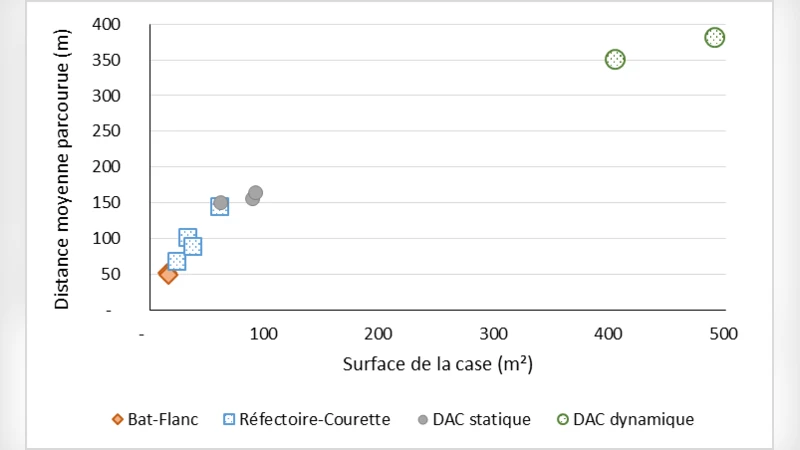
Assessment of the motor activity of group-housed sows in commercial farms. The objective of this study was to specify the level of motor activity of pregnant sows housed in groups in different housing systems. Eleven commercial farms were selected for this study. Four housing systems were represented: small groups of five to seven sows (SG), free access stalls (FS) with exercise area, electronic sow feeder with a stable group (ESFsta) or a dynamic group (ESFdyn). Ten sows in mid-gestation were observed in each farm. The observations of motor activity were made for 6 hours at the first meal or at the start of the feeding sequence, two consecutive days and at regular intervals of 4 minutes. The results show that the motor activity of group-housed sows depends on the housing system. The activity is higher with the ESFdyn system (standing: 55.7%), sows are less active in the SG system (standing: 26.5%), and FS system is intermediate. The distance traveled by sows in ESF system is linked to a larger area available. Thus, sows travel an average of 362 m $\pm$ 167 m in the ESFdyn system with an average available surface of 446 m${}^2$ whereas sows in small groups travel 50 m $\pm$ 15 m for 15 m${}^2$ available.
💡 Research Summary
This study quantitatively evaluated the motor activity of group‑housed pregnant sows across four commercial housing systems to determine how housing design influences sow behavior. Eleven commercial farms in France were selected, each representing one of four systems: (1) Small Groups (SG) of five to seven sows confined to approximately 15 m², (2) Free‑Access Stalls (FS) combined with a dedicated exercise area, (3) Electronic Sow Feeder with a stable group (ESFsta), and (4) Electronic Sow Feeder with a dynamic group (ESFdyn) where group composition changes with each feeding event. Ten mid‑gestation sows per farm (total = 110 sows) were observed for six consecutive hours, beginning at the first meal or at the start of the feeding sequence. Observations were recorded every four minutes, capturing posture (standing vs. lying) and locomotion. Distance traveled was measured using video tracking calibrated against known reference points, allowing calculation of mean travel distance and standard deviation for each system.
Statistical analysis (ANOVA with Tukey post‑hoc tests) revealed clear system‑dependent differences. Standing proportion was highest in the ESFdyn system (55.7 % of observations), intermediate in FS (≈40 %), lower in ESFsta (≈35 %), and lowest in SG (26.5 %). Correspondingly, mean travel distance varied dramatically: ESFdyn sows covered an average of 362 ± 167 m, ESFsta sows 210 ± 120 m, FS sows 150 ± 80 m, and SG sows only 50 ± 15 m. The larger available floor area in ESFdyn (average 446 m² per group) was strongly correlated with increased movement, whereas the constrained 15 m² in SG limited both standing time and locomotion.
These findings underscore that housing design directly shapes sow welfare‑related behaviors. Higher activity levels in ESFdyn likely reflect increased opportunities for exploration, competition for feed, and social interaction due to the dynamic regrouping and ample space. Such activity can promote musculoskeletal health, reduce stereotypies, and improve overall welfare. However, elevated movement also raises energy expenditure, potentially affecting feed conversion efficiency and production economics. Conversely, the low activity observed in SG may predispose sows to lameness, reduced bone density, and heightened stress, despite lower feed costs associated with smaller facilities.
Practical implications for producers include the need to balance space allocation, feeding technology, and group management. When adopting dynamic electronic feeding systems, careful attention must be paid to equitable feed distribution and monitoring of social hierarchy to avoid excessive aggression. For farms constrained to small‑group or stall‑based systems, supplemental enrichment (e.g., manipulable objects, increased floor space, or scheduled exercise periods) may be necessary to mitigate inactivity‑related welfare issues.
The study’s limitations involve its relatively short observation window (six hours centered on feeding) and the absence of direct links to production outcomes such as litter size, sow weight gain, or health events. Future research should incorporate longitudinal behavioral monitoring, physiological stress markers, and productivity metrics to develop comprehensive models that optimize both welfare and economic performance.
In conclusion, the research demonstrates that sow motor activity is markedly higher in housing systems that provide extensive floor area and dynamic group composition, particularly the ESFdyn system. These results support the recommendation that commercial swine operations consider expanding usable space and implementing flexible feeding strategies to enhance sow welfare while carefully managing the associated nutritional and management trade‑offs.
Comments & Academic Discussion
Loading comments...
Leave a Comment