On the nuclear halo of a proton pencil beam stopping in water
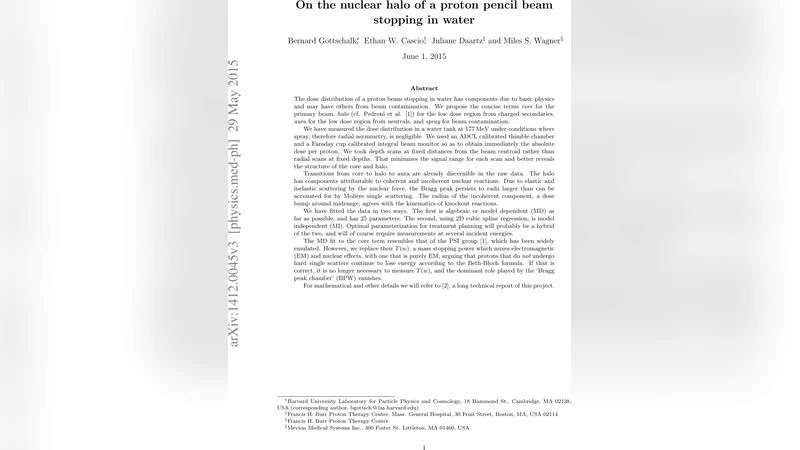
The dose distribution of a pencil beam in water consists of a core, a halo, an aura and (possibly) spray. The core is due to primary protons which suffer multiple Coulomb scattering (MCS) and slow down by multiple collisions with atomic electrons (Bethe-Bloch theory). The halo is due to charged secondaries, many of them protons, from elastic interactions with H, elastic and inelastic interactions with O, and nonelastic interactions with O. We show that the halo radius is roughly one third of the beam range. The aura is due to neutral secondaries (neutrons and gamma rays). Spray denotes dose, avoidable in principle, coming in from the beam line. We have measured the absolute dose at 177 MeV using a test beam in a water tank. The beam monitor was a PPIC ‘proton counter’ and the field IC a dose calibrated Exradin T1. We took depth-dose scans at ten displacements from the beam axis ranging from 0 to 10 cm. The dose spans five orders of magnitude, and the transition from halo to aura is obvious. We present model-dependent (MD) and model-independent (MI) fits to these data. The MD fit has 25 parameters, and the goodness of fit (rms (measurement/fit) - 1) is 15%. The MI fit uses cubic spline fits in depth and radius. The goodness of fit is 9%. This fit is more portable and conceptually simpler. We discuss the prevalent parameterization of the core/halo originated by the PSI group. We argue that its use of T(w), a mass stopping power which includes energy deposited by nuclear secondaries, is incorrect. The electromagnetic (Bethe-Bloch) mass stopping power should be used instead. In consequence, ‘Bragg peak chamber’ measurements and associated corrections are, in our view, irrelevant. Furthermore, using T(w) leads to spurious excess dose on the axis of the core around midrange, which may be significant in fields involving relatively few pencil beams.
💡 Research Summary
This paper provides a comprehensive experimental and modeling study of the nuclear halo that surrounds a 177 MeV proton pencil beam in water, a phenomenon of growing importance for modern pencil‑beam scanning (PBS) proton therapy. The authors first introduce a clear terminology that separates the dose distribution into four components: core (primary protons undergoing only electromagnetic interactions), halo (charged secondaries produced by hard single scatters), aura (neutral secondaries such as neutrons and gammas), and spray (unwanted beam contamination from upstream equipment).
Using a dedicated test beam at the Francis H. Burr Proton Therapy Center, absolute dose measurements were obtained with a plane‑parallel ionization chamber (PPIC) serving as the integral beam monitor and an ADCL‑calibrated Exradin T1 thimble chamber for the field dose. Rather than the conventional radial scans at fixed depths, the authors performed depth scans at ten fixed radial offsets (0–10 cm). This approach reduces the dynamic range of each scan and makes the transition from core to halo to aura visually evident in the raw data. The measured depth‑dose curves span five orders of magnitude, clearly showing a Bragg‑peak‑like feature persisting to large radii and a broad “mid‑range bump” at radii of several centimeters.
The physical origin of the halo is dissected in detail. Charged secondaries arise from four classes of hard interactions: (1) electromagnetic elastic scattering on hydrogen and oxygen (the single‑scattering tail of the Molière distribution), (2) nuclear elastic scattering on H and O, (3) nuclear inelastic scattering on O (excitation of the target nucleus), and (4) non‑elastic reactions on O that eject protons or clusters. Kinematic analysis shows that the most energetic charged secondaries can travel laterally up to roughly one‑third of the incident proton range, which for 177 MeV corresponds to about 8 mm. This explains why commercial Bragg‑Peak Chambers (BPCs) with a 4 cm radius are too small to capture the full halo at clinical PBS energies.
Two fitting strategies are presented. The model‑dependent (MD) fit uses a physics‑based functional form with 25 parameters describing the core (Bethe‑Bloch stopping power, Fermi‑Eyges transport, range straggling), the halo angular and energy spectra, and the aura contribution. The MD fit reproduces the data with a root‑mean‑square (RMS) deviation of 15 % (measurement/fit – 1). The model‑independent (MI) fit employs a two‑dimensional cubic spline regression in depth and radius, requiring far fewer parameters and achieving a better RMS deviation of 9 %. The MI approach is computationally simpler and more portable, making it attractive for integration into treatment‑planning systems (TPS).
A central critique is directed at the widely used PSI model, which incorporates a mass stopping power T(w) that mixes electromagnetic and nuclear energy loss. The authors argue that for the core, only the pure electromagnetic stopping power (Bethe‑Bloch) should be used because protons that have not undergone a hard scatter continue to lose energy solely via electromagnetic processes. Consequently, the measurement of T(w) with a BPC and the associated correction procedures become unnecessary. Using T(w) leads to an artificial excess dose on the beam axis around mid‑range, which could be clinically relevant in fields composed of a small number of pencil beams.
The paper also discusses the clinical implications of the halo. Although the halo contributes only about 10 % of the total integrated dose, its spatial extent means that overlapping halos from neighboring pencil beams can increase the dose in the low‑dose region, affecting field‑size factors and potentially normal‑tissue sparing. The aura, while extending far beyond the patient, contributes negligibly to the high‑dose region but must be considered for shielding and whole‑room dose assessments. Spray, although minimized in the experimental setup, is identified as a source of additional low‑dose contamination arising from degraders, beam‑profile monitors, and beam‑pipe walls; mitigation strategies are suggested.
In summary, the authors provide (1) a high‑quality absolute measurement of the proton beam halo in water at a clinically relevant energy, (2) a clear physical explanation of halo formation based on coherent (elastic) and incoherent (inelastic, non‑elastic) nuclear reactions, (3) two complementary fitting methodologies, with the model‑independent spline approach offering superior accuracy and ease of implementation, and (4) a compelling argument that the traditional BPC‑based correction and the mixed stopping power T(w) are unnecessary and potentially misleading. The work offers a solid foundation for more accurate dose‑calculation algorithms in PBS proton therapy and highlights the need to incorporate halo physics explicitly when commissioning TPS or evaluating low‑dose spill‑over in complex treatment fields.
Comments & Academic Discussion
Loading comments...
Leave a Comment