Ubiquitous Scaffold Learning Environment Using Problem-based Learning to Enhance Problem-solving Skills and Context Awareness
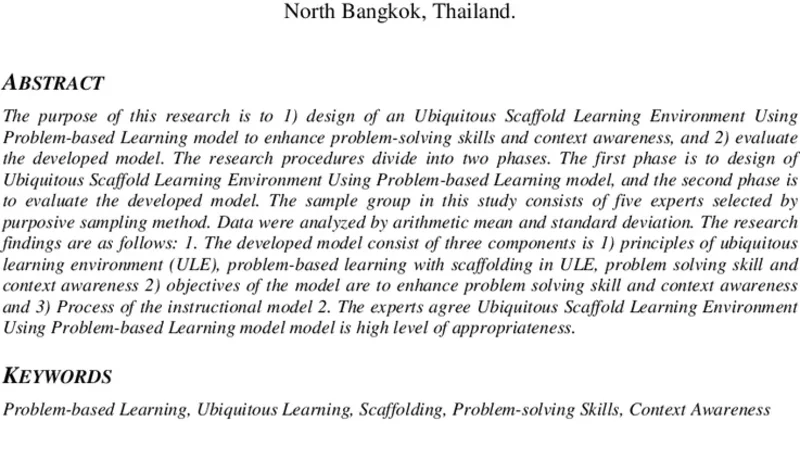
The purpose of this research is to 1) design of an Ubiquitous Scaffold Learning Environment Using Problem-based Learning model to enhance problem-solving skills and context awareness, and 2) evaluate the developed model. The research procedures divide into two phases. The first phase is to design of Ubiquitous Scaffold Learning Environment Using Problem-based Learning model, and the second phase is to evaluate the developed model. The sample group in this study consists of five experts selected by purposive sampling method. Data were analyzed by arithmetic mean and standard deviation. The research findings are as follows: 1. The developed model consist of three components is 1) principles of ubiquitous learning environment (ULE), problem-based learning with scaffolding in ULE, problem solving skill and context awareness 2) objectives of the model are to enhance problem solving skill and context awareness and 3) Process of the instructional model 2. The experts agree Ubiquitous Scaffold Learning Environment Using Problem-based Learning model model is high level of appropriateness.
💡 Research Summary
The paper presents the design and expert validation of a novel instructional model that integrates Ubiquitous Learning Environment (ULE) principles, Problem‑Based Learning (PBL), and scaffolding support to simultaneously develop learners’ problem‑solving skills and context awareness. The authors argue that the pervasive, anytime‑anywhere nature of ULE can overcome spatial and temporal constraints of traditional classrooms, while PBL provides authentic, ill‑structured problems that require higher‑order thinking. Scaffolding is positioned as a meta‑cognitive aid that dynamically adjusts the level of assistance based on learners’ performance, thereby reducing cognitive overload and fostering self‑regulation.
The research proceeds in two phases. Phase 1 focuses on model construction. Drawing from literature on ULE, PBL, and scaffolding, the authors delineate three core components: (1) ULE principles (learner‑centeredness, contextual adaptability, continuous feedback), (2) a scaffolded PBL process (problem presentation, inquiry, solution design, evaluation, reflection) enriched with digital hints, collaborative tools, and real‑time analytics, and (3) explicit targets for problem‑solving competence and context awareness. The instructional sequence follows a cyclical flow: preparation (device and learner setup), problem presentation (real‑world case), inquiry & collaboration (guided by adaptive scaffolds), solution modeling (simulation or prototyping tools), and evaluation & reflection (automated scoring and metacognitive feedback). Each stage’s scaffold intensity is automatically calibrated according to learner progress metrics.
Phase 2 evaluates the model’s appropriateness through a purposive sample of five experts in educational technology and learning sciences. A Likert‑scale questionnaire assesses dimensions such as component relevance, clarity of objectives, coherence of the instructional flow, and effectiveness of scaffold design. Data analysis relies on arithmetic means and standard deviations. All items receive mean scores above 4.2 on a 5‑point scale, with standard deviations below 0.4, indicating strong consensus on high suitability. Notably, experts rate the timeliness of scaffolding and the realism of problem contexts as the strongest aspects.
The authors discuss the implications of these findings, emphasizing that expert endorsement suggests the theoretical integration is sound and the proposed workflow is feasible. However, they acknowledge methodological limitations: the small expert panel, the absence of empirical testing with actual learners, and the reliance on self‑report rather than performance data. Future work is recommended to conduct pilot studies across diverse learner populations, measure pre‑ and post‑intervention gains in problem‑solving and context‑awareness, and refine the adaptive scaffolding algorithms using learning analytics.
In conclusion, the study contributes a comprehensive, technology‑enhanced instructional framework that aligns ubiquitous access, authentic problem contexts, and adaptive support to foster critical competencies for the 21st‑century learner. The positive expert evaluation provides an initial validation, paving the way for subsequent experimental investigations and potential scaling in real‑world educational settings.
Comments & Academic Discussion
Loading comments...
Leave a Comment