Effects of dimers on cooperation in the spatial prisoners dilemma game
We investigate the evolutionary prisoner's dilemma game in structured populations by introducing dimers, which are defined as that two players in each dimer always hold a same strategy. We find that influences of dimers on cooperation depend on the t…
Authors: Haihong Li, Hongyan Cheng, Qionglin Dai
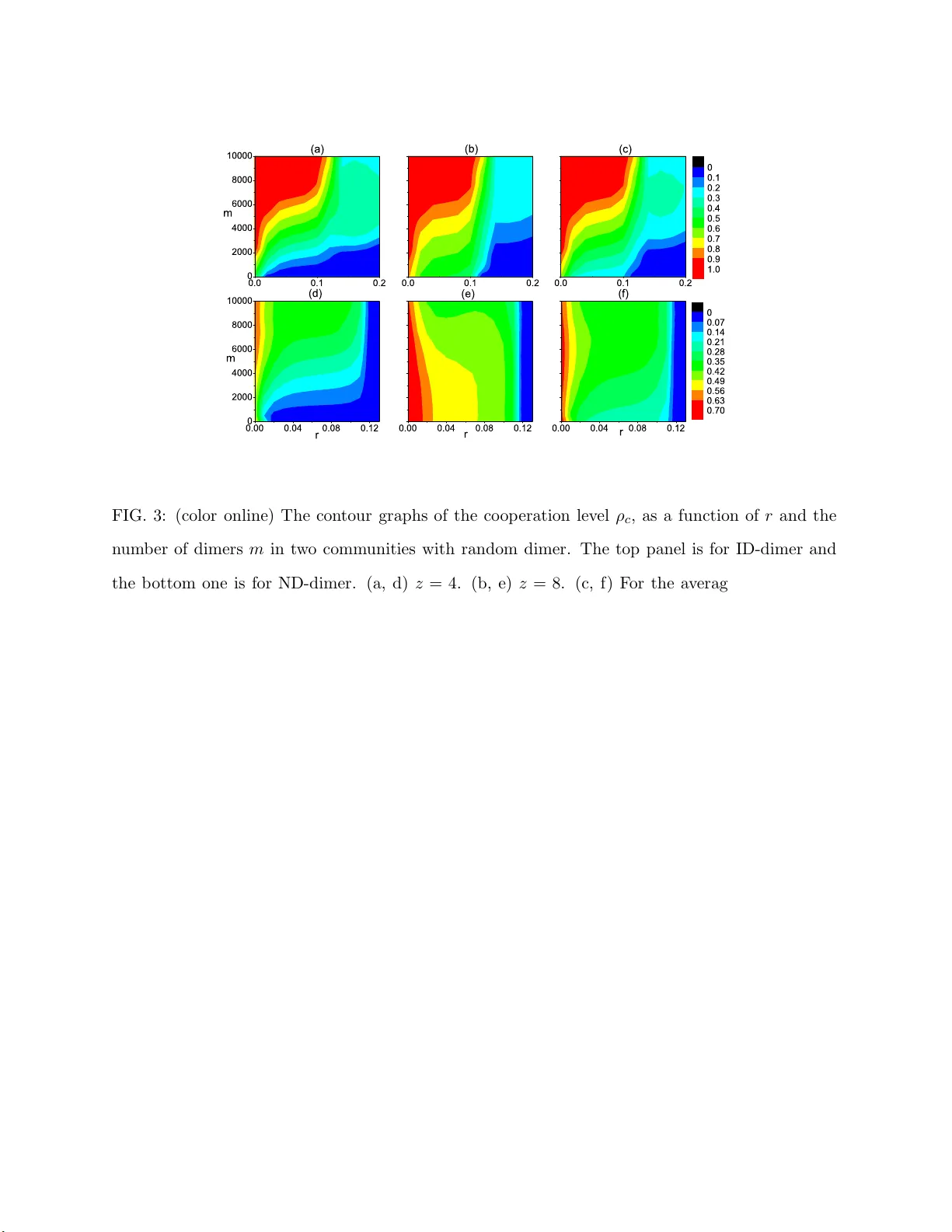
Effects of dimers on co op eration in the spatial prisoner’s dilemma game ∗ Haihong Li(), 1 , † Hongy an Cheng(), 1, 2 Qionglin Dai(), 1 Ping Ju(), 1 Mei Zhang(), 2 and Junzhong Y ang() 1 1 Scho ol of Scienc e, Beijing University of Posts and T el e c ommunic ations, Beijing, 100876, Pe ople’s R epublic of China 2 Dep artment of Physics, B eijing Normal University, Beijing, 100875, Pe ople’s R epublic of China Abstract W e in v estigate the ev olutionary prisoner’s dilemma game in structured p opu lati ons by in tro- ducing dimers, whic h are defin ed as that t w o pla y ers in eac h dimer alwa ys hold a same strategy . W e find that influ en ce s of d im er s on co op eration dep end on th e t yp e of d im er s and the p opu la- tion structur e. F or those dimers in whic h p lay ers interac t with eac h other, the co op eration lev el increases w ith the num b er of dimers though the co op eration impro v emen t leve l dep end s on the t yp e of net w ork structur es. On the other hand, the dimers, in whic h there are not m utual inter- actions, will not d o any go o d to the co op eratio n lev el in a single comm unity , but inte restingly , will impro v e the co op eration lev el in a p opulation with t w o comm unities. W e explore the relation- ship b et we en dimers and self-in teractions and find that the effects of d im er s are similar to th at of self-in teractions. Also, we fi nd that the dimers, which are established o v er tw o comm unities in a m ulti-comm unit y netw ork, act as one t yp e of int eraction throu gh which information b et wee n comm unities is comm unicated b y the requiremen t that t w o pla y ers in a dimer hold a same strategy . Keyw ords: Prisoner’s dilemma ga me, Co op eration fr equ ency , Netw orks P ACS num b ers: 02 .50.Le, 87.23 .Kg, 89.75.Fb ∗ This w ork is suppor ted by the pro jects of National Natural Science F oundation of China under Gr a n t No . 10775 022, Gr an t No. 909 21015 a nd the F undamental Resear c h F unds for the Central Univ ersities. † Electronic address: ha iho ngli@bupt.edu.cn 1 I. INTR ODUCTIO N The sp on taneous emergence of co op eration in groups of selfish individuals is ubiquitous in h uman society and biological system s and the evolutionary g ame theory has b een considered as an imp ortant approach to in ves tigate the co op erativ e b eha vior in those systems. As one of the most in triguing games, the evolutionary prisoner’s dilemma game (PDG) has attracted m uch a t ten tion o v er the last few decades [1] for gaining understanding the emergence of co op eration. In a PDG, each individual c ho oses co op eration (C) or defection (D) as her comp eting strategy . When the po pulation is w ell- mixed, a PDG fails to sustain co operat ion, whic h is often at o dds with realit y where mutual co op eration may also b e the final outcome of the ga me [2– 4]. In Now ak a nd Ma y’s seminal w o rks [5, 6], the t w o-dimensional (2D) square lattice and the in teraction b et wee n nearest neigh b ors enable co op erators to protect themselv es against exploitatio n of defectors by for ming compact clusters on the lattice. F rom then on, the evolutionary PDG on a structured populat io n has been a hot sp ot. The influences on co op eration by differen t f a ctors o f mo dels hav e b een studied in tensiv ely . F or example, a la rge set o f strategies were used [7–9], differen t ev olutionary rules w ere in tro duced [10, 11], differen t types of ra ndomnes s were considered [12–16], and so on. Also, the influences of p opulation structure on co op eration ha v e attra cted muc h attention, f o r example, types of net w o rk structure [5, 17 – 26] a nd the top ological prop erties of structure suc h as av erage degree [27], degree-mixing patt erns [28] a nd clustering co efficien t [29, 30]. Generally , the o pinion that the div ersit y in p ersonalities o f individuals o r in p opulation structures could enhance co op eration in an ev olutio nary PD G [10, 31–37] has b een widely accepted. No w, t he in v estigation on an ev olutiona ry PDG has been extended to structured p opula- tions with communities . Lozano et al. studied t he PDG in tw o practical net w orks in which in ter-comm unit y structure and in tra-communit y structure w ere designed and f o und that co op eration dep ends strongly on b oth intra-comm unity heterogeneit y and inte r-communit y connectivit y [3 8, 39]. In [40], t he authors considered the p opulation with tw o comm unities and studied the effects o f in ter-connection on co op eration. They found that co op eration ma y displa y a resonance-like b eha vior with the v aria t ion of the n umber o f inter-connec tions. Consider that, in h uman so ciet y , there alw ays exist man y small coalitions such a s family mem b ers, colleag ues, friends, colla b orat o rs, and so on. The mem b ers within one coalit io n 2 alw ays hold the same b elief and b ehav e in a consisten t wa y . It is an in teresting question that ho w co op eration v aries when the small coalitions are in tro duced in to structured p opulations. In this w ork, w e consider the influence s of the factors on co op eration b y in tro ducing dimers to a n ev olutio nary PDG in structured p opulations. In each dimer, tw o play ers alw a ys hold a same strategy . The pap er is organized as follow s. In section 2, the mo del incorp orating dimers and the categories of dimers ar e in t r o duced. In section 3, w e firstly discuss the effects of different categories of dimers on coo peration in square lattices and ER netw orks [41]. And then, we compare the effects o f dimers a nd self-in teraction. F inally , w e expand t he study to p opulations with tw o comm unities [40] and more rich phenomen a are found. In the final section, we giv e some discussions and conclusions. I I. MODEL In a standard ev olutionary PD G, there are t w o steps in one g ene ration. In the first step, eac h pla y er follows co op eration s x = ( 1 0 ) or defection s x = ( 0 1 ). The pay off of a pla y er x accum ulating b y playing PDGs with her neigh b ors can b e expressed as P x = X y ∈ Ω x s + x Qs y , (1) where s + x denotes the transp ose o f the state vec tor s x . Ω x includes a ll of the neigh b ors of the pla y er x . F or simplicit y , but without loss o f g enerality , w e follow the previous work [12] and ado pt the re-scaled pa y off matrix Q dep ending on one single parameter r for PDG Q = 1 − r 1 + r 0 , 1 < 1 + r < 2 . (2) In this notation, 1 < 1 + r < 2 measures a defector’s temptation to exploit the neigh b oring co op erators a nd − r denotes the suc ker’s pay off f or a co op erator encoun tering a defector. Here, r denotes t he ratio of the costs of co op eration to the net b enefits of co op eration. In the second step, the play er x will adopt the strategy s y of a randomly c hosen neigh b or y with a probabilit y whic h is determined by the pa y off difference b et we en them [15]: W ( s x ← s y ) = 1 / [1 + exp [( P y − P x ) /K ]] , (3) 3 where the pa r a meter K , whic h is analogous to the temp erature in F ermi-D ir a c distribution in statistical phy sics, c haracterizes the sto c hastic uncertainties in making decisions for t he pla y er x [14, 15]. Throughout the work, w e set K = 0 . 1. In this w ork, the play ers in the p opulation are divided in to tw o groups: one with ordinary pla y ers who follow the standard ev olutiona ry PDG, a nd the other with dimers. The play ers in dimers behav e differen tly from the ordinary play ers only in the step of strategy updating : in eac h dimer, the one with higher pa y off up dates her strategy ordinarily a nd t he other just follows her partner. Based on whether the t w o play ers in a dimer play g ame with eac h other or not, dimers can b e classified in t o t w o categories: in t eracting ones (I-D imer) and non-inte racting ones (N-Dimer). Each category of dimers can b e sub divided into lo cal dimers (L-D imer) and distan t dimers (D-D imer) dep ending on whether the play ers in a dimer a re neigh b ors or not on the g iven net w ork. T o b e noted, f o r ID-Dimer, the given net work structure is mo dified b y extra connections b et ween pla y ers in dimers and, f o r NL- Dimer, the g iven netw ork structure is mo dified b y cutting the connections b etw een play ers in dimers. In this work, w e do not consider NL-Dimer and just fo cus on the effects of the other three categories o f dimers on co opera t ion in differen t types of p opulation structures such as square lat tices with p erio dic b oundary conditions and degree z = 4, Erd¨ os-R ´ en yi (ER) [41] net works with mean degree z = 8 and structural p opulatio ns with t w o comm unities. In a t w o -comm unit y-structure p opulation where one communit y is a square la ttice with z = 4 and the other a square lattice with z = 8, dimers are established o ver these t w o comm unities, that is, tw o play ers in a dimer lo cate on differen t comm unities. Throughout this w ork, w e set the num b er of pla y ers in the p opulation to be N = 10 , 000. Initially , in the Monte Carlo s im ulations, m dimers are randomly assigned through the p opulation and play ers ta ke the strategy of C or D with equal pro ba bility . T o measure the co op eration lev el, the co op erator fr equency ρ c will b e monitored when the ev olution of strat- egy pattern reache s its steady state. All the f o llo wing data are obtained with sync hronous strategy up dating and each p oint is g ained b y av eraging 1000 generations after a transien t time of 6000 g eneratio ns and b y av eraging ov er 1 00 indep ende n t realizations. 4 0 . 0 0 . 1 0 . 2 0 . 3 0 2 0 0 0 4 0 0 0 m 0 . 0 0 . 1 0 . 2 0 . 3 0 2 0 0 0 4 0 0 0 0 . 0 0 0 . 0 2 0 . 0 4 0 2 0 0 0 4 0 0 0 ( f ) ( c ) ( b ) ( a ) 0 0 . 1 0 . 2 0 . 3 0 . 4 0 . 5 0 . 6 0 . 7 0 . 8 0 . 9 1 . 0 0 . 0 0 . 1 0 . 2 0 2 0 0 0 4 0 0 0 ( d ) ( e ) r m 0 . 0 0 . 1 0 . 2 0 2 0 0 0 4 0 0 0 r 0 . 0 0 . 1 0 . 2 0 2 0 0 0 4 0 0 0 r FIG. 1: (col or online) The contour graphs of the co op eration leve l ρ c for ev olutionary PDGs, as functions of r and the num b er of dimers m on square lattices with z = 4 (top panel) and ER net w orks with mean degree z = 8 (b ottom p anel). m increases from 0 to 4400 in all cases. (a, d) F or IL-Dimer. (b, e) F or I D-Dimer. (c, f ) F or ND-Dimer. I I I. SIMULA TION RESUL T S AND ANAL YSIS Generally , co op eration is main tained in an ev olutionary PDG on net w orks b y f orming co op erator clusters (C-clusters). The in teractions b et w een co op erators at the b oundaries of C-clusters and tho se inside C-clusters enable co op erators at t he b oundaries to ha v e high pa y o ffs to comp ete with surrounding defectors. In tuitiv ely , the same strategy held by the pla y ers in a dimer mak e it p ossible t ha t co op erator dimers (C-dimer) serv e as seeds for C-clusters and tend to accelerate the expansion of C-clusters. Therefore, it seems that the presence o f dimers in an ev olutio nary PDG w ould impro v e co op eration. How ev er, a s w e sho w b elo w, the effects of dimers on co op eration are not self-eviden t and whether co op eration is impro v ed or not dep ends on the t yp e of dimers and the structure of the underlying net w orks. Firstly , w e inv estigate the effects of dimers o n co op eration in p o pulations without multi- comm unity . The con tour graphs of co op erator frequency ρ c as functions of r a nd the n um b er of dimers m are presen ted in figure 1. The top panel sho ws the results for IL-Dimer, ID -Dimer 5 and ND-Dimer on square lattices, resp ectiv ely . F or the range of r that is not co v ered here, almost all of ρ c reac hes 0 or will descend to 0 a nd no mor e raise of ρ c app ears. Intere stingly , the presence o f interaction b et w een play ers in a dimer plays a decisiv e role on co op eration. Dimers enhance co op eration strongly f or both IL-Dimer and ID-Dimer. Esp ecially , in these t w o situations, the state that all play ers b ecome co op erators (All-C state) may b e r eac hed for a large rang e of r where co op erators die off in the absence of dimers. F urthermore, ID-Dimer sho ws a faster growth of ρ c with the n um b er of dimers than IL-Dimer in the range of r < 0 . 2 , whic h indicates a stronger co op eration enhancemen t fo r ID-Dimer than IL-Dimer. The stronger co op eration enhancemen t for ID -Dimer results from the presence of shortcuts established by the t w o pla y ers in each dimer. T og ether with a same strategy held b y play ers in a dimer, these shortcuts shorten the av erage distance b et w een a ny t wo pla ye rs, whic h sp eeds up the expansion of C-clusters. O n the other hand, the presence of ND-Dimer deteriorates co op eration, i.e., ρ c decreases with the n um b er of dimers. The deteriorat ion of co op eration f or ND-D imer could b e explained by t he b ehav ior of C-dimer. Since there are no in teractions b et we en pla y ers in these C-dimers, the adv antage in pay off f o r co op era t o rs at the b oundaries of C-clusters o v er defectors ma y b e w eak ened. Additionally , due to the absence of in teraction b et w een the pla y ers in these C-dimers, the sp eeding up of the expansion of C-clusters is lost and t he defectors will b enefit fro m these C-dimers prov ided that they are the neigh b ors of these C-dimers. Both of these suppress co op eration in ND-D imer and the suppression o f co operat ion increases with the num b er of dimers. The b ottom panel in figure 1 shows the results fo r IL-D imer, ID- Dimer and ND-Dimer on ER net works, resp ectiv ely . In comparison with the to p panel in figure 1 , t he improv e- men t of co op eration b y IL-Dimer and ID-Dimer is observ ed, though the impro v emen t is not prominen t. How ev er, the influence o f ND -Dimer on co op eration is quite differen t from that on square lattices: ρ c is insensitiv e to the presence of dimers in this situation. Consider t ha t, in ER net w orks where the mean distance b et w een a n y t w o pla y ers is short, the play ers in C-clusters are alw a ys exp osed to defectors and defectors alwa ys b enefit from co op erators in C-clusters in an or dina r y PDG. When ND-Dimer is intro duce d, defectors cannot g et more b enefits from C-dimer than those in the absence of ND-Dimer. Therefore, the deterioration of co op eration b y ND-Dimer on square latt ice s is missed on ER net w orks and co op eration is indep enden t of the n um b er of dimers. It is w ell kno wn that the inclusion of self-in teractio n in an ev olutionary PDG on net works 6 0 . 0 0 . 2 0 . 4 0 . 6 0 . 8 1 . 0 0 . 0 0 . 2 0 . 4 0 . 6 0 . 8 1 . 0 0 . 0 0 . 2 0 . 4 0 . 6 0 . 8 1 . 0 0 . 0 0 . 2 0 . 4 0 . 6 0 . 8 1 . 0 0 . 0 0 . 1 0 . 2 0 . 3 0 . 4 0 . 0 0 . 2 0 . 4 0 . 6 0 . 8 1 . 0 0 . 0 0 . 1 0 . 2 0 . 3 0 . 4 0 . 0 0 . 2 0 . 4 0 . 6 0 . 8 1 . 0 ( a ) c , d ( m ) c , s ( m ) r = 0 . 1 0 r = 0 . 2 4 ( b ) c , d ( m ) c , s ( m ) r = 0 . 1 0 r = 0 . 2 0 ( c) c r ( d ) c r FIG. 2: (color online) The relationships b et w een the co op erator frequencies ρ c,s for square lattices with self-interac tion and ρ c,d for those with dimers. (a) ρ c,d is for IL-Dimer. Closed squares are for r = 0 . 10 and op en circles for r = 0 . 24. (b) ρ c,d is for ID-Dimer. C losed s q u ares are f or r = 0 . 10 and op en circles for r = 0 . 20. (c) The closed sym b ols are for IL-Dimer with m = 2000 (squ ares) and m = 4400 (circles). The op en symb ols are for the case without d im er s and in whic h there are 4000 (squares) or 8800 (circles) play ers with self-in teraction. (d) The closed symb ols are for ID-Dimer with m = 2000 (squ ares) and m = 4400 (circles). Th e op en symbols are for the case without dimers and in whic h there are 4000 (squares) or 8800 (circles) p la y ers with self-in teraction. The structure of netw orks for the case with self-inte raction is same as th at in ID-Dimer, wh ic h is mo dified by the shortcuts b et ween p la y ers in dimers. [15] fa v ors co op eration. How ev er, how self-in teraction relat es to realit y is unknow n. As far as it is concerned that a same strategy is held b y tw o pla y ers in a dimer, w e find that the in teraction b et we en play ers in a dimer for IL-Dimer o r ID-Dimer acts as self-in teraction and either IL-D imer or ID-Dimer prov ides a wa y to realize self-in tera ctio n for play ers to some exten t. T o mak e it clear, w e compare the effects of IL- Dimer ( o r ID -Dimer) a nd self-in t era ctio n on co op eration. W e take square lat t ices with z = 4 as examples. It has to b e men tioned that the square lattices with the presence of ID-Dimer are mo dified b y the shortcuts b et ween play ers in dimers. Therefore, the net w orks with self-in teraction to b e studied a re ’square latt ices’ with the same shortcuts as those established b y dimers. T o 7 b e noted, not all pla y ers on net w orks hav e self-interaction and the num b er of pla y ers with self-in t era ctio n is t wice as man y as the n um b er of dimers. F or a giv en n um b er of dimers m , w e monitor the co op erator frequencies ρ c,s ( m ) for net w orks with self-in teraction and ρ c,d ( m ) for net works with dimers. As sho wn in the top panel in fig ur e 2 where the r elationships b et w een ρ c,s ( m ) and ρ c,d ( m ) are presen ted, ρ c,s ( m ) is p ositiv ely correlated with ρ c,d ( m ) and the slop e o f ρ c,d o v er ρ c,s is ro ug hly aro und 1, which means that IL-Dimer or ID-Dimer do es pro vide a w a y to realize self-in teraction. How ev er, some differences exist b et w een the systems with self-in teraction and those with IL-Dimer or ID-D imer. F or example, as sho wn in the b ottom panel in figure 2 where ρ c,s and ρ c,d against r for different m are presen ted, ρ c,s is alwa ys higher than ρ c,d for small r whereas ρ c,s b ecomes lo w er t ha n ρ c,d for large r . Additionally , the ab o v e mo del is inv estigated in square lattices and ER net w orks with some other mean degrees , suc h as z = 8 for square lattices and z = 4 f or ER net w orks. The analogous phenomena could b e obtained. Since that there is an explicit dep endence betw een the v a lue o f the K and the outcome of the prisoner’s dilemma follow ing the F ermi up date rule, w e test the w ork with different K and find t he robustness o f our results against the v ariation of K . Secondly , w e consider the effects of dimers on a p opulation with tw o commun ities: one is a square lattice with z = 4 and the other with z = 8. As stated in the model section, tw o pla y ers in each dimer b elong to differen t commun ities and are randomly selected. Clearly , dimers on this p opulation structure fall into the category of either ID-Dimer or ND-Dimer. The effects of dimers on co op eration for ID-D imer and ND-Dimer are illustrated in the top panel and the b ottom panel in figure 3, resp ectiv ely . The left and middle columns sho w the contour graphs of ρ c on the r - m space for the t w o commun ities resp ectiv ely and the righ t column is for the whole p opulation. Similar t o the p opulations without comm unity structure, co op eration is improv ed for ID-Dimer and a high lev el of co op eration may b e reac hed. A resonance-lik e b eha vior with the v aria tion of the num b er of dimers could b e observ ed when r > 0 . 1, whic h is similar to that in [40] whic h w as discussed part icularly . In con trast with the p opulations without comm unit y structure, ND-Dimer indeed enhances co op eration. F or ND -Dimer, thoug h co op eration is a little do wngraded in the comm unit y with z = 8 in whic h ρ c is hig her, co op eration, b oth in the whole p opulation and in the comm unity with z = 4 in whic h ρ c is low er, is enhanced in comparison with that in the absence of dimers. As men tioned ab ov e, the deterioration of co op eration in a square lattice 8 0 . 0 0 . 1 0 . 2 0 2 0 0 0 4 0 0 0 6 0 0 0 8 0 0 0 1 0 0 0 0 ( a ) m 0 . 0 0 . 1 0 . 2 ( b ) 0 . 0 0 . 1 0 . 2 ( c) 0 0 . 1 0 . 2 0 . 3 0 . 4 0 . 5 0 . 6 0 . 7 0 . 8 0 . 9 1 . 0 0 . 0 0 0 . 0 4 0 . 0 8 0 . 1 2 0 2 0 0 0 4 0 0 0 6 0 0 0 8 0 0 0 1 0 0 0 0 ( d ) r m 0 . 0 0 0 . 0 4 0 . 0 8 0 . 1 2 ( e ) r 0 . 0 0 0 . 0 4 0 . 0 8 0 . 1 2 ( f ) r 0 0 . 0 7 0 . 1 4 0 . 2 1 0 . 2 8 0 . 3 5 0 . 4 2 0 . 4 9 0 . 5 6 0 . 6 3 0 . 7 0 FIG. 3: (color online) Th e con tour graphs of th e co op eratio n leve l ρ c , as a function of r and th e n umber of d imers m in tw o comm unities with random dimer. The top panel is for ID-dimer and the b ottom one is for ND-dimer. (a, d) z = 4. (b, e) z = 8. (c, f ) F or the av eraged ρ c o ver t w o comm u nities. with ND -Dimer originates from t w o factors in volving C-dimers: pla y ers in C-dimers lo cating inside C-clusters can not supp ort their partners at the b oundaries of C-clusters, y et supp ort the defectors neigh b oring their partners indirectly . Ho w ev er, for ND- D imer defined ov er tw o comm unities, the deterioration of co op eration b y the first factor is lost and, consequen tly , the do wngrade of co op eration by ND-D imer in the comm unit y z = 8 with a hig h lev el of co op eration b ecomes w eak. On the other hand, the requiremen t that the play ers in dimers hold a same strategy ma y enhance co op eration if one of play ers is in a C-cluster. Com bining these together, w e o bserv e a w eak deterioration of co op eration in o ne comm unit y whereas the enhancemen t of co op eration in the other one and in the whole p opulation. An interes ting comparison can b e made b et we en the results in this w ork and those in [40]. Both w orks consider the ev o lution of co op eration in a p opulation with t w o in teracting comm unities, but the w ay s of in teraction are differen t. Either in tera ctio n through ID-Dimer or interaction through ND-Dimer ma y lead to t w o differen t ev olutions of co op eration in comparison with t hose in [40 ]. F or interaction with ty p e o f ID- Dimer, in teraction b et w een comm unities alw a ys impro v es co operat io n, whic h is indep enden t of the co op eration lev els in 9 isolated comm unities. Actually , ev en when co op eration is extinct in b oth isolated commu - nities, co op eration ma y still reac h a high lev el. F or in teraction with t yp e of ND -Dimer, the co op eration lev els in t w o comm unities may decrease sim ultaneously for w eak interaction, and a resonance-lik e b eha vior of co op eration against in teraction strength may a pp ear for that the co op eration lev els in tw o comm unities are no t in the in t erme diate range. IV. CONCLUSIO NS In conclusion, w e in tro duce dimers in whic h tw o play ers hold t he same strategy to an ev olutiona ry PDG on structured p opulations. The effects of dimers on co op eration are in- v estigated. W e find that influences of dimers on co op eration dep end on the t yp e of dimers and the p opulation structure. F o r example, ID-D imer alwa ys enhances co op eration and a high lev el of co op eration may b e reac hed with a large num b er of dimers. Ho w eve r, the influences of ND-Dimer on co op eration dep end on the p opulation structure strongly: dete- rioration of co op eration o n square lattices, lit t le v ariation of co op eration on ER net w orks, and enhancemen t of co op eration on the p opulation with t w o comm unities. So me in teresting discussions b et w een the results in t his w ork and previous studies are made. Fir stly , w e dis- cuss the relationship b et w een dimers and self-in teractions and find that the effect of dimers is similar to that of self-in teraction. Secondly , we compare the in teraction through inte r- connections b et w een comm unities, where interaction is realized by pla ying games b et w een pla y ers in differen t communities , with that through dimers, where in teraction is realized through holding a same strat egy b y tw o pla y ers in a dimer. F or the in teraction thro ugh dimers, rich phenomena a re observ ed. References [1] R. Axelrod, The evolution of c o op er ation , Basic Books, New Y ork (1984). [2] J. Hofbauerand, K. Sigm un d Evolutionary Games and Popula tion Dynamics , C ambridge Uni- v ersit y Press, Cam bridge (199 8). [3] G. S . Wilkinson Natur e 308 (198 4) 181. 10 [4] M. Milinski Natur e 325 (1987) 433. [5] M. A. No w ak and R. M. May Natur e 359 (1992 ) 826. [6] M. A. No w ak and R. M. May Int. J. Bifur c at. Chaos Appl. Sci. Eng. 3 (19 93) 35. [7] C. Hauert and H. G. S c huster J. The or. Bi ol. 192 (1998) 155. [8] K. Lind gren and M. G. Nordahl Physic a D 75 (1994) 292. [9] M. R. F rean Pr o c. R. So c. B 257 (1994) 75. [10] G. Abr amson and M. K u p erman Phys. R ev. E 63 (2001) 030901(R) . [11] M. Masuda and K. Aihara Phys. L ett. A 313 (20 03) 55. [12] C. Hauert and G. Szab´ o Am. J. Phys. 73 (20 05) 405. [13] M. A. No wak, S. Bonho effer and R. M. Ma y Int. J. Bifu r c at. Chaos Appl. Sci. Eng. 4 (19 94) 33. [14] L. E. Blume Games Ec on. Behav. 44 (20 03) 251. [15] G. Szab´ o and C. T ¨ oke Phys. R ev. E 58 (19 98) 69. [16] M. Zh ang and J. Y ang Commun. The or. P hys. 56 (201 1) 31. [17] F. C. San tos and J. M. Pa c heco Phys. R ev. L ett. 95 (2005) 09810 4. [18] J. G´ omez -Garde ˜ nes , M. Campillo, L. M. Flor ´ ıa , and Y. Moreno Phys. R ev. L ett. 98 (2007) 10810 3. [19] G. Szab´ o and G. F´ ath Phys. R ep. 446 (2007 ) 97. [20] O. Dura´ an and R. Mu let Physic a D 208 (2005) 257. [21] P . Holme, A. T ru sina, B. J. Kim, and P . Minnh agen Phys. R ev. E 68 (2003) 030 901. [22] Z. W u, X. Xu, Y. C hen, and Y. W ang Phys. R ev. E 71 (20 05) 037103. [23] J. V uk ov, G. Szab´ o, and A. S zolnoki Phys. R ev. E 77 (2008) 026109. [24] W. X. W ang, J. Ren, G. Chen, and B. W ang Phys. R ev . E 74 (2006) 0561 13. [25] H. Ohtsuki, M. A. No wak, and J . M. P ac heco Phys. R ev . L ett. 98 (2007) 108106. [26] J. Poncela , J. G´ omez-Ga rde ˜ nes , L. M. Flor ´ ıa, and Y. Moreno New J . Phys. 9 (2007) 184. [27] H. Ohtsuki, C. Hauert, E. Lieb erman, and M. A. Now ak Natur e 441 (2006 ) 502. [28] Z. Rong, X. Li, and X. W ang Phys. R ev . E 76 (20 07) 027101. [29] S. Assenza, J. G´ omez-G arde ˜ nes, and V. Latora P hys. R ev. E 78 (2008) 01710 1. [30] Y. Liu , Z. Li, X. Chen, and L. W ang Chin. P hys. B 18 (2009) 2623 . [31] Z. W u, X. Xu and Y. W ang Chin. Phys. L ett. 23 (200 6) 531. [32] B. J. Kim, A. T rusina, P . Holme, P . Minnhagen, J. S. Chung, and M. Y. Ch oi Phys. R ev. E 11 66 (20 02) 021907. [33] N. Masuda and K. Aihara Phys. L ett. A 313 (2003) 55. [34] S. V an Segbro ec k, F. C. Sant os, T. Lenaerts, and J . M. Pa c heco Phys. R ev. L ett. 102 (200 9) 05810 5. [35] L. Lu thi, E. P estelacci, and M. T omassini Physic a A 387 (200 8) 955. [36] D. Y ang, H. Lin, C. W u, and J. Sh uai New J. Phys. 11 (200 9) 073048. [37] H. Y ang, Z . W u, C. Zhou, T. Zh ou, and B. W ang Phys. R ev. E 80 (2009) 046108. [38] S. Lozano, A. Arenas, an d A. S´ anc hez PL oS ON E 3(4) (2008 ) e1892 . [39] S. Lozano, A. Arenas, an d A. S´ anc hez J. Ec on. Inter ac. Co or d. 3 (20 08) 183. [40] H. Li, Q. Dai, H. Cheng, and J. Y ang New J. P hys. 12 (2010) 09 3048. [41] P . Erd¨ os and A. R´ en y i Publ. M ath . (Debr e c en) 6 (1959) 290. 12
Original Paper
Loading high-quality paper...
Comments & Academic Discussion
Loading comments...
Leave a Comment