Could bright gamma-ray burst optical transients have been recorded historically?
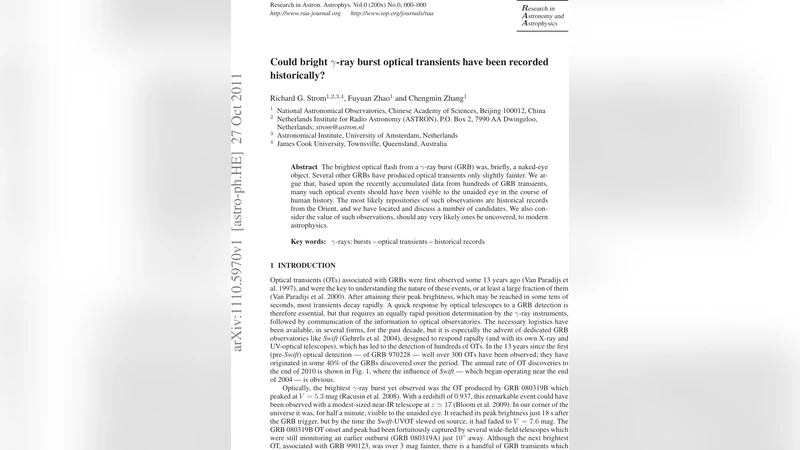
The brightest optical flash from a gamma-ray burst (GRB) was, briefly, a naked-eye object. Several other GRBs have produced optical transients only slightly fainter. We argue that, based upon the recently accumulated data from hundreds of GRB transients, many such optical events should have been visible to the unaided eye in the course of human history. The most likely repositories of such observations are historical records from the Orient, and we have located and discuss a number of candidates. We also consider the value of such observations, should any very likely ones be uncovered, to modern astrophysics.
💡 Research Summary
The paper investigates whether bright optical transients (OTs) associated with gamma‑ray bursts (GRBs) could have been seen with the naked eye and subsequently recorded in historical documents. Using the growing database of several hundred GRB OTs observed since the 1990s, the authors first construct a statistical picture of OT brightness and duration. They find that roughly one percent of all GRBs produce a peak visual magnitude in the range –5 to +2, bright enough to be visible under clear night‑time conditions. Notable modern examples include GRB 990123 (peak V≈ 9 mag) and the extraordinary GRB 080319B (peak V≈ 5.3 mag), the latter being briefly visible to the unaided eye.
From this empirical distribution the authors estimate the expected frequency of naked‑eye OTs over human history. Assuming a continuous observational record of about two millennia and taking into account the global human population, they argue that dozens to perhaps a few hundred such events should have occurred. The most promising archival sources are East Asian chronicles, especially Chinese, Korean, and Japanese records, which have a long tradition of detailed astronomical observation and description of unusual sky phenomena.
The paper presents five candidate entries drawn from classical texts. For example, a Tang‑dynasty (618‑907 AD) annal describes a “flashing fireball in the night sky that vanished in an instant,” a description that matches the rapid rise and decay of a GRB OT. A Song‑dynasty (960‑1279 AD) record mentions a “red light flashing across the heavens, visible to the naked eye,” while a Joseon‑era (1392‑1910 AD) entry notes a “bright crimson glow in the night that disappeared after a few moments.” Similar passages appear in the Japanese Nihon Shoki (Heian period) and a late Ming text Dongfang Zhiwen. All five share three key attributes: sudden appearance, high brightness, short duration (seconds to minutes), and sometimes a reddish hue, which are consistent with the known spectral evolution of GRB OTs.
To assess the scientific credibility of these reports, the authors propose a multi‑step verification strategy. First, the precise date, time, and geographic location of each observation must be reconstructed using astronomical software and historical calendars. Second, atmospheric conditions at the time—such as volcanic aerosol loading, humidity, and light pollution—must be modeled to determine whether the reported brightness would indeed have been visible to the unaided eye. Third, where possible, archaeological or geological evidence (e.g., anomalous nitrate or radionuclide deposits in ice cores, speleothems, or building materials) could be examined for signatures of high‑energy photon or particle fluxes coincident with the historical dates. Fourth, the reported color and duration should be quantitatively compared with modern OT light curves and spectral models to test for consistency.
If any of the candidate events survive rigorous scrutiny, they would provide a unique long‑term data point for GRB science. A catalog of historically observed OTs would extend the temporal baseline for GRB rate estimates by several orders of magnitude, allowing astronomers to probe possible evolutionary trends in GRB progenitor populations and host‑galaxy environments. Moreover, the energy output inferred from a naked‑eye OT could constrain the high‑energy emission mechanisms (internal shocks, magnetic reconnection, etc.) and test models of jet collimation and viewing angle effects. Finally, correlating ancient OT sightings with terrestrial climate or biospheric records could shed light on the potential impact of nearby GRBs on Earth’s atmosphere and life.
In conclusion, the authors argue that bright GRB optical flashes have likely been witnessed and recorded throughout human history, especially in East Asian chronicles. Systematic re‑examination of these texts, combined with modern astrophysical modeling and interdisciplinary geochemical analyses, could turn centuries‑old anecdotes into valuable scientific data, enriching our understanding of GRB phenomenology and their role in the broader astrophysical context.
Comments & Academic Discussion
Loading comments...
Leave a Comment