Profile shape stability and phase jitter analyses of millisecond pulsars
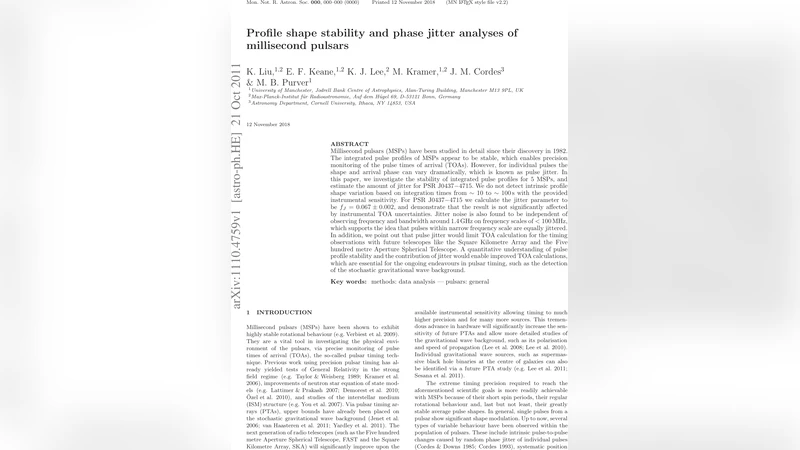
Millisecond pulsars (MSPs) have been studied in detail since their discovery in 1982. The integrated pulse profiles of MSPs appear to be stable, which enables precision monitoring of the pulse times of arrival (TOAs). However, for individual pulses the shape and arrival phase can vary dramatically, which is known as pulse jitter. In this paper, we investigate the stability of integrated pulse profiles for 5 MSPs, and estimate the amount of jitter for PSR J0437-4715. We do not detect intrinsic profile shape variation based on integration times from ~10 to ~100 s with the provided instrumental sensitivity. For PSR J0437-4715 we calculate the jitter parameter to be f_J=0.067+-0.002, and demonstrate that the result is not significantly affected by instrumental TOA uncertainties. Jitter noise is also found to be independent of observing frequency and bandwidth around 1.4 GHz on frequency scales of <100 MHz, which supports the idea that pulses within narrow frequency scale are equally jittered. In addition, we point out that pulse jitter would limit TOA calculation for the timing observations with future telescopes like the Square Kilometre Array and the Five hundred metre Aperture Spherical Telescope. A quantitative understanding of pulse profile stability and the contribution of jitter would enable improved TOA calculations, which are essential for the ongoing endeavours in pulsar timing, such as the detection of the stochastic gravitational wave background.
💡 Research Summary
This paper presents a systematic investigation of the stability of integrated pulse profiles for five millisecond pulsars (MSPs) and a quantitative assessment of pulse phase jitter, with a particular focus on PSR J0437‑4715. The authors begin by defining a correlation coefficient (ρ) between an observed integrated profile and a high‑signal‑to‑noise (SNR) template, and they derive the theoretical scaling (1 − ρ ∝ SNR⁻²) that holds in the high‑SNR regime. From this they introduce a “shape constant” C ≡ SNR·√(1 − ρ), which should be invariant if the intrinsic profile does not change. By measuring C for a series of short integrations (10–100 s) and comparing with the value C₀ obtained directly from the template, they test for any detectable profile evolution.
The paper also addresses pulse phase jitter, which manifests as stochastic variations in the arrival phase of individual pulses. Assuming that single‑pulse phases follow a Gaussian distribution, the jitter contribution to the TOA uncertainty is expressed as σ_J = f_J·R·U(t)/√N, where f_J is the jitter parameter (the width of the phase distribution in units of pulse width), R is the pulse period, U(t) the template shape, and N the number of pulses summed. The total TOA error is modeled as σ_total² = σ_rn² + σ_J² + σ_scint² + σ₀², incorporating radiometer noise, jitter, diffractive scintillation, and any additional systematic terms. By analysing timing residuals on short timescales and adjusting σ_J until the reduced chi‑square of the residuals approaches unity, the authors extract f_J.
Observations were carried out with the Parkes 64‑m telescope using two receivers: the 20‑cm multibeam (MB) and the H‑OH system. Data were recorded with the CPSR2 coherent dedisperser (2‑bit, two 64‑MHz bands centred at 1341 and 1405 MHz) and, for PSR J0437‑4715, also with the newer 8‑bit digital filterbank (DFB). Standard calibration steps—2‑bit digitisation correction, edge channel removal, polarisation calibration—were applied. For each pulsar, the authors computed ρ and C across many short integrations; the measured C values agree with C₀ within statistical uncertainties, indicating no detectable intrinsic profile variation over the examined timescales.
For PSR J0437‑4715, 500 short integrations from a single epoch were used to determine the jitter parameter. The result f_J = 0.067 ± 0.002 is robust against variations in instrumental TOA uncertainties. Moreover, the jitter noise was found to be independent of observing frequency and bandwidth on scales < 100 MHz around 1.4 GHz, suggesting that pulses within such narrow frequency slices experience the same jitter.
The authors conclude that, with current instrumentation, integrated MSP profiles are stable on timescales of tens of seconds, and jitter does not dominate TOA errors. However, the dramatic sensitivity improvements expected from next‑generation facilities such as the Square Kilometre Array (SKA) and the Five‑hundred‑metre Aperture Spherical Telescope (FAST) will reduce radiometer noise to the point where jitter becomes the primary limitation on timing precision. Accurate knowledge of profile stability and jitter parameters will therefore be essential for future high‑precision pulsar timing experiments, including pulsar timing arrays aimed at detecting the stochastic gravitational‑wave background.
Comments & Academic Discussion
Loading comments...
Leave a Comment