Removing Orbital Debris with Lasers
Orbital debris in low Earth orbit (LEO) are now sufficiently dense that the use of LEO space is threatened by runaway collisional cascading. A problem predicted more than thirty years ago, the threat from debris larger than about 1 cm demands serious attention. A promising proposed solution uses a high power pulsed laser system on the Earth to make plasma jets on the objects, slowing them slightly, and causing them to re-enter and burn up in the atmosphere. In this paper, we reassess this approach in light of recent advances in low-cost, light-weight modular design for large mirrors, calculations of laser-induced orbit changes and in design of repetitive, multi-kilojoule lasers, that build on inertial fusion research. These advances now suggest that laser orbital debris removal (LODR) is the most cost-effective way to mitigate the debris problem. No other solutions have been proposed that address the whole problem of large and small debris. A LODR system will have multiple uses beyond debris removal. International cooperation will be essential for building and operating such a system.
💡 Research Summary
The paper addresses the growing problem of orbital debris in low‑Earth orbit (LEO), where objects larger than about 1 cm have become so numerous that the risk of a runaway collisional cascade (the Kessler effect) threatens all space activities. Statistical data show roughly 2,200 large objects (≥ 1 m) and about 190 k objects (≥ 1 cm) in the 400–2,000 km band, with a peak density around 800–1,000 km. Small debris, which cannot be reliably tracked, dominate the collision risk; the probability of a fatal impact on the International Space Station is estimated at ~7 % per decade. Existing mitigation concepts—Whipple shields, grappling, nets, electrodynamic tethers, and clouds of gas, mist, or aerogel—are either prohibitively expensive, one‑time solutions, or introduce new hazards.
The authors categorize laser‑based approaches into three regimes. Low‑intensity photon‑pressure lasers provide Δv on the order of centimeters per second, far too small to be useful. Continuous‑wave (CW) heating can cause melting and irregular ablation, producing thrust that largely cancels out and requiring impractically large apertures. Pulsed laser orbital debris removal (LODR), first proposed fifteen years ago, operates at the vapor‑plasma transition where the momentum‑coupling coefficient (Cₘ) peaks. Using a 5 ns pulse, the optimal fluence for aluminum is about 53 kJ m⁻², yielding Cₘ ≈ 75 µN·s J⁻¹.
System design calculations show that delivering this fluence at a range of 1,000 km demands a diffraction‑limited spot of ~31 cm. With a beam quality factor M²≈2.0 (Strehl ratio 0.25) and wavelength 1.06 µm, the required effective aperture is roughly 13 m. Modern lightweight segmented mirrors (e.g., Keck 10 m, SALT 9.8 m, the planned 42 m E‑ELT) make such apertures feasible, especially when combined with adaptive optics or phase‑conjugation to correct atmospheric turbulence. Assuming 80 % transmission through the optics and 50 % overall atmospheric loss, a 7.3 kJ pulse energy is needed; at a repetition rate of 12.5 Hz this corresponds to an average laser power of about 91 kW.
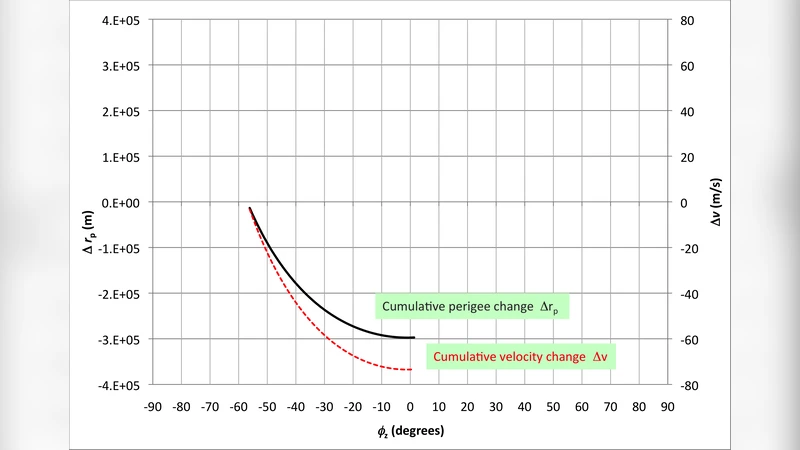
The thrust model incorporates target areal density (μ≈10 kg m⁻²), an efficiency factor ηc≈0.3 to account for imperfect thrust direction, tumbling, and beam spill‑over, and the momentum coupling coefficient. Each pulse imparts roughly 0.12 m s⁻¹ of Δv. To achieve the ~150 m s⁻¹ perigee reduction required for re‑entry, about 1,250 pulses are needed, which can be delivered in a single overhead pass lasting ~100 s. Simulations for objects up to 1 kg and altitudes up to 1,000 km confirm that a “starter” LODR system could de‑orbit such targets in one pass.
Cost analysis compares the laser approach with mechanical removal. Bonnal’s estimate of $27 M per large object (≈1 ton) is used as a benchmark; the authors argue that, after amortizing the capital cost of the laser facility over many years and many targets, LODR becomes the most economical option. Moreover, the laser facility could serve secondary functions such as space‑situational awareness, communications, and atmospheric studies, providing additional value.
The paper acknowledges several uncertainties. Atmospheric transmission and weather impose site‑specific constraints; the assumed ηc=0.3 may be optimistic without real‑time tracking and adaptive beam steering. Multi‑target engagement strategies (beam splitting, multiple apertures) are not detailed, and the policy implications of ground‑based high‑power lasers aimed at orbiting objects (potential weaponization) are only briefly mentioned.
In conclusion, the authors argue that recent advances in lightweight large‑aperture mirrors, high‑repetition‑rate multi‑kilojoule lasers derived from inertial‑fusion research, and adaptive optics make LODR technically feasible and cost‑effective. They call for experimental validation, refined atmospheric modeling, development of robust tracking and targeting algorithms, and an international governance framework to share costs and ensure responsible use. If these steps are taken, laser‑based debris removal could become the cornerstone of sustainable LEO operations.
Comments & Academic Discussion
Loading comments...
Leave a Comment