Exploring the structural regularities in networks
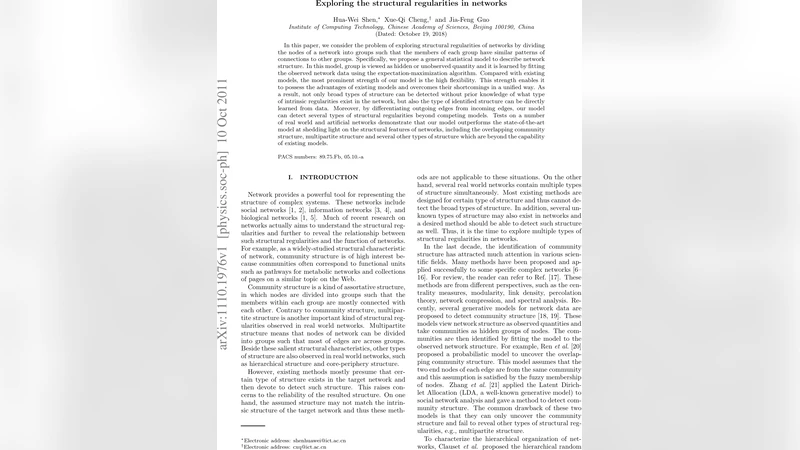
In this paper, we consider the problem of exploring structural regularities of networks by dividing the nodes of a network into groups such that the members of each group have similar patterns of connections to other groups. Specifically, we propose a general statistical model to describe network structure. In this model, group is viewed as hidden or unobserved quantity and it is learned by fitting the observed network data using the expectation-maximization algorithm. Compared with existing models, the most prominent strength of our model is the high flexibility. This strength enables it to possess the advantages of existing models and overcomes their shortcomings in a unified way. As a result, not only broad types of structure can be detected without prior knowledge of what type of intrinsic regularities exist in the network, but also the type of identified structure can be directly learned from data. Moreover, by differentiating outgoing edges from incoming edges, our model can detect several types of structural regularities beyond competing models. Tests on a number of real world and artificial networks demonstrate that our model outperforms the state-of-the-art model at shedding light on the structural features of networks, including the overlapping community structure, multipartite structure and several other types of structure which are beyond the capability of existing models.
💡 Research Summary
The paper addresses the fundamental problem of uncovering structural regularities in complex networks without prior knowledge of the type of structure present. The authors propose a General Stochastic Block model (GSB) that treats node group memberships as hidden variables and explicitly models the probabilities of connections between groups with a block matrix ω. Unlike traditional stochastic block models, GSB introduces two separate centrality parameters for each group: θ_{ri} representing the probability that node i acts as the tail (out‑going) of an edge from group r, and φ_{sj} representing the probability that node j acts as the head (in‑coming) of an edge into group s. This separation allows the model to capture directionality, asymmetric roles, and overlapping memberships in a unified probabilistic framework.
The generative process is as follows: for each observed edge e_{ij}, first select a pair of groups (r, s) with probability ω_{rs}; then select the tail node i from group r according to θ_{ri}; finally select the head node j from group s according to φ_{sj}. The probability of observing an edge between i and j is therefore Σ_{r,s} ω_{rs} θ_{ri} φ_{sj}. The parameters satisfy normalization constraints Σ_{r,s} ω_{rs}=1, Σ_i θ_{ri}=1 for each r, and Σ_j φ_{sj}=1 for each s.
Parameter estimation is performed via the Expectation‑Maximization (EM) algorithm. In the E‑step, the posterior probability q_{ij}^{rs}=Pr(g_{ij}^{tail}=r, g_{ij}^{head}=s | e_{ij}, ω, θ, φ) is computed using the current parameter values. In the M‑step, ω, θ, and φ are updated to maximize the expected complete‑data log‑likelihood, subject to the normalization constraints. The updates have closed‑form expressions: ω_{rs}= (∑{ij} A{ij} q_{ij}^{rs}) / (∑{ij} A{ij}), θ_{ri}= (∑{j,s} A{ij} q_{ij}^{rs}) / (∑{i,j,s} A{ij} q_{ij}^{rs}), φ_{sj}= (∑{i,r} A{ij} q_{ij}^{rs}) / (∑{i,j,r} A{ij} q_{ij}^{rs}). These equations are iterated until convergence. The computational cost per iteration is O(m·c²), where m is the number of edges and c the number of groups; the total cost is O(T·m·c²) with T iterations.
A key advantage of GSB is that the learned block matrix ω directly reveals the type of structural regularity. A dominant diagonal in ω indicates assortative (community) structure; a dominant off‑diagonal pattern signals multipartite (disassortative) structure; asymmetric patterns can encode core‑periphery or hierarchical arrangements. Moreover, the soft membership vectors α_{ir}=P(group r | node i as tail) and β_{js}=P(group s | node j as head) provide fuzzy overlapping community assignments, allowing nodes to belong to multiple groups simultaneously. Hard partitions can be obtained by assigning each node to the group with maximal α or β if desired.
The authors evaluate GSB on synthetic networks designed to exhibit overlapping communities, multipartite, core‑periphery, and hierarchical structures. Using normalized mutual information (NMI) and adjusted Rand index (ARI), GSB consistently outperforms several state‑of‑the‑art baselines, including Newman’s mixture model, degree‑corrected stochastic block models, and mixed‑membership stochastic block models. Real‑world experiments on social (e.g., political blogs), biological (protein‑protein interaction), and information networks further demonstrate the model’s ability to automatically infer the underlying structural pattern. For instance, in a political blog network, ω reveals two polarized clusters with a set of blogs that have high α and β values for both clusters, capturing the overlapping nature of some blogs that link across the divide.
In summary, the paper contributes a highly flexible probabilistic framework that unifies the detection of a broad spectrum of network structures—communities, multipartite, core‑periphery, hierarchies, and overlapping patterns—without requiring any a priori specification of the structure type. By separating outgoing and incoming centralities, allowing soft group memberships, and employing an efficient EM inference scheme, the General Stochastic Block model advances the state of network analysis and opens avenues for further extensions such as Bayesian non‑parametric versions, dynamic networks, and scalable distributed implementations.
Comments & Academic Discussion
Loading comments...
Leave a Comment