Chandra Publication Statistics
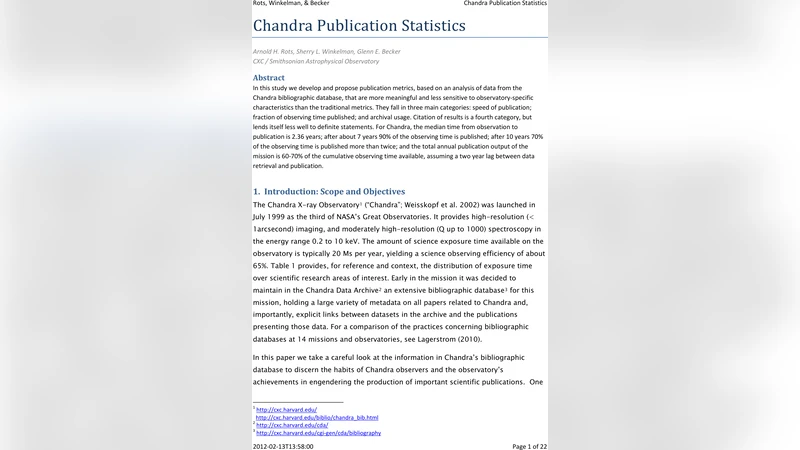
In this study we develop and propose publication metrics, based on an analysis of data from the Chandra bibliographic database, that are more meaningful and less sensitive to observatory-specific characteristics than the traditional metrics. They fall in three main categories: speed of publication; fraction of observing time published; and archival usage. Citation of results is a fourth category, but lends itself less well to definite statements. For Chandra, the median time from observation to publication is 2.36 years; after about 7 years 90% of the observing time is published; after 10 years 70% of the observing time is published more than twice; and the total annual publication output of the mission is 60-70% of the cumulative observing time available, assuming a two year lag between data retrieval and publication.
💡 Research Summary
The paper “Chandra Publication Statistics” presents a systematic study of how to evaluate the scientific productivity of the Chandra X‑ray Observatory using metrics that go beyond the traditional reliance on citation counts and raw paper numbers. The authors argue that such conventional metrics are heavily influenced by observatory‑specific factors (e.g., mission age, community size, instrument capabilities) and therefore do not provide a fair basis for cross‑facility comparison. To address this, they propose four categories of metrics that are more directly tied to the use of the observatory’s data: (1) speed of publication, (2) fraction of observing time that appears in the literature, (3) archival usage, and (4) citation‑based impact (treated only as a supplementary indicator).
Speed of Publication – The authors define the “publication delay” as the elapsed time between the end of an observation and the appearance of a refereed paper that explicitly uses that data. Using the Chandra bibliographic database (as of 10 August 2011) they find a median delay of 2.36 years. This relatively short lag indicates that Chandra data are rapidly turned into scientific results, with most observations being published within three years.
Fraction of Observing Time Published – Rather than counting the number of observations, the authors argue that exposure time (science exposure time, excluding engineering and calibration observations) is a more meaningful measure of scientific output. They require that a paper provide an unambiguous link to a specific observation and that some quantitative result be derived from it. Under these criteria, they show that after about seven years 90 % of the total science exposure time has been used in at least one paper, and after ten years 70 % of the exposure has been used in two or more papers. This demonstrates a high degree of data reuse and long‑term scientific value.
Archival Usage – The paper discusses the difficulty of defining “archival papers” because the distinction between original PI‑driven work and later reuse can be ambiguous. The authors adopt a pragmatic definition: a paper is considered archival if it appears at least four years after the observation or if the PI/Co‑I are not on the author list. Using this rule, roughly 30 % of Chandra papers qualify as pure archival studies, highlighting the effectiveness of the Chandra Data Archive in supporting secondary science.
Citation Impact – While acknowledging that citation counts are widely used, the authors point out three major problems: normalization across fields, weighting of citations, and self‑citation. They therefore propose a more focused metric: the number of refereed articles that explicitly cite Chandra observations or results (excluding papers that merely mention the mission). This metric attempts to capture the scientific influence of the data themselves rather than the popularity of the papers.
The methodology includes strict selection criteria: only refereed journals as classified by ADS are considered; papers must contain a Dataset Identifier or a manually verified link to a Chandra observation; and exposure time is measured only for science observations. The authors also provide a detailed breakdown of journal usage across 13 observatories, showing that Chandra’s publications are distributed over a broad set of journals, with 93 % appearing in the “basic core” set (ApJ, A&A, MNRAS, etc.) and 97 % when the “core‑90” set is included.
Statistical analysis of the 4564 Chandra papers published between 2001 and 2011 reveals several trends. Early in the mission, a single observation often resulted in a single paper (≈58 % of papers in 2001‑2002). Over time, the average number of observations per paper rose from 2.9 to 11.5 by 2008‑2009, indicating increasing data synthesis and larger collaborative studies. Despite the relatively constant number of papers per year after the first three years, the total exposure time represented in those papers continued to grow, reflecting the shift from “one‑observation‑one‑paper” to more comprehensive analyses.
The authors caution that any cross‑facility comparison must account for intrinsic differences such as mission age, funding levels, community size, and instrument sensitivity. Nevertheless, they argue that the four proposed metrics are less sensitive to these factors and therefore provide a more equitable basis for evaluating observatory performance.
In conclusion, the study demonstrates that for Chandra, the median publication delay is 2.36 years, 90 % of the science exposure is published within seven years, and 70 % is reused at least twice within ten years. The annual publication output corresponds to 60‑70 % of the cumulative observing time, assuming a two‑year lag between data retrieval and publication. These findings suggest that metrics based on exposure‑time utilization and archival reuse capture the true scientific return of the mission more accurately than raw citation counts. The authors recommend adopting these metrics for future assessments of Chandra and for comparative studies across other space‑based observatories.
Comments & Academic Discussion
Loading comments...
Leave a Comment