The Fermi Bubbles. II. The Potential Roles of Viscosity and Cosmic Ray Diffusion in Jet Models
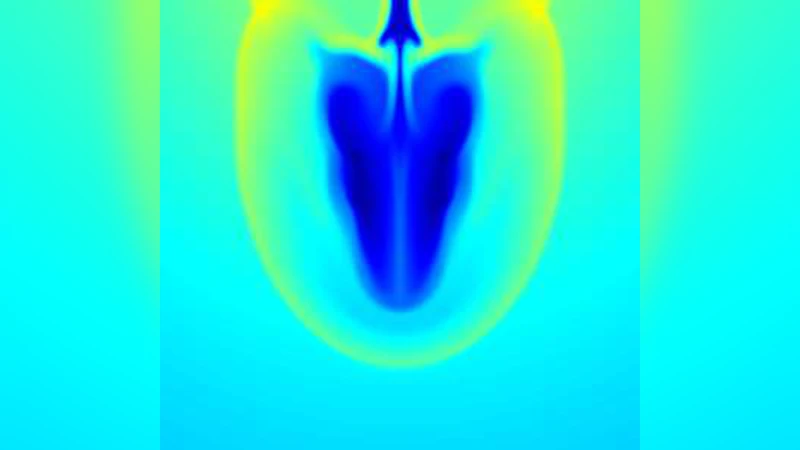
The origin of the Fermi bubbles recently detected by the Fermi Gamma-ray Space Telescope in the inner Galaxy is mysterious. In the companion paper Guo & Mathews (Paper I), we use hydrodynamic simulations to show that they could be produced by a recent powerful AGN jet event. Here we further explore this scenario to study the potential roles of shear viscosity and cosmic ray (CR) diffusion on the morphology and CR distribution of the bubbles. We show that even a relatively low level of viscosity (\mu_{visc} >~ 3 g cm^{-1} s^{-1}, or ~0.1% - 1% of Braginskii viscosity in this context) could effectively suppress the development of Kelvin-Helmholtz instabilities at the bubble surface, resulting in smooth bubble edges as observed. Furthermore, viscosity reduces circulating motions within the bubbles, which would otherwise mix the CR-carrying jet backflow near bubble edges with the bubble interior. Thus viscosity naturally produces an edge-favored CR distribution, an important ingredient to produce the observed flat gamma-ray surface brightness distribution. Generically, such a CR distribution often produces a limb-brightened gamma-ray intensity distribution. However, we show that by incorporating CR diffusion which is strongly suppressed across the bubble surface (as inferred from sharp bubble edges) but is close to canonical values in the bubble interior, we obtain a reasonably flat gamma-ray intensity profile. The similarity of the resulting CR bubble with the observed Fermi bubbles strengthens our previous result in Paper I that the Fermi bubbles were produced by a recent AGN jet event. Studies of the nearby Fermi bubbles may provide a unique opportunity to study the potential roles of plasma viscosity and CR diffusion on the evolution of AGN jets and bubbles.
💡 Research Summary
**
The paper builds on the authors’ earlier work (Paper I) that demonstrated how a recent, powerful AGN jet from the Galactic centre could inflate the large, bilobular gamma‑ray structures now known as the Fermi bubbles. While the previous hydrodynamic simulations reproduced the bubbles’ size, location, and overall shape, they suffered from two notable discrepancies with observations: (1) the bubble surfaces displayed pronounced Kelvin‑Helmholtz (KH) and Rayleigh‑Taylor (RT) instabilities, producing ragged edges, whereas the observed bubbles have smooth, sharply defined boundaries; and (2) the simulated cosmic‑ray (CR) distribution tended to concentrate near the bubble edges, leading to a limb‑brightened gamma‑ray surface‑brightness profile, contrary to the roughly uniform brightness seen in the data.
To address these issues, the authors introduce two additional physical processes into their two‑dimensional, axisymmetric ZEUS‑like code: (i) shear viscosity in the hot halo gas, and (ii) spatially varying CR diffusion. The viscosity is parameterised by a dynamic coefficient μ_visc. Although the Braginskii (Spitzer) viscosity for a 2.4 × 10⁶ K plasma would be orders of magnitude larger, the authors find that a modest value of μ_visc ≈ 3 g cm⁻¹ s⁻¹ (about 0.1–1 % of the Braginskii value) is sufficient to suppress KH growth at the bubble surface. Viscous stresses also damp the internal vortex motions that would otherwise mix the jet back‑flow with the bubble interior, thereby naturally creating a CR pressure profile that is enhanced toward the bubble rim (“edge‑favoured”).
The second ingredient is a two‑zone diffusion model. Across the bubble surface the diffusion coefficient is set to a very low value, κ_surface = 3 × 10²⁶ cm² s⁻¹, effectively preventing CRs from leaking out and preserving the observed sharp edges. Inside the bubble, however, the diffusion coefficient is allowed to take a canonical Galactic value, κ_int = (1–6) × 10²⁸ cm² s⁻¹. By varying κ_int the authors explore how internal diffusion reshapes the CR distribution. They find that for κ_int ≈ 3 × 10²⁸ cm² s⁻¹ the CRs spread sufficiently within the bubble to flatten the projected gamma‑ray intensity, while still retaining the edge‑favoured pressure gradient imposed by viscosity. This combination yields a surface‑brightness profile that is nearly uniform, matching the Fermi observations.
The simulations adopt a fixed Galactic potential (bulge, disk, dark halo) and an initially isothermal halo (T = 2.4 × 10⁶ K) in hydrostatic equilibrium with a central electron density n_e0 = 0.1 cm⁻³. The jet parameters are held constant across runs: speed v_jet = 3 × 10⁹ cm s⁻¹, radius R_jet = 0.4 kpc, duration t_jet = 0.4 Myr, CR energy density e_jcr = 1 × 10⁻¹⁰ erg cm⁻³, and a density contrast of 0.01 relative to the ambient medium. The total jet power is ≈8.6 × 10⁴² erg s⁻¹, delivering ≈2 × 10⁵⁶ erg over both jets. The computational grid spans 20 kpc with 400 × 400 uniform zones, plus an additional logarithmic extension to 50 kpc. The simulation is halted when the bubble reaches a height of ≈10.5 kpc, which the authors identify as the dynamical age t_Fermi ≈ 1.5–2 Myr.
Key findings:
- Viscosity suppresses surface instabilities. Even a modest μ_visc eliminates KH ripples, producing the smooth, sharply bounded bubbles seen in the data.
- Viscosity damps internal circulation. This prevents the jet back‑flow from mixing with the bubble interior, yielding a CR pressure distribution that peaks near the rim.
- Edge‑favoured CR distribution alone would cause limb‑brightening. Without additional physics the projected gamma‑ray map would be brighter at the edges than at the centre, contrary to observations.
- Internal CR diffusion flattens the intensity profile. Allowing κ_int ≈ 3 × 10²⁸ cm² s⁻¹ spreads CRs throughout the bubble interior, reducing the edge‑to‑center contrast while preserving the sharp outer boundary set by the low κ_surface.
- Combined model reproduces all major observational features. The resulting bubble morphology, edge smoothness, and gamma‑ray surface‑brightness uniformity are in good agreement with the Fermi data, reinforcing the AGN‑jet origin hypothesis.
The authors acknowledge several limitations. The simulations are two‑dimensional and axisymmetric, which may underestimate the role of three‑dimensional magnetic draping and turbulence in stabilising the bubble surface. The treatment of CRs is simplified: only the total CR energy density is evolved, neglecting separate electron and proton populations, synchrotron and inverse‑Compton losses, and streaming effects. Consequently, the paper does not predict the detailed gamma‑ray spectrum, leaving that for future work. Moreover, the physical justification for the chosen viscosity and diffusion coefficients—particularly the degree of suppression across the bubble surface—remains phenomenological; observational constraints on halo viscosity and magnetic field geometry would be valuable.
In summary, by incorporating a modest shear viscosity and a spatially varying CR diffusion coefficient, the authors resolve the two principal shortcomings of earlier jet‑driven bubble models. Their results provide a coherent physical picture in which a recent (~1–3 Myr) AGN outburst from Sgr A* inflates the Fermi bubbles, with viscosity stabilising the surface and diffusion shaping the internal CR distribution to yield the observed flat gamma‑ray brightness. Future three‑dimensional MHD simulations and multi‑wavelength observations will be essential to test the inferred plasma properties and to refine the model’s predictions for the CR composition and spectral characteristics.
Comments & Academic Discussion
Loading comments...
Leave a Comment