Radiative feedback and cosmic molecular gas: numerical method
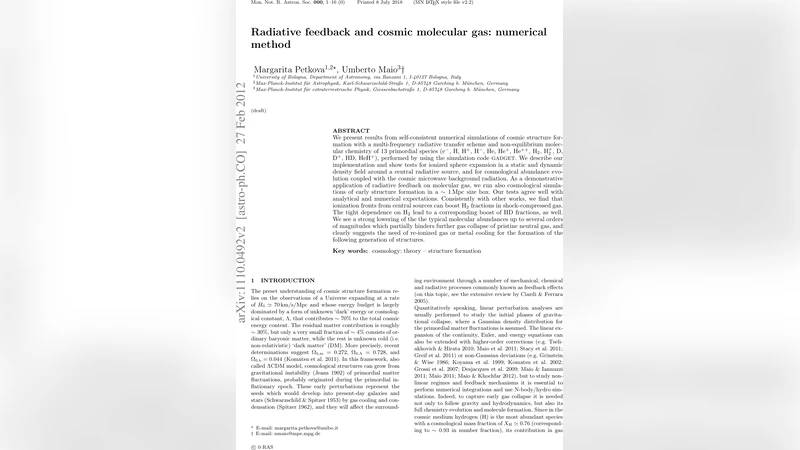
We present results from self-consistent 3D numerical simulations of cosmic structure formation with a multi-frequency radiative transfer scheme and non-equilibrium molecular chemistry of 13 primordial species (e-, H, H+, H-, He, He+, He++, H2, H2+, D, D+, HD, HeH+), performed by using the simulation code GADGET. We describe our implementation and show tests for ionized sphere expansion in a static and dynamic density field around a central radiative source, and for cosmological abundance evolution coupled with the cosmic microwave background radiation. As a demonstrative application of radiative feedback on molecular gas, we run also cosmological simulations of early structure formation in a ~1Mpc size box. Our tests agree well with analytical and numerical expectations. Consistently with other works, we find that ionization fronts from central sources can boost H2 fractions in shock-compressed gas. The tight dependence on H2 lead to a corresponding boost of HD fractions, as well. We see a strong lowering of the the typical molecular abundances up to several orders of magnitudes which partially hinders further gas collapse of pristine neutral gas, and clearly suggests the need of re-ionized gas or metal cooling for the formation of the following generation of structures.
💡 Research Summary
This paper presents a self‑consistent three‑dimensional numerical framework that couples multi‑frequency radiative transfer (RT) with non‑equilibrium chemistry of thirteen primordial species within the widely used GADGET‑3 smoothed‑particle hydrodynamics (SPH) code. The authors extend the moment‑based RT scheme of Petkova & Springel (2009) by introducing a frequency‑binning approach that treats each photon‑energy interval separately. Radiation from stellar sources is modeled as a black‑body spectrum with effective temperatures of 3 × 10⁴ K and 10⁵ K, allowing the inclusion of photons both above and below the hydrogen ionization threshold, notably those in the Lyman‑Werner (LW) band (11.2–13.6 eV) that are crucial for H₂ photodissociation. The Eddington tensor, required for the closure of the moment equations, is computed via a tree algorithm, making the method independent of the number of sources and thus scalable to cosmological volumes.
The chemical network follows the abundances of electrons, H, H⁺, H⁻, He, He⁺, He²⁺, H₂, H₂⁺, D, D⁺, HD, and HeH⁺. Reaction rates are taken from up‑to‑date compilations (Abel et al. 1997; Galli & Palla 1998; Yoshida et al. 2003) and include collisional processes as well as photo‑ionization and photo‑dissociation. For the LW band the authors adopt the shielding prescription of Draine & Bertoldi (1996). Chemical evolution is solved implicitly at each hydrodynamic timestep, ensuring stability even when reaction timescales become very short.
The implementation is validated through a series of tests. First, the classic Strömgren sphere problem is reproduced in a static uniform medium, confirming that the ionization front radius and expansion speed match analytical expectations. Second, the same problem is examined in a dynamically collapsing medium, demonstrating that the ionization front can drive a shock that compresses the gas, temporarily enhancing H₂ formation via the H⁻ and H₂⁺ pathways. Third, the authors compare the cosmological evolution of primordial abundances (including the impact of the cosmic microwave background) against published results, finding excellent agreement.
Having passed these benchmarks, the authors apply the method to a cosmological simulation of a (1 Mpc)³ comoving volume that follows the formation of the first minihalos and Population III stars. A central massive star emits ionizing and LW photons; the resulting ionization front (I‑front) expands, creating a high‑temperature, low‑density H II region. In the dense shell just behind the I‑front, the shock compresses the gas, raising the electron fraction and thereby catalyzing H⁻ formation. This cascade leads to a temporary boost in H₂ and, consequently, HD abundances, allowing the gas to cool below 200 K. However, inside the ionized region the intense radiation destroys molecules, reducing H₂ and HD by up to six orders of magnitude. The net effect is a strong suppression of the overall molecular fraction in the volume, implying that subsequent star formation would require additional cooling channels such as metal line cooling or dust emission.
The study thus highlights the dual nature of radiative feedback: while ionizing radiation can destroy molecules (negative feedback), the associated shock‑compressed shells can foster molecule formation (positive feedback). By integrating multi‑frequency RT with a comprehensive primordial chemistry network, the authors provide a robust tool for future investigations of early structure formation, including the interplay with supernova feedback, metal enrichment, and the transition from Population III to Population II star formation.
Comments & Academic Discussion
Loading comments...
Leave a Comment