Universal behavior of extreme value statistics for selected observables of dynamical systems
The main results of the extreme value theory developed for the investigation of the observables of dynamical systems rely, up to now, on the Gnedenko approach. In this framework, extremes are basically identified with the block maxima of the time ser…
Authors: Valerio Lucarini, Davide Far, a
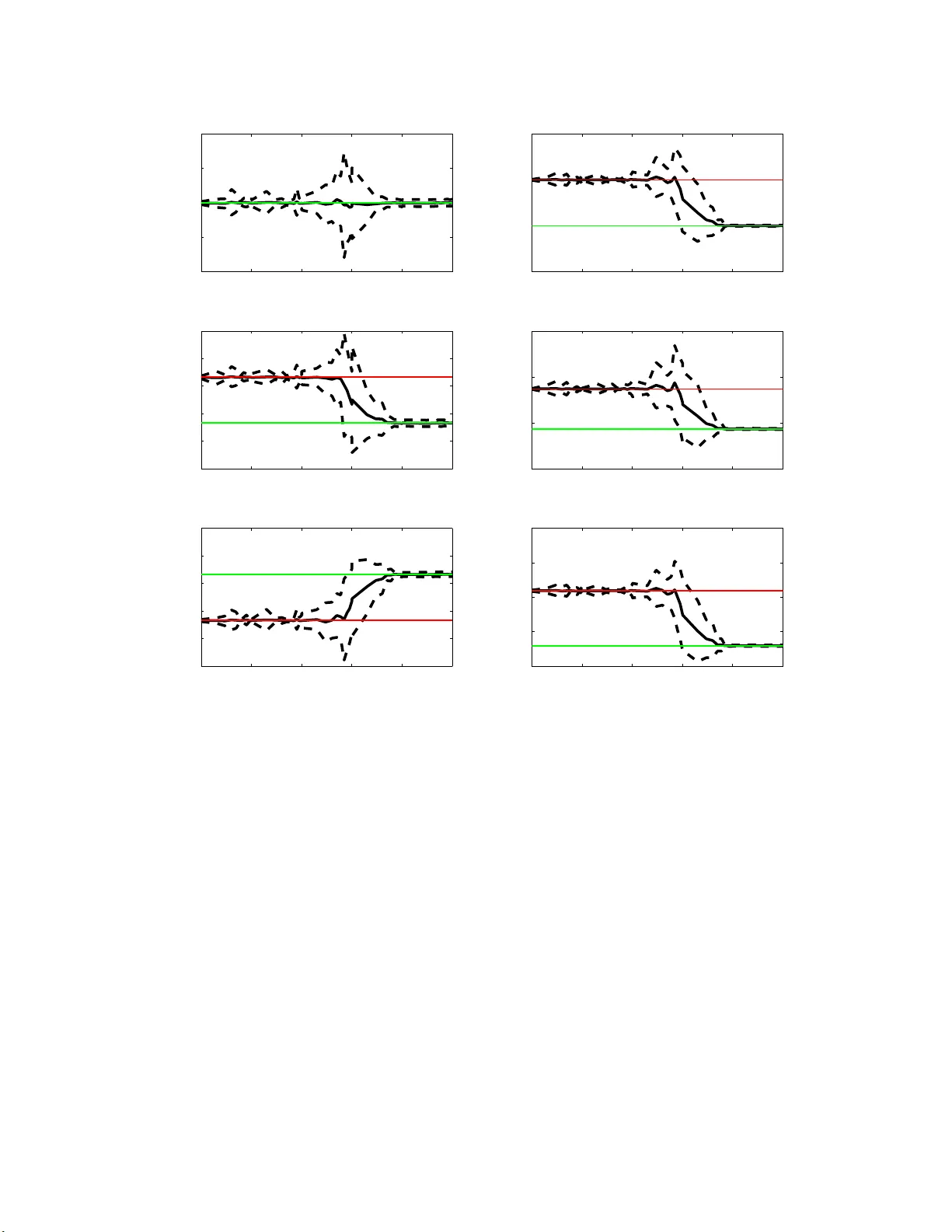
Univ ersal b eha vior of extreme v alue statistics for select ed observ ables of dynamical systems V alerio Lucarini, ∗ Davide F aranda, and Jero en W outers Klimac ampus, University of Hambur g, Grindelb er g 5, 20144, Hambur g, Germany (Dated: September 17, 2018) The main results of the extreme v alue t heory developed for the in vestiga tion of t h e observ ables of dynamical systems rely , up to n o w, on th e Gned enko approac h. In t h is framew ork, ex tremes are basically identified with t h e block maxima of the time series of the c hosen observ able, in the limit of infinitely long blocks. It has b een prov ed that, assuming suitable mixing conditions for the un derlying dyn amical systems, the ex tremes of a sp ecific class of observ ables are distributed according to the so called Generalized Extreme V alue (GEV) distribution. Direct calculations sho w that in the case of qu asi-perio dic dynamics the blo ck max ima are not distributed a ccording to the GEV distribu tion. In this pap er w e show that, in order to obtain a universal b ehaviour of the extremes, the req uiremen t of a mixing dy namics can b e relaxed if the Pa reto approach is used, based up on considering the exceedances o ver a giv en th reshold. Requiring that the inv arian t measure locally scal es with a w ell defi ned exp onent - the local d imension -, w e show that the limiting distribution for the exceedances of th e observ ables previously studied with t he Gnedenko approac h is a Generalized Pareto distribution where the parameters dep end s only on the local dimensions and the v alue of the threshold. This result allo ws to ex t end the ex treme value th eory for dyn amical systems to th e case of regular motions. W e also provide connections with t he results obtained with the Gnedenko approach. In order to provide furt h er supp ort to our fin dings, w e p resen t the results of numerical exp eriments carried out considering the w ell-known Chirik ov standard map. I. INTRO DUCT ION Extreme v alue Theory was origina lly in tro duced b y Fisher and Tipp ett [1] and formalis e d b y Gnedenko [2], who sho wed that the distribution of the maxima of a s a m- ple of indep enden t identically distributed (i.i.d) sto chas- tic v ariables co n verges under very general co nditions to a member o f the so- called Gener alised Extr e me V alue (GEV) distribution. The attention of the scien tific com- m unity to the problem of understanding extreme v a lues theory is growing, also b ecause this theory is cr ucial in a wide class of applications for defining risk factors such as those r e la ted to insta bilities in the financia l markets and to natural hazards related to seismic, climatic a nd h ydro - logical extreme even ts. Even if the probability of extr e me even ts decre a ses with their magnitude, the damage that they ma y bring increase s rapidly with the magnitude a s do es the cost of pr o tection against them. F rom a theo- retical p oint o f view, extreme v alues of obser v ables are related to large fluctuations of the corresp onding under- lying system. An extensive account of r ecent results and relev a n t applica tio ns is given in [3]. The traditional (’Gnedenk o’) approach for the statisti- cal inference of extr emes is r elated to the or iginal results by Gnedenko [2]: we par tition the exp erimental time se- ries into bins of fixed length, we extr act the maximum of each bin, and fit the selected data to the GEV distribu- tion family us ing metho ds suc h as maximum likelihoo d estimation (MLE ) or L-moments. See [4] for a detailed ∗ Email: valerio. lucarini@zmaw .de ; Also at: Departmen t of Mathematics and Statistics, Univ ersity of Reading, Reading, UK. account of this metho dolog y . The selection of just one maximum in a fixed p erio d ma y lead to the loss of rele- v ant information on the lar g e fluctuations of the system, esp ecially w he n there are many la r ge v a lues in a given per io d [5]. This problem can b e taken care of b y con- sidering several of the larg est order statistics instead o f just the lar g est one. F or suc h maxima distr ibutions we exp ect co n vergence to the Generalize d Pareto Distribu- tion (GPD) in tro duced by Pick ands I I I [6] and B alkema and De Haan [7] to mo del the exceedances ov er a given threshold. W e call this the ’Pareto’ a pproach. Also this approach has b een widely adopted for studying empiri- cally natural ex treme phenomena such as those related to wa ves, winds, temper atures, earthquakes and floo ds [8–10]. Both the Gnedenko and P ar e to appr oaches w ere orig- inally designed to study extreme v alues for series of i.i.d v ar ia bles. In this ca se it is well known that a strong connections exists be t ween the tw o metho dolog ies, as we hav e that if blo ck maxima ob ey the GE V distribution, then exceedances ov er some hig h threshold will ha ve an asso ciated GPD. Mo reov er, the sha pe par ameter of the GPD and that of the corresp onding GEV distribution are ident ical [11]. As a r e s ult, s e veral pr actical methods (e.g. Hill’s and Pick ands’ estimators) develop ed fo r estimat- ing the sha pe para meter of the GEV distr ibution of th e extremes of a given time series are actually ba sed upo n comparing the GPD fits at v a rious thresholds [1 2, 13]. In practical terms, it app ears that, while the Gnedenko and Pareto appro aches provide equiv alent information in the asymptotic limit o f infinitely long time series, the GPD statistics is mor e robust when realistic, finite time series are considered ( see, e.g., [14]). In rec en t y ear s, esp ecially under the influence of the 2 rapid developmen t of numerical modelling in the g eo- ph ysica l sciences and of its applications for the investiga- tion of the so cio -economic impacts of extreme ev ents, it has beco me of great relev ance to understand whether it is p o ssible to apply the extreme v alue theor y on the time series of observ ables of deterministic dynamical sys tems . Carefully devised numerical exper imen ts on clima te mod- els of v arious degree s of co mplexit y have shown tha t the sp eed o f conv ergence (if a n y) of the statistical pr o per ties of the extr e mes definitely dep ends on the chosen clima tic v ar ia ble of interest [4 , 15–17]. Several papers ha ve addressed this iss ue at a more gen- eral level. A firs t imp orta nt result is that when a dy- namical system has a re g ular (perio dic of quasi- per io dic) behaviour, we do no t expect, in general, to find conv er- gence to GEV distr ibutions for the extremes of any ob- serv able. These re s ults have been presented by Balakr- ishnan et al. [18], and more recently , b y Nicolis et al. [19] and by Haiman [20]. A different mathematical approach to extreme v alue theory in dyna mical systems was prop osed in the land- mark paper by Collet [21], whic h has pa ved the wa y fo r the r ecent r esults obtaine d in th e last few years [22–25]. The starting p oint of all of these inv estigatio ns has b een to asso ciate to the sta tio nary sto c hastic pr oc e ss giv en by the dynamica l system, a new stationary indep endent s e- quence which ob eys o ne of the cla ssical thre e extreme v alue laws intro duced by Gnedenko [2]. T he assump- tions which are necessar y to observe a GEV distribu- tion in dynamical systems rely o n the choice of suitable observ ables (sp ecific functions of the distance b etw een the o rbit and the initial condition, chosen to b e on the attractor) and the fulfillment of particular mixing con- ditions that guar a n tee the indep endence o f subsequent maxima. Recent studies hav e shown that the r esulting parameters of the GEV distr ibutions can b e expres sed as simple functions o f the lo cal (aro und the initial co ndi- tion) dim ensio n of the attra c to r, and detailed numerical inv e stigations hav e clarified the co nditio ns under which conv ergence to th e theor etical GEV distr ibutions can be satisfactorily ac hieved when considering finite time series [26–28]. In this pap er, w e wis h to attempt a unification of these t wo lines o f work by using the Pareto rather than the Gnedenko approach. W e choose the same clas s of ob- serv ables pr e sen ted in [22–28] a nd show that, assuming only that the lo cal mea sures scales with the lo cal dimen- sion [29], it is p ossible to obtain by direc t in tegra tion a GPD for the thresho ld exceedences when considering a g e neric or bit of a dynamical systems, without requir- ing any spec ia l mixing pr ope rties. The par ameters will depe nd only o n the choice of the thresho ld and, more impo rtantly , on the lo cal dimension. Note that Castillo and Hadi [5 ] had a lready p ointed out that in the case of p erio dic or quasi-p erio dic motion the Gnedenko ap- proach to the ev aluation of the extr e me v a lue sta tistics is inefficien t, basica lly b ecaus e in the limit of very lar ge blo c ks, w e tend to obser v e always the same maximum in all bins. T o s uppor t our analytical results w e provide nu merica l expe r imen ts that we carry out considering the classic Chiriko v standard map [30]. This pap er is orga n- ised as follows. In sectio n 2 w e reca pitulate the extreme v alue theor y for dynamical sy stems obtained using the Gnedenko approa c h. In section 3 we present our general results obta ined using the Pareto appro ach. In sec tio n 4 w e provide support to our inv estiga tion by examining the res ults of the n umerical simulations p erformed o n the standard map. In s e c tion 5 w e pre s en t our final r emarks and future sc ien tific p ers pectives. II. GNEDENK O APPR OA CH: G ENERALIZED EXTREME V ALUE DISTRIBUTIONS IN DYNAMICAL SYSTEMS Gnedenko [2] studied the conv ergence of maxima of i.i.d. v a riables X 0 , X 1 , ..X m − 1 with cum ulative distribution function (cdf ) F ( x ) = P { a m ( M m − b m ) ≤ x } where a m and b m are normaliz- ing s equences and M m = max { X 0 , X 1 , ..., X m − 1 } . Under general h yp othesis on the nature of the paren t distribu- tion of data, Gnedenko [2] show ed that the as y mptotic distribution o f maxima, up to an a ffine change of v ar i- able, b elongs to a single family of gener alized distribu- tion ca lled GEV distribution whose cdf can b e written as: F GE V ( x ; µ, α, κ ) = e − t ( x ) (1) where t ( x ) = ( 1 + κ ( x − µ α ) − 1 /κ if κ 6 = 0 e − ( x − µ ) /α if κ = 0 . (2) This ex pr ession holds for 1 + κ ( x − µ ) /α > 0, using µ ∈ R (lo cation parameter) and α > 0 (scale parameter) as sc a l- ing constants in pla ce of b m , and a m [31], in particular, in F ar anda et al. [27] we ha ve shown that µ = b m and α = 1 / a m , where κ ∈ R is the shap e para meter (also called the tail index). When κ → 0, the distr ibution co r- resp onds to a Gumbel type (Type 1 dis tr ibution). When the index is pos itiv e, it corres ponds to a F r´ echet (Type 2 distribution); when the index is neg ative, it corresp onds to a W e ibull (T yp e 3 distributio n). Let us cons ider a dynamical system (Ω , B , ν , f ), where Ω is the in v ariant set in some manifold, usually R d , B is the Borel σ -alg ebra, f : Ω → Ω is a measura ble map and ν a n f - in v a riant Borel measur e. In order to adapt the e x treme v alue theor y to dynamical systems, follow- ing [22–25], w e consider the stationary stochastic pro ces s X 0 , X 1 , ... given by: X m ( x ) = g (dist( f m ( x ) , ζ )) ∀ m ∈ N (3) 3 where ’dist’ is a distance in the am bient space Ω, ζ is a given p oint and g is an obs erv able f unction. The partial maximum in th e Gnedenk o appro ach is defined a s: M m = max { X 0 , ..., X m − 1 } . (4) Defining r = dist( x, ζ ), we consider the three classes of observ ables g i , i = 1 , 2 , 3: g 1 ( r ) = − log( r ) (5) g 2 ( r ) = r − β (6) g 3 ( r ) = C − r β (7) where C is a co nstant and β > 0 ∈ R . Using the ob- serv able g i we obtain conv erg ence of the statistics of the blo c k maxima of their time series obtained by evolving the dynamical s y stem to the Type i distribution if one can prove t wo sufficien t conditions called D 2 and D ′ , which basically imply a sort of indep endence of the series of extremes resulting from the mixing of the underlying dynamics [22]. The conditions cannot b e simply related to the usual concepts of strong or w eak mixing, but are indeed not obeyed by o bserv able s of systems featuring a regular dynamics or power-la w de c ay of co r relations. A co nnection also exists b etw een the existence of ex- treme v a lue laws and the statistics of fir st return a nd hitting times, which provide infor mation on how fast the po in t star ting fro m the initial co ndition ζ comes back to a neighborho o d of ζ , as shown by F reitas et al. [23] and F reitas et al. [32]. In pa rticular, they prov ed that for dynamical systems p ossessing an inv ariant measur e ν , the existence of an exp onential hitting time statistics on balls aro und ν -almost any po int ζ implies the exis - tence o f extreme v alue laws for one o f the observ ables of t yp e g i , i = 1 , 2 , 3 describ ed ab ove. T he co n verse is also true, namely if we hav e an extreme v a lue law which applies to the obser v ables of type g i , i = 1 , 2 , 3 achiev- ing a ma x im um at ζ , then w e hav e exp onential hitting time statistics to balls with cen ter ζ . Recently these re- sults hav e b een g e neralized to lo cal returns ar ound balls centered a t p erio dic points [24]. In F a randa et a l. [26, 27, 28] we analised b oth from an analytical and numerical point of view the extreme v alue distribution in a wide class of low dimensiona l maps. W e divided the time series of length k of the g i observ ables int o n bins ea c h containing the same num b er m o f ob- serv ations, and selected the maxim um (or the minim um) v alue in each o f them [33]. W e showed that at le ad- ing order (the formulas ar e asymptotically correct for m, k → ∞ ), the GE V parameter s in mixing maps can be written in terms of m (or equiv a le n tly n ) and the lo- cal dimension of the attractor D . W e ha ve: • g 1 -type o bs erv able: α = 1 D µ ∼ 1 D ln( k /n ) κ = 0 (8) • g 2 -type o bs erv able: α ∼ n − β D µ ∼ n − β D κ = β D (9) • g 3 -type o bs erv able: α ∼ n β D µ = C κ = − β D (10) Moreov er, we clearly show ed that o ther kind o f distribu- tions not belonging to the GEV family are obser v ed for quasi-p erio dic and p erio dic motio ns. II I. THE P A RETO APPRO ACH: GENERALIZED P A RETO DISTRIBUTIONS IN DYNAMICAL SYSTEMS W e define an exceeda nce a s z = X − T , which mea- sures by ho w m uch X exceeds the threshold T . As dis- cussed above, under the same co nditions under which the blo ck maxima of the i.i.d. sto ch as tic v aria bles X ob ey the GEV statistics, the exceeda nces z are asymp- totically dis tr ibuted according to the Generalised Pareto Distribution [11]: F GP D ( z ; ξ , σ ) = 1 − 1 + ξz σ − 1 /ξ for ξ 6 = 0 , 1 − exp − z σ for ξ = 0 , (11) where the range of z is 0 ≤ z < ∞ if ξ ≤ 0 and 0 ≤ z ≤ σ /ξ if ξ > 0. W e c o nsider the same set up describ ed in the previous se ction and take in to account an o bserv a bles g = g (dist( x, ζ )) = g ( r ), such that g achiev es a ma xim um g max for r = 0 (finite or infinite) and is monotonically decr easing. W e study the exceedance ab ov e a threshold T defined as T = g ( r ∗ ). W e obtain an ex ceedence every time the dista nce b etw een the o r- bit of the dynamica l system and ζ is smaller than r ∗ . Therefore, we define the exceedances z = g ( r ) − T . By the Bayes’ theorem, we hav e that P ( r < g − 1 ( z + T ) | r < g − 1 ( T )) = P ( r < g − 1 ( z + T )) /P ( r < g − 1 ( T )). In terms of in v ariant meas ure of the system, we hav e that the probability H g,T ( z ) of observing an e xceedance of at least z given that an exceedence o ccurs is giv en by: H g,T ( z ) ≡ ν ( B g − 1 ( z + T ) ( ζ )) ν ( B g − 1 ( T ) ( ζ )) . (12) Obviously , the v alue of the previous expr e ssion is 1 if z = 0. In agreement with the conditions g iven on g , the e x pression contained in Eq. (12 ) monotonica lly de- creases with z and v anishes when the r adius is g iv en b y g − 1 ( g max ). Note that the cor resp onding cdf is g iven by F g,T ( z ) = 1 − H g,T ( z ). In order to address the problem of extremes, we hav e to consider small r a dii. At this rega rd we will in vok e, and assume, the existence of the following limit lim r → 0 log ν ( B r ( ζ )) log r = D ( ζ ) , for ζ chosen ν − a.e. , (13) where D ( ζ ) is the lo cal dimension of the attractor [2 9]. Therefore, w e r ewrite the fo llowing expression for the tail 4 probability of exceedance: H g,T ( z ) ∼ g − 1 ( z + T ) g − 1 ( T ) D . (14) where w e hav e droppe d the ζ dep endence of D to simplify the notation. By substituting g with spe cific observ able we ar e c onsidering, w e obtain explicitly the corresp ond- ing extreme v a lue distribution law. By choosing a n observ able of the form given by either g 1 , g 2 , or g 3 , we derive a s extr eme v alue distribution law one mem b er of the Gene r alised Pareto Distribution family given in Eq. (11). Results a re detailed b elow: • g 1 -type o bs erv able: σ = 1 D ξ = 0 ; (15) • g 2 -type o bs erv able: σ = T β D ξ = β D ; (16) • g 3 -type o bs erv able: σ = ( C − T ) β D ξ = − β D . (17) The prev ious expr essions show that there is a simple al- gebraic link b etw een the par ameters of the GPD a nd the lo cal dimensio n of the attractor around the p oint ζ . This implies that the statistics of extremes provides us with a new algor ithmic tool for estimating the lo ca l fine struc- ture of the attracto r. These results show that it is pos si- ble to der ive gener al pro per ties for the extreme v alues o f the o bs erv ables g 1 , g 2 , or g 3 independently on the qualita- tive prop erties of the underlying dynamics, b e the s ystem per io dic, quasi-p erio dic, or chaotic. Ther efore, b y taking the P ar eto instead of the Gnedenko approa c h, w e are able to o vercome the m ixing conditions (or the requirements on the prope r ties of the hitting time s tatistics) needed to derive a general extre me v alue theory for dyna mical sys- tems, as propo s ed in [21–25]. In [26–28] w e had prop osed that the rea son why a link b etw e en the extreme v alue the- ory and the lo cal prop erties of the in v ar iant measur e in the vicinity of the po in t ζ can be explained b y the fact that selecting the extremes o f the o bs erv ables g 1 , g 2 , or g 3 amounts to perfo r ming a zo om around ζ . In the c ase of the Gnedenko appro ach, such a picture is acc urate only if the dynamics is mixing (time and spatial selection cri- teria ar e equiv alent). Instead, in the case of the Pareto approach, this is literally what we are doing when writing Eq. (14), as we ar e remapping the r adius of the ball in a monotonic fashion though the inv erse o f the g - functions. A. Relationship be t ween the Gnedenko and P areto approac hes The rela tion b et ween GEV a nd GPD parameters have bee n alrea dy discussed in literature in cas e of i.i.d v ar i- ables [13, 14, 34, 3 5]. Coles [13] and Katz et al. [34] have pr ov en that the cdf of the GE V defined as F GE V ( z ; µ, α, κ ) can b e a symptotically wr itten a s that of GPD under a high enough thres hold as follows: F GE V ( z ; µ, α, κ ) ∼ F GP D ( z ; T , σ , ξ ) = = 1 − 1 − ξ z − T σ 1 /ξ (18) where κ = ξ , σ = α + ξ ( T − µ ), and T = µ + σ ξ ( λ − ξ − 1), with ln( α ) = ln( σ ) + ξ ln( λ ). In the present case, we hav e to compa re Eq s. (8)-(10) for GEV with Eq s . (1 5 )-(17) for GPD, keeping in mind that the GEV r esults hold only under the mixing conditions discussed b efore. While it is immediate to chec k that κ = ξ , the other relations hips are v alid in the limit of large n , as ex p ected. IV. NUMERICAL INVESTIGA TION The standar d ma p [36] is an are a-preserv ing chaotic map defined on the bidimensiona l torus, a nd it is one of the most widely- studied examples of dynamical c hao s in ph ysics . The corres ponding mec hanical system is usually called a kicked ro tator. It is defined as: ( y t +1 = y t − K 2 π sin(2 π x t ) mo d 1 x t +1 = x t + y t + 1 mo d 1 (19) The dyna mics o f the map giv en in E q . (19 ) can b e regular or chaotic. F or K << 1 the motion follows quasi pe rio dic orbits for a ll initial co nditio ns , wherea s if K >> 1 the motion turns to b e chaotic and irr egular. An in teresting behavior is achiev ed when K ∼ 1: in this ca se we ha ve co existence o f regular a nd chaotic motions depending on the chosen initia l conditions [37]. W e perfo r m for v arious v a lues of K ra nging from K = 10 − 4 up to K = 1 0 2 an ensemble of 200 simula- tions, each characterise d b y a different initial co ndition ζ randomly taken on the bidimensional to rus, and we com- pute for each orbit the observ ables g i , i = 1 , 2 , 3. In each case, the ma p is iter ated until obtaining a statistics con- sisting 10 4 exceedances, where the threshold T = 7 · 10 − 3 and β = 3. W e hav e carefully ch eck ed tha t all the re- sults are indeed robust with respe c t to the choice of the threshold and of the v a lue of β . F or each o rbit, w e fit the statistics of the 10 4 exceedances v alues of the observ- ables to a GPD distr ibution, using a ML E estimation [5] implemented in the MA TLAB c function gp dfit [3 8]. The results are shown in Fig. 1 for the infer r ed v alues of ξ and σ and should b e compared with E qs. (15)-(17). When K ≪ 1, we obtain that the estimates of ξ and σ are compatible with a dimension D = 1 for all the initial conditions: we have that the ensemble spread is neg lig i- ble. Similar ly , for K ≫ 1, the estimates for ξ and σ agr ee remark ably well with having a lo cal dimension D = 2 for all the initial conditions. In the transition regime, whic h o ccurs fo r K ≃ 1, the ensem ble spread is muc h hig her, bec ause the scaling prop erties of the measur e is differ- ent among the v arious initial conditions. As exp ected, 5 the ensemble av erage s of the pa rameters change mo no- tonically fr om the v alue p ertaining to the regular r egime to that p ertaining to the c haotic regime with incr e asing v alues of K . Ba sically , this measur es the fact that the so-called r egular islands s hrink with K . Note that in the case of the o bserv a ble g 1 , the es timate of the ξ is ro- bust in a ll regimes, even if, as exp ected, in the trans itio n betw een low and high v alues of K the ensemble spread is larg er. These re s ults can also b e co mpared with the analysis presented in F ara nda et al. [26], where w e used the Gnedenk o approach. In that case, the v alues ob- tained in the regula r regions were inconsistent with the GEV findings, the very reaso n b eing that the dynamics was indee d not mixing. Here, it is clear that the statis- tics can b e c o mputed in all cases, a nd we have a p ow erful metho d for dis criminating regular fro m chaotic b ehaviors through the analysis o f the inferr ed lo cal dimension. V. CONCLUSIONS The growing attention of the s cien tific co mm unity in understanding the behavior of extreme v alues hav e led, in the r ecent pa st, to the development o f an extreme v alue theory for dynamica l systems. In this fra mew ork , it has bee n shown that the sta tistics of ex treme v alue can b e linked to the statistics of return in a neighbor hoo d of a certain initial co nditions by choosing sp ecial observ ables that dep end on the distance betw een the itera ted tra jec- tory and its s ta rting po in t. Until now, rig orous results hav e b een obtained assuming the existence of an in v ari- ant mea s ure for the dynamical sy stems and the fulfill- men t of indep endence re q uirement o n the se r ies of ma x- ima achiev ed by imp o sing D ′ and D 2 mixing conditions, or, alter natively , assuming a n exp onential hitting time statistics [22–25]. The par a meters of the GE V distri- bution obtained c ho osing a s observ ables the fu nction g i , i = 1 , 2 , 3 defined a bove dep end on the lo ca l dimension of the attractor D and numerical algorithms to p erform sta- tistical inference can b e set up for mixing systems having bo th absolutely contin uous and singular inv ariant mea- sures [27, 28, 39, 40]. Instea d, when considering systems with regular dynamics, the statistics of the blo ck maxima of any observ able do es not conv erge to the GEV family [18, 19]. T aking a complement ar y p oint of v ie w, in this pap er we have studied the statistics of exceedances for the s ame class of obse r v ables and derived the limiting distributions assuming only the existence of an inv ar iant measure and the p oss ibilit y to define a lo cal dim ensio n D ar o und the po in t ζ of interest. T o prove that the limiting distribution is a GPD w e did not use any further conditions. In partic- ular no assumptions on the mixing natur e of the maxima sequence ha ve b een made. T his means that a GPD lim- iting distribution holds for the statistics of exceedance of ev ery kind of dyna mical systems and it dep ends only on the thres hold v alue a nd on the lo ca l dimension once we choose the o bs erv ables g i , i = 1 , 2 , 3 . Other functions can conv erge to the limiting behaviour of the GPD family if they asymptotically b ehave like the g i ’s (compare the discussion in [2 3]). Nonetheless, this requires , ana lyti- cally , to per form separ ately the limit for the threshold T going to g max and that for the r adius of the ball going to zero. In practical terms , this requires, p otentially , muc h stricter selec tio n criteria for the exceedances when finite time serie s ar e considered. W e note that, as the parameter ξ is inv ersely prop or- tional to D , one ca n exp ect that each time we ana lyse systems of intermediate or high dimensionality , the dis- tributions for g 2 and g 3 observ ables will be virtually in- distinguishable from what obtained co nsidering the g 1 observ able: the ξ = 0 is in this sense an attr acting mem- ber of the GPD family . This may also explain, at lea st qualitatively , why the Gum b e l ( k = 0 for the GEV fa m- ily) distribution is so efficient in describing the extremes of a large v ariety of natural phenomena [3]. The universality of this approach allows to resolve the debate on whether there exists or not a g eneral way to ob- tain informa tio n ab out extreme v alues for quasi-p erio dic motions raised in Ba lakrishnan et al. [18] and Nicolis et al. [ 19]. This is due to the fact that considering several of the larg e st order statistics instead of just the large s t one we can study orbits wher e numerous exceeda nce a re observed in a given blo ck, as it happ ens for s ystems with per io dic or quasi- per iodic b ehaviors. As an example, one may consider a system with m ultiple commensurable fre- quencies: choo sing a block length lar ger or equal to the smallest commo n per io d, we sele c t alwa ys the same v alue for any considere d observ able. On the other hand for mixing maps w e find, as exp ected, an asymptotic eq uiv- alence o f the results obtained via the Gnedenk o and via the Pareto a pproach. The Pareto appr oach provides a way to reconstruct lo- cal pr ope r ties of in v ariant measures: once a thr e s hold is chosen and a suitable exceeda nce s tatistics is recorded, we can compute the lo cal dimensio n for different initial conditions taken on the attracto r . This is true also in the o pp osite direction: if the knowledge of the exact v alue for the lo cal dimension is av ailable, once we chose a small enough radius (threshold), it is pos sible to compute a pri- ori the pro per ties of ex tremes without doing a n y further computations. In fact, the expressio n for the parameters Eqs. (15)-(17) do not co n tain a n y dep endence on the prop erties of the dynamics except the local dimensio n. Besides the analytical results, we hav e proved that Pareto approach is easily accessible for numerical in vesti- gations. The algorithm used to perfo r m numerical simu - lations is versatile and computationally accessible: unlike the GE V a lgorithm that requires a very high n umber of iterations to obtain unbiased statistics, using the P ar eto approach w e can fix a priori a v alue for the threshold and the num b er of maxima necess ary to construct the statis- tics. With the simulations car ried out o n the standard maps, w e o btain meaning ful res ults with a muc h s ma ller statistics with resp ect to what o bserved when considering the Gnedenko approach. 6 W e hop e tha t the pres en t con tribution ma y pro vide a to ol that is not o nly useful for the analysis of extr e me even ts itself, but als o for characterising the dynamica l structure of attractors b y giving a robust way to c o m- pute the lo cal dimensions , with the new pos s ibilit y of emb ra cing also the c a se of quasi- p erio dic motions. F uture inv estigatio ns will include the systematic study of the impact on the extreme v alue statistics of adding sto ch as tic noise to regular and chaotic deter ministic dy- namical s y stems, a nd the use o f the Ruelle resp onse the- ory [41, 42] to study the mo dulation of the statistics o f extremes due to changes in the internal or exter nal pa- rameters of the sys tem, esp ecially in view of p otentially relev a n t applications in geophysics such a s in the cas e of climate studies [43, 4 4]. ACKNO WLEDGMENT S The autho rs acknowledge v arious us eful ex changes with R. Blender and K. F ra edrich, a nd the fina n- cial supp ort o f the EU-ERC pro ject NAMASTE- Thermo dynamics of the Climate System. [1] R. Fisher and L. Tipp ett, in Pr o c e e dings of the Cambridge philosophic al so ciety , V ol. 24 (1928) p . 180. [2] B. Gnedenko, The Annals of Mathematics 44 , 423 (1943). [3] M. Ghil et a l., Nonlinear Process in Geophysics 18 , 295 (2011). [4] M. F elici, V. Lu carini, A. Sp eranza, and R. Vitolo, Jour- nal of Atmospheric Science 64 , 2137 (2007). [5] E. Castillo and A. Hadi, Journal of the American Statis- tical Asso ciation , 1609 (1997). [6] J. Pick ands I I I, the Annals of Statistics , 119 (1975). [7] A. Balk ema and L. De Haan, The Annals of Probability , 792 (1974). [8] E. Simiu and N. H ec kert, Journal of Structural Engineer- ing 122 , 539 (1996). [9] A. Bayliss and R. Jones, Pe aks-over-thr eshold flo o d datab ase (Institute of Hyd rology , 1993). [10] V. Pisarenko and D. Sornette, Pure and Ap plied Geo- physics 160 , 2343 (2003). [11] M. Leadb etter, G. Lindgren, and H . Ro otzen , Extr emes and r elate d pr op erties of r andom se quenc es and pr o c esses. (Springer, New Y ork, 1983). [12] P . Embrec hts, C. K lupp elberg, and T. Mik osh, “Mo d- elling Extremal Even ts,” (1997). [13] S. Coles, An intr o duction to statistic al m od eling of ex- tr eme v alues (Springer V erlag, 2001). [14] Y. Ding, B. Cheng, and Z. Jiang, Adv ances in Atmo- spheric S ciences 25 , 507 (2008). [15] V. Kharin, F. Zwiers, and X. Zhang, Journal of Climate 18 , 5201 (2005). [16] S. V ann itsem, T ellus A 59 , 80 (2007). [17] R. Vitolo, P . Ruti, A. D ell’Aquila, M. F elici, V. Lucarini, and A. Sp eranza, T ellus A 61 , 35 (2009). [18] V. Balakrishnan, C. Nicolis, and G. Nicolis, Journal of Statistical Physics 80 , 307 (1995). [19] C. Nicolis, V. Balakrishnan, and G. Nicolis, Physic al review letters 97 , 210602 (2006). [20] G. Haiman, Statistics & Probability Letters 65 , 451 (2003). [21] P . Collet, Ergo dic Theory and Dynamical Systems 21 , 401 (2001). [22] A. F reitas and J. F reitas, S tatistics & Probability Letters 78 , 1088 (2008). [23] A. F reitas, J. F reitas, and M. T odd , Probabilit y Theory and Related Fields , 1 (2009). [24] A . F reitas, J. F reitas, and M. T o dd, Arx iv preprint arXiv:1008.13 50 (2010). [25] C. Gupta, M. H olland, and M. Nicol, Lozi-like maps, and Lorenz-lik e maps, p reprint (2009). [26] D . F aranda, V . Lucarini, G. T urchetti, and S. V aienti, Arxiv p reprint arXiv:1107 .5972 (2011). [27] D . F aranda, V . Lucarini, G. T urchetti, and S. V aienti, Accepted for publication in Journal of Statistical Ph ysics (2011). [28] D . F aranda, V . Lucarini, G. T urchetti, and S. V aienti, Arxiv p reprint arXiv:1106 .2299 (2011). [29] C. Bandt, in Physics and the or etic al c omputer scienc e: fr om numb ers and language s to ( quantum) crypto gr aphy se curity , edited by J. Gazeau, J. Ne ˇ set ˇ ril, and B. R o v an (IOS Press, Amsterdam, 2007) pp. 91–112. [30] B. Chirik ov and D . Shepelyansky , Sc holarped ia 3 , 3550 (2008). [31] J. Pick ands I II , The An nals of Mathematical S tatistics 39 , 881 (1968). [32] A . F reitas, J. F reitas, and M. T o dd, (2011). [33] S . Coles, J. Heffernan, and J. T awn, Extremes 2 , 339 (1999). [34] R . Katz, G. Brush, and M. P arlange, Ecology 86 , 1124 (2005). [35] Y . Malev ergne, V. Pisarenko , and D. S orn ett e, A pplied Financial Economics 16 , 271 (2006). [36] B. Chiriko v, Institute of Nuclear Physics, Nov osibirsk (1969). [37] E. O t t, Chaos in Dynamic al Systems (Cam bridge Un i- versi ty Press, New Y ork , 2002). [38] W. Martinez and A. Ma rtinez, Computational statistics handb o ok with M A TLAB (CRC Press, 2002). [39] R . Vitolo, M. Holland, and C. F erro, Chaos: An In- terdisciplinary Journal of Nonlinear Science 19 , 043127 (2009). [40] M. Holland, R . Vitolo, P . Rabassa, A . S terk, and H. Broer, Arxiv preprint arXiv:1107.5 673 (2011). [41] D . Ruelle, Phys. Letters A 245 , 220 (1998). [42] D . Ruelle, Nonlinearit y 22 , 855 (2009). [43] R . Abramov and A. Ma jda, Nonlinearity 20 , 2793 (2007). [44] V . Lucarini and S. Sarno, Nonlin. Processes Geophys 18 , 7 (2011). 7 −3 −2 −1 0 1 2 −0.2 −0.1 0 0.1 0.2 log10(K) ξ (g 1 ) a) −3 −2 −1 0 1 2 0 0.1 0.2 0.3 0.4 log10(K) ξ (g 2 ) b) −3 −2 −1 0 1 2 −0.5 −0.4 −0.3 −0.2 −0.1 log10(K) ξ (g 3 ) c) −3 −2 −1 0 1 2 0 0.5 1 1.5 log10(K) σ (g 1 ) d) −3 −2 −1 0 1 2 0 1 2 3 log10(K) σ (g 2 ) e) −3 −2 −1 0 1 2 0.02 0.04 0.06 0.08 0.1 log10(K) σ (g 3 ) f) FIG. 1. GPD parameters for t he observ ables g i , i = 1 , 2 , 3 computed ove r orbits of the standard map, for v arious v alues of the constant K . F or each v alue of K , results refer to an esnsem ble of 200 randomly chosen initial conditions ζ . The notation p ( g i ) indicates the p arameter p computed using t h e extreme v alue statistics of the observ able g i . a) ξ ( g 1 ) VS K , b) ξ ( g 2 ) VS K , c) ξ ( g 3 ) VS K , d) σ ( g 1 ) VS K , e) σ ( g 2 ) VS K , f ) σ ( g 3 ) VS K . Blac k solid li nes: ensemble-a verag e v alue. Blac k dotted lines: ensem ble spread ev aluated as one stand ard deviation of the ensemble. Green lines: theoretical v alues f or regular orbits. Red lines: theoretical v alues for c haotic orbits.
Original Paper
Loading high-quality paper...
Comments & Academic Discussion
Loading comments...
Leave a Comment