Achieving Fast Reconnection in Resistive MHD Models via Turbulent Means
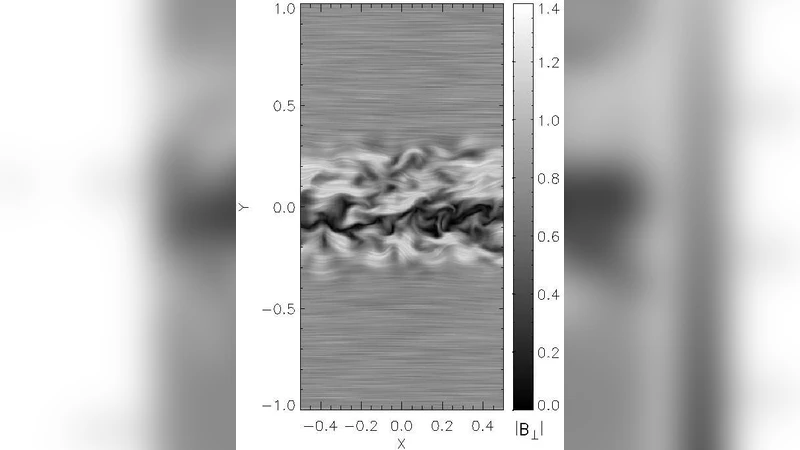
Astrophysical fluids are generally turbulent and this preexisting turbulence must be taken into account for the models of magnetic reconnection which are attepmted to be applied to astrophysical, solar or heliospheric environments. In addition, reconnection itself induces turbulence which provides an important feedback on the reconnection process. In this paper we discuss both theoretical model and numerical evidence that magnetic reconnection gets fast in the approximation of resistive MHD. We consider the relation between the Lazarian & Vishniac turbulent reconnection theory and Lapenta’s numerical experiments testifying of the spontaneous onset of turbulent reconnection in systems which are initially laminar.
💡 Research Summary
The paper investigates how pre‑existing turbulence and turbulence generated by reconnection itself can make magnetic reconnection fast in resistive magnetohydrodynamics (MHD). The authors combine the theoretical framework of Lazarian & Vishniac (1999, hereafter LV99) – which introduced the concept of stochastic magnetic‑field line wandering in three‑dimensional turbulence – with a series of three‑dimensional resistive MHD simulations originally performed by Lapenta and collaborators. LV99 predicts that the reconnection rate V_rec is set by the width of the outflow region, which is controlled by the amplitude and scale of the turbulent motions rather than by the microscopic resistivity η. In the weak‑turbulence regime the model yields V_rec ≈ u_turb (l/L)^{1/2} or, expressed through the turbulent power input P, V_rec ≈ (P V_A l)^{1/2}, where l is the injection scale, u_turb the velocity of the largest eddies, V_A the Alfvén speed, and L the length of the current sheet.
To test these predictions, the authors set up a simple reconnection geometry: two oppositely directed magnetic domains separated by a thin current sheet. The computational box is periodic along the shared field direction (z) and open along the inflow direction (x). After an initial relaxation phase of seven Alfvén crossing times, a Sweet‑Parker current sheet forms and reconnection proceeds at the classical rate ∝ η^{1/2}. Then isotropic solenoidal turbulence is driven in a central volume around the current sheet. The turbulence reaches a statistically steady state after about eight crossing times. Grid resolutions range from 256×512×256 to 512×1028×512, allowing the authors to explore the influence of numerical diffusion.
The simulations reveal a dramatic transformation of the current sheet: instead of a smooth, thin layer, a chaotic network of many narrow current peaks appears, indicating multiple simultaneous reconnection sites. The reconnection speed is measured via the rate of decrease of the absolute B_x flux across a central yz‑plane, which effectively captures both direct reconnection and the advection of reconnected loops.
Key results include:
- Scaling with turbulent power – When the input power P is varied while keeping the injection wavenumber fixed, the measured V_rec follows the predicted √P dependence (Fig. 3), confirming the LV99 scaling.
- Independence from resistivity – For a fixed turbulent driving, reconnection speeds remain essentially constant over more than an order of magnitude change in η (Fig. 4). In contrast, the laminar Sweet‑Parker rates scale as η^{1/2}, as expected.
- Robustness against anomalous resistivity – Introducing a current‑dependent anomalous resistivity (a proxy for collisionless effects) speeds up individual microscopic events but does not alter the global reconnection rate.
- Resolution effects – Increasing numerical resolution slightly raises V_rec because turbulence cascades to smaller scales, widening the stochastic outflow region, not because of reduced numerical resistivity.
These findings substantiate the LV99 picture that in a turbulent plasma the reconnection layer is broadened by magnetic‑field line wandering, making the reconnection rate set by macroscopic turbulent motions rather than microscopic diffusion. Consequently, astrophysical environments such as the interstellar medium, stellar convection zones, and accretion disks can experience magnetic topology changes on dynamical timescales irrespective of their collisionality.
The authors conclude that turbulent reconnection provides a natural explanation for fast energy release in solar flares, for efficient magnetic flux transport in galactic dynamos, and for rapid particle acceleration in high‑energy astrophysical sources. They suggest future work should address the coupling of this MHD‑scale process to kinetic plasma effects, explore observational signatures (e.g., flare light curves, spectral line broadening), and extend the analysis to more realistic, stratified astrophysical settings.
Comments & Academic Discussion
Loading comments...
Leave a Comment