Observing Lense-Thirring Precession in Tidal Disruption Flares
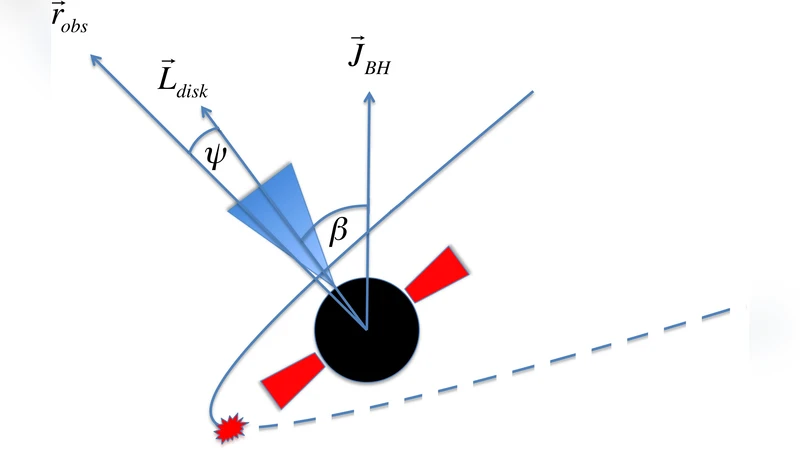
When a star is tidally disrupted by a supermassive black hole (SMBH), the streams of liberated gas form an accretion disk after their return to pericenter. We demonstrate that Lense-Thirring precession in the spacetime around a rotating SMBH can produce significant time evolution of the disk angular momentum vector, due to both the periodic precession of the disk and the nonperiodic, differential precession of the bound debris streams. Jet precession and periodic modulation of disk luminosity are possible consequences. The persistence of the jetted X-ray emission in the Swift J164449.3+573451 flare suggests that the jet axis was aligned with the spin axis of the SMBH during this event.
💡 Research Summary
The paper investigates how the relativistic frame‑dragging (Lense‑Thirring) effect of a rotating super‑massive black hole (SMBH) influences the evolution of a tidal‑disruption event (TDE) accretion disk and any associated relativistic jet. When a star passes within the tidal radius Rₜ of an SMBH, it is torn apart; roughly half of the stellar debris remains bound and returns to pericenter after a fallback time t_fall. The returning streams collide, circularize, and form a thick (H/R ≈ 1) accretion disk whose angular momentum vector L_disk is initially tilted by an angle β relative to the black‑hole spin vector J_BH.
Two distinct precession mechanisms are identified. First, the thick disk behaves as a solid body: the Lense‑Thirring torque integrated over the disk yields a precession period T_prec = 2π sin β (J/τ). Assuming a power‑law surface density Σ ∝ R^{−ζ}, the authors derive an analytic expression (Eq. 3) showing that T_prec depends mainly on the spin parameter a, the density index ζ, and the inner/outer radii of the disk. For plausible ζ values (−3/2, 0, 1) the period varies by a factor of ≈ 7.
Second, each returning debris stream experiences differential Lense‑Thirring precession (DSP). The authors first present a post‑Newtonian estimate (Eqs. 7‑8) and then solve the full Kerr geodesic equations numerically, confirming that the angular shift Δφ_orb grows with black‑hole spin a, with decreasing pericenter radius r_p, and with larger inclination β. DSP supplies a time‑dependent angular momentum flux to the disk, causing non‑periodic evolution of L_disk in addition to the solid‑body precession.
Observational consequences follow. Disk precession modulates the observed luminosity by a factor cos ψ, where ψ is the angle between the disk normal and the line of sight; when the disk becomes edge‑on, the flux can drop by two orders of magnitude and the spectrum reddens, producing a “blinking” TDE. If a relativistic jet aligns with the disk angular momentum, the jet will precess out of the observer’s line of sight on the same timescale, limiting the observable jet duration t_obs ≈ T_prec · θ_jet/(2π sin β), where θ_jet is the jet opening angle.
The authors apply this framework to the well‑studied Swift J1644+57 event, which displayed a bright X‑ray jet for > 14 days. Using inferred parameters (M_BH ≈ 10⁵–10⁶ M_⊙, a ≈ 0.8, r_p ≈ 13 R_S, θ_jet ≈ 10^{−1.5} rad), they find that a solid‑body precession would have moved the jet out of view in a few days unless either (i) the spin is extremely low (a ≲ 10⁻²), (ii) the initial stellar orbit was almost coplanar with the black‑hole equator (β ≈ θ_jet), or (iii) the jet is anchored to the black‑hole spin axis rather than the disk. The persistence of the jet favors scenario (iii), implying that in this case the jet direction remained fixed to J_BH despite the disk’s precession.
Finally, the paper outlines future directions: high‑resolution GRMHD simulations to test the solid‑body versus Bardeen‑Petterson warping regimes, and large‑scale TDE surveys (e.g., LSST, eROSITA) to collect statistics on jet longevity and precession signatures. Such data will enable constraints on SMBH spin distributions and on whether jets preferentially align with the spin axis, the disk angular momentum, or magnetic field geometry. In summary, Lense‑Thirring precession is a key dynamical ingredient in TDEs, producing observable modulations in both disk emission and jet orientation, and Swift J1644+57 provides a compelling test case for these theoretical predictions.
Comments & Academic Discussion
Loading comments...
Leave a Comment