Local properties on the remainders of the topological groups
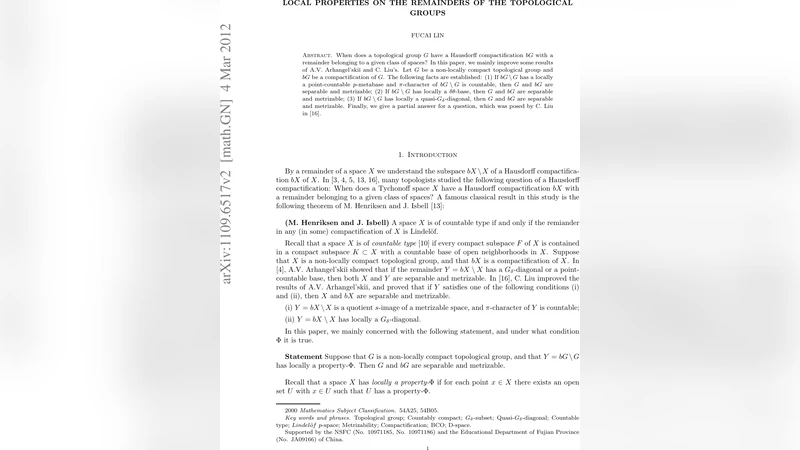
When does a topological group $G$ have a Hausdorff compactification $bG$ with a remainder belonging to a given class of spaces? In this paper, we mainly improve some results of A.V. Arhangel’ski\v{\i} and C. Liu’s. Let $G$ be a non-locally compact topological group and $bG$ be a compactification of $G$. The following facts are established: (1) If $bG\setminus G$ has a locally a point-countable $p$-metabase and $\pi$-character of $bG\setminus G$ is countable, then $G$ and $bG$ are separable and metrizable; (2) If $bG\setminus G$ has locally a $\delta\theta$-base, then $G$ and $bG$ are separable and metrizable; (3) If $bG\setminus G$ has locally a quasi-$G_{\delta}$-diagonal, then $G$ and $bG$ are separable and metrizable. Finally, we give a partial answer for a question, which was posed by C. Liu in \cite{LC}.
💡 Research Summary
The paper investigates when a non‑locally compact topological group (G) admits a Hausdorff compactification (bG) such that the remainder (Y=bG\setminus G) belongs to a prescribed class of spaces. Building on earlier work of Arhangel’skiĭ and Liu, the author replaces global hypotheses on the remainder by “local” ones: for each point of (Y) there is a neighbourhood possessing the required property. The main results can be summarised as follows.
-
Local point‑countable (p)-metabase with countable (\pi)-character.
If every point of (Y) has an open neighbourhood that carries a point‑countable (p)-metabase and the overall (\pi)-character of (Y) is countable, then (G) and its compactification (bG) are both separable and metrizable. The proof proceeds by first showing that under the countable (\pi)-character hypothesis (Y) is a Lindelöf (p)-space (Henriksen–Isbell theorem). Lemma 2.3 guarantees that each countably compact subset of (Y) becomes a compact (G_{\delta})-set, and Lemma 2.4 upgrades the local point‑countable (p)-metabase to a global one. Consequently (Y) acquires a (G_{\delta})-diagonal, and the classical Arhangel’skiĭ–Liu metrizability theorem applies. -
Local (\delta\theta)-base.
Replacing the (p)-metabase by a (\delta\theta)-base (a family of open sets with finite order at each point) yields the same conclusion. Lemma 2.8 shows that a locally (\delta\theta)-base can be refined to a global (\delta\theta)-base, after which the same chain of arguments as in (1) leads to separability and metrizability of (G) and (bG). -
Local (c)-semistratifiable (CSS) and (\sigma\sharp)-spaces.
The author further extends the method to remainders that are locally CSS or locally (\sigma\sharp). Both classes are known to be generalisations of developable spaces. Under the same countable (\pi)-character assumption, the same reasoning shows that (G) and (bG) are separable metrizable. -
Local quasi‑(G_{\delta})-diagonal.
Section 3 treats the case where (Y) possesses a quasi‑(G_{\delta})-diagonal. Lemma 3.1 proves that a (p)-space whose compact subsets are metrizable is “Ohio‑complete”, i.e., there exists a (G_{\delta})-subset of the compactification containing (G) and separating each new point by a (G_{\delta})-set. Theorem 3.2 splits into two sub‑cases: (i) (Y) is first countable, in which case known results guarantee that every countably compact subset of (Y) is compact metrizable and a Lindelöf (p)-space with a quasi‑(G_{\delta})-diagonal is metrizable; (ii) (G) itself is a paracompact (p)-space, which again yields Ohio‑completeness and allows the construction of a global (G_{\delta})-subset. In both sub‑cases, the remainder becomes separable and metrizable, and consequently so do (G) and (bG). Lemma 3.3 shows that a locally quasi‑(G_{\delta})-diagonal Lindelöf space actually has a global quasi‑(G_{\delta})-diagonal, simplifying the argument. -
Partial answer to Liu’s question.
Liu asked whether the following two conditions are sufficient for metrizability: (1) each point of (Y) has an open neighbourhood in which every countable compact subset is metrizable and a (G_{\delta})-set; (2) (\pi\chi(Y)\le\omega). The paper provides a partial affirmative answer: under the additional hypotheses explored in the previous sections (e.g., existence of a local point‑countable (p)-metabase or a local (\delta\theta)-base), the answer is yes. However, the general question remains open, and the author outlines possible directions for future work.
Methodological highlights.
The central technique is to combine the countable (\pi)-character condition with local base‑type properties to obtain global base‑type structures (point‑countable (p)-metabase, (\delta\theta)-base, quasi‑(G_{\delta})-diagonal). Once a global structure is in place, classical metrizability theorems for topological groups (Arhangel’skiĭ’s theorem on groups with a (G_{\delta})-diagonal, Liu’s refinements) can be invoked. The paper also leverages the Henriksen–Isbell theorem that a space of countable type has Lindelöf remainders, and the notion of Ohio‑completeness to handle the quasi‑(G_{\delta}) case.
Significance.
By shifting from global to local hypotheses, the author substantially widens the class of remainders for which metrizability of the underlying group and its compactification can be guaranteed. This contributes to a deeper understanding of how the fine structure of the remainder influences the global topology of the group, and opens new avenues for studying compactifications of non‑locally compact groups under weaker assumptions.
Comments & Academic Discussion
Loading comments...
Leave a Comment