Floating and sinking: the imprint of massive scalars around rotating black holes
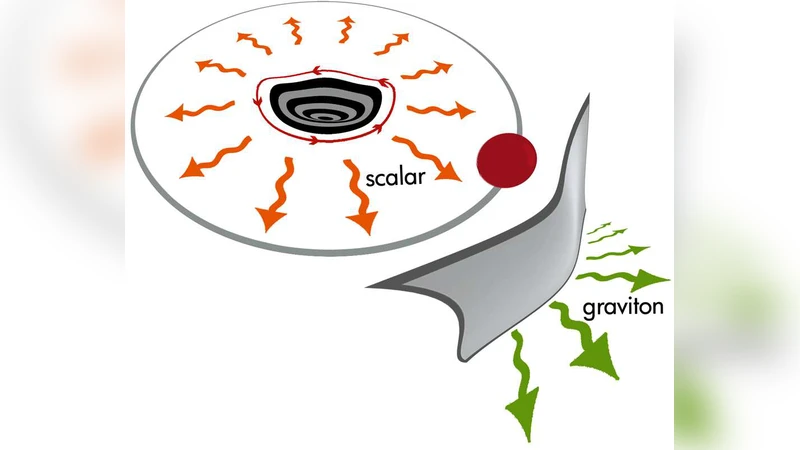
We study the coupling of massive scalar fields to matter in orbit around rotating black holes. It is generally expected that orbiting bodies will lose energy in gravitational waves, slowly inspiralling into the black hole. Instead, we show that the coupling of the field to matter leads to a surprising effect: because of superradiance, matter can hover into “floating orbits” for which the net gravitational energy loss at infinity is entirely provided by the black hole’s rotational energy. Orbiting bodies remain floating until they extract sufficient angular momentum from the black hole, or until perturbations or nonlinear effects disrupt the orbit. For slowly rotating and nonrotating black holes floating orbits are unlikely to exist, but resonances at orbital frequencies corresponding to quasibound states of the scalar field can speed up the inspiral, so that the orbiting body “sinks”. These effects could be a smoking gun of deviations from general relativity.
💡 Research Summary
The paper investigates how a massive scalar field, when coupled to a small orbiting body around a rotating (Kerr) black hole, can dramatically alter the usual inspiral driven by gravitational‑wave emission. The scalar obeys the Klein‑Gordon equation with a source term proportional to the trace of the particle’s stress‑energy, (∇²‑μₛ²)ϕ = α T, where α encodes the strength of the coupling (e.g., Brans‑Dicke parameter). The authors consider circular equatorial orbits and work in the adiabatic regime, assuming the radiation‑reaction timescale is much longer than the orbital period.
Using Teukolsky’s formalism for gravitational waves and a separated radial‑angular decomposition for the scalar, they compute the energy fluxes at infinity (gravitational and scalar) and at the horizon (scalar only). Superradiance occurs when the wave frequency satisfies ω < m Ω_H (Ω_H is the black hole’s horizon angular velocity). In that regime the scalar horizon flux ˙E_{s,r+} becomes negative, meaning the black hole supplies energy to the field.
If the negative scalar horizon flux exactly cancels the positive fluxes (gravitational radiation to infinity plus scalar radiation to infinity), the total energy loss ˙E_T = ˙E_g + ˙E_s vanishes. The particle’s orbital energy then remains constant, producing a “floating orbit”. This condition is met when the orbital frequency matches a quasi‑bound state of the massive scalar, i.e. a resonance with frequency
ω_res ≃ μₛ
Comments & Academic Discussion
Loading comments...
Leave a Comment