The Emission from Inner Disk and Corona in the Low and Intermediate Spectral States of Black Hole X-ray Binaries
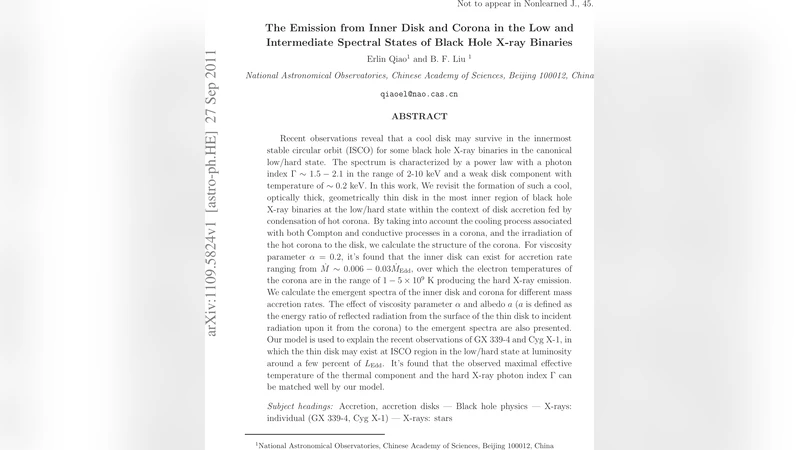
Recent observations reveal that a cool disk may survive in the innermost stable circular orbit (ISCO) for some black hole X-ray binaries in the canonical low/hard state. The spectrum is characterized by a power law with a photon index $\Gamma \sim 1.5-2.1$ in the range of 2-10 keV and a weak disk component with temperature of $\sim 0.2$ keV. In this work, We revisit the formation of such a cool, optically thick, geometrically thin disk in the most inner region of black hole X-ray binaries at the low/hard state within the context of disk accretion fed by condensation of hot corona. By taking into account the cooling process associated with both Compton and conductive processes in a corona, and the irradiation of the hot corona to the disk, we calculate the structure of the corona. For viscosity parameter $\alpha=0.2$, it’s found that the inner disk can exist for accretion rate ranging from $\dot M \sim 0.006-0.03 \dot M_{\rm Edd}$, over which the electron temperatures of the corona are in the range of $1-5\times 10^9\ \rm K$ producing the hard X-ray emission. We calculate the emergent spectra of the inner disk and corona for different mass accretion rates. The effect of viscosity parameter $\alpha$ and albedo $a$ ($a$ is defined as the energy ratio of reflected radiation from the surface of the thin disk to incident radiation upon it from the corona) to the emergent spectra are also presented. Our model is used to explain the recent observations of GX 339-4 and Cyg X-1, in which the thin disk may exist at ISCO region in the low/hard state at luminosity around a few percent of $L_{\rm Edd}$. It’s found that the observed maximal effective temperature of the thermal component and the hard X-ray photon index $\Gamma$ can be matched well by our model.
💡 Research Summary
This paper addresses a long‑standing puzzle in the low/hard state (LHS) of black hole X‑ray binaries (BHXRBs): recent high‑quality observations have revealed a weak, cool thermal component (kT≈0.2 keV) and a relativistically broadened Fe Kα line even when the source is in the canonical hard state. Such features imply that a geometrically thin, optically thick accretion disc may extend down to the innermost stable circular orbit (ISCO), contrary to the traditional picture in which the inner disc is truncated and replaced by a hot, optically thin, advection‑dominated accretion flow (ADAF).
The authors revisit the “disk‑corona condensation” scenario, in which a hot corona (modeled as an ADAF‑like flow) overlies a thin disc and exchanges mass and energy with it. Two cooling mechanisms are treated simultaneously: vertical thermal conduction from the corona to the disc, and inverse Compton scattering of soft photons emitted by the disc. The ratio λ of Compton to conductive cooling is introduced, allowing a smooth transition between conduction‑dominated and Compton‑dominated regimes at each radius. Analytic expressions for the condensation rate, electron temperature profile, bremsstrahlung luminosity, and Compton luminosity are derived (Eqs. 1‑11).
A crucial addition to earlier work is the inclusion of coronal irradiation of the disc. The intrinsic coronal luminosity (sum of bremsstrahlung and Compton components) is treated as a point source at height H_s above the disc. The incident flux, modulated by the disc albedo a, contributes to the disc’s effective temperature via σT_eff⁴ = F_cnd + F_irr (Eqs. 12‑16). An iterative scheme is employed: a trial T_eff,max is used to compute the condensation rate, which in turn yields a new T_eff,max; the process repeats until convergence.
Numerical calculations are performed for a black‑hole mass of 10 M_⊙, viscosity parameter α=0.2, and various albedos. The key results are:
- For accretion rates ṁ ≡ Ṁ/Ṁ_Edd between 0.006 and 0.03, a residual inner disc can survive down to the ISCO.
- In this regime the coronal electron temperature lies in the range 1–5 × 10⁹ K, producing a hard X‑ray power‑law with photon index Γ≈1.5–2.1 in the 2–10 keV band.
- As ṁ increases, the Compton‑dominated region expands outward, the inner disc grows radially, and the spectrum softens; as ṁ decreases, conduction dominates, the inner disc shrinks, and the hard component strengthens.
- The model predicts a maximum effective disc temperature of ≈0.2 keV, consistent with observations.
To generate spectra, the authors use a Monte‑Carlo code (based on Pozdniakov et al. 1977) to simulate multiple Compton scatterings in the corona, assuming a Maxwellian electron distribution and optical depth τ<1. The total emergent spectrum consists of (1) multi‑temperature blackbody emission from the thin disc, partially Compton‑upscattered by the corona, and (2) bremsstrahlung emission from the transition layer between disc and corona.
The model is applied to two well‑studied sources: GX 339‑4 and Cyg X‑1. For GX 339‑4, observations during a low/hard state at L≈0.8 % L_Edd show a thermal component with kT≈0.165 keV and a hard photon index Γ≈1.63. The condensation model reproduces both the temperature and the photon index for ṁ≈0.01–0.02, α≈0.2, and a≈0.15. Similar agreement is found for Cyg X‑1, where the inferred disc temperature and hard slope are matched by the same parameter set.
The paper’s contributions are threefold:
- It presents a self‑consistent, radially continuous disk‑corona model that simultaneously incorporates conductive and Compton cooling.
- It adds the effect of coronal irradiation, allowing a realistic calculation of the disc’s effective temperature and thus the soft photon supply for Comptonisation.
- It demonstrates quantitative agreement with observed spectral properties of GX 339‑4 and Cyg X‑1, supporting the existence of a cool inner disc in the low/hard state.
The authors acknowledge limitations: the emission from the outer ADAF and the outer thin disc are omitted, which could affect the total luminosity at very low ṁ (<0.01). They also note that the model assumes a non‑rotating black hole (ISCO at 3 R_S) and a fixed coronal geometry. Future work should explore the impact of black‑hole spin, a broader range of α and a, and time‑dependent state transitions, as well as incorporate the full outer flow to produce a complete broadband spectrum.
In summary, by treating both conductive and Compton cooling on equal footing and including coronal irradiation, the authors provide a robust physical framework that explains how a thin disc can persist down to the ISCO even in the low/hard state, reconciling theoretical models with the latest X‑ray observations of BHXRBs.
Comments & Academic Discussion
Loading comments...
Leave a Comment